SAP Business Data Cloud and Snowflake: Reimagining the Intelligent Enterprise
By Douglas Day Co-Founder, Datalab.
SAP Business Data Cloud and Snowflake: Reimagining the Intelligent Enterprise
By Douglas Day Co-Founder, Datalab.
Connect on Email | LinkedIn | Medium | datalabsolutions.ai
How SAP Business Data Cloud and Snowflake are changing enterprise architecture by replacing complex integration with real-time intelligence.
The End of the ETL EraFor years, enterprise data strategies have centred on one fundamental challenge: how do you unlock the value of operational data without creating an increasingly complex web of integrations, data warehouses and reporting platforms?
For organisations running SAP, this challenge is particularly familiar. SAP systems are exceptionally good at running the business — processing orders, managing finance, controlling manufacturing and orchestrating supply chains — but turning that operational data into timely business insight has traditionally required significant engineering effort. Data needed to be extracted, transformed, replicated and loaded into separate analytical platforms before the business could begin asking meaningful questions.
This approach worked, but it came at a cost. Every new integration introduced another pipeline to maintain, another copy of the data to govern, and another point of failure to monitor. Over time, many organisations found themselves investing more effort in moving data than in using it.
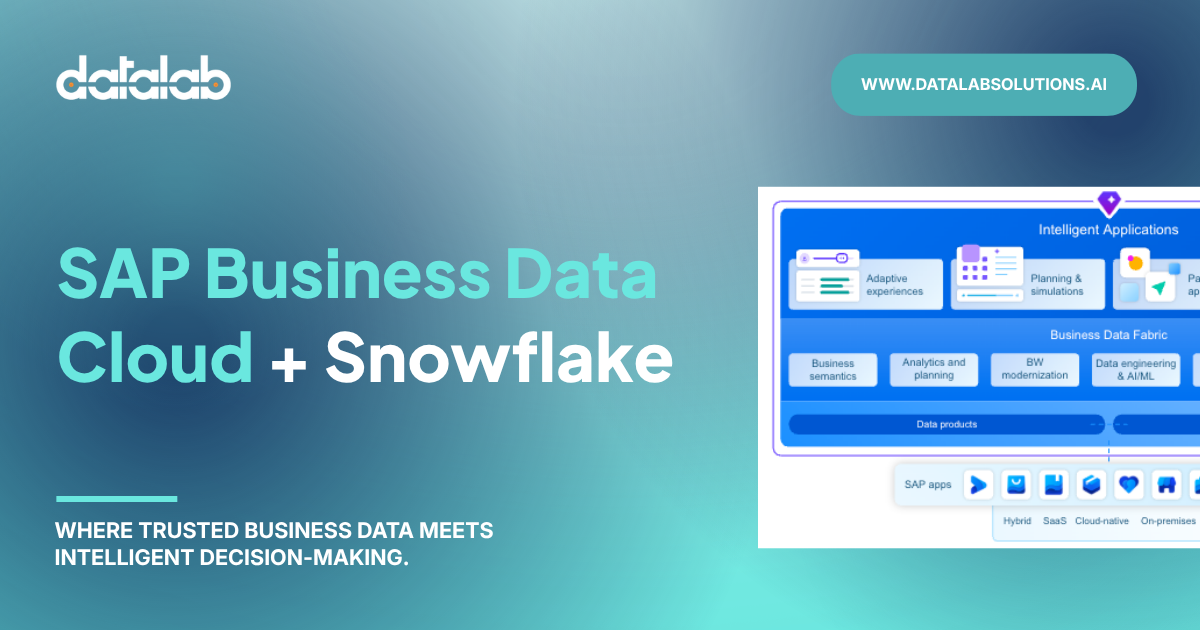
The emergence of SAP Business Data Cloud (BDC) represents a significant shift in thinking. Rather than viewing SAP simply as an ERP system, Business Data Cloud positions SAP as a trusted provider of governed business data that can be securely consumed across the wider enterprise. Instead of continually replicating information into multiple downstream systems, organisations can expose trusted business data products that retain the context and business semantics already defined within SAP.
This seemingly simple change has profound implications.
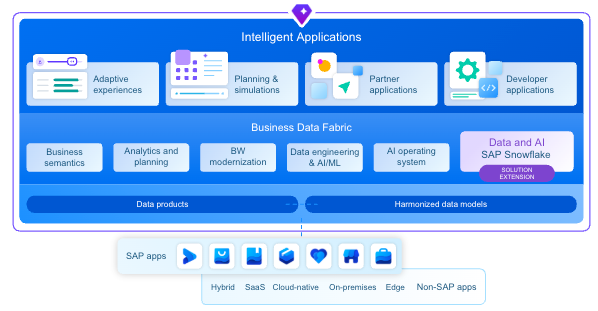
SAP Business Data Cloud (BDC)
Rather than building yet another warehouse containing copies of SAP data, organisations can begin treating data as a shared enterprise asset. Finance, procurement, manufacturing, sales and supply chain data become immediately more accessible while remaining governed by the business rules that already exist inside SAP. The result is less duplication, stronger governance and a significant reduction in the engineering effort traditionally associated with enterprise reporting.
Where the opportunity becomes truly compelling is when Business Data Cloud is combined with Snowflake.
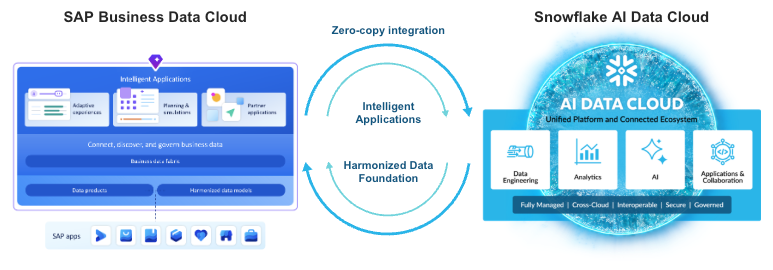
SAP Business Data Cloud and Snowflake Zero-copy Integration
Few organisations operate exclusively within SAP. Customer data may reside in Salesforce, workforce information in Workday, service operations in ServiceNow, manufacturing telemetry in IoT platforms, and customer behaviour across digital applications. The real business questions almost always span multiple systems.
How profitable are customers once warranty claims are considered? Which supply chain disruptions are beginning to impact customer service? How does workforce availability influence manufacturing throughput? Which marketing campaigns are driving profitable sales rather than simply increasing revenue?
These questions cannot be answered by SAP alone.
Snowflake provides the connective tissue that brings these disparate data sources together. Through open data sharing, support for Apache Iceberg, native connectors and an AI-native architecture, Snowflake allows organisations to combine SAP business data with virtually any other enterprise dataset without creating the traditional maze of point-to-point integrations.
This is where the conversation moves beyond cloud migration and towards business transformation.
One of the most significant trends shaping modern data platforms is the move towards zero data movement architectures. Historically, organisations copied data repeatedly as it travelled from operational systems into staging areas, enterprise data warehouses, reporting databases and finally business intelligence tools. Every copy increased storage costs, introduced latency and created another version of the truth that required governance.
Today’s architecture looks fundamentally different. Secure sharing technologies and open data ecosystems allow analytics to happen much closer to where the data already resides. Rather than building elaborate plumbing to transport information around the organisation, businesses can focus on extracting value from it. Engineering teams spend less time maintaining pipelines and more time delivering insights that improve business performance.
For executives, this translates directly into faster decision-making. Instead of waiting for overnight batch processes or weekly reporting cycles, finance teams can monitor operational performance as transactions occur. Supply chain managers gain immediate visibility into disruptions before they impact customers. Manufacturing teams can detect quality issues earlier, while sales leaders can understand changing customer behaviour as it unfolds rather than after the opportunity has passed.
The benefits extend well beyond reporting. Artificial intelligence becomes substantially more valuable when it can access trusted, governed business data in real time. Large language models, intelligent agents and predictive analytics all depend on accurate context. Combining SAP Business Data Cloud with Snowflake provides precisely that foundation, enabling organisations to build AI applications that understand not only raw data but also the business meaning behind it.
This dramatically shortens both time to value and time to insight.
Historically, major analytics initiatives often required months of integration work before the first dashboard could be delivered. Modern cloud architectures reduce that effort considerably. With less time spent building infrastructure and maintaining integrations, organisations can focus their investment on solving business problems. New use cases can be delivered in weeks rather than months, allowing the business to realise value much earlier in its transformation journey.
Equally important is the reduction in operational complexity. Every integration that is eliminated is one less process to monitor, one less reconciliation exercise to perform and one less security boundary to manage. As enterprise architectures become simpler, they also become more resilient, easier to govern and less expensive to operate.
Ultimately, the migration to SAP Business Data Cloud should not be viewed as another infrastructure upgrade. It represents an opportunity to rethink how enterprise data is managed, shared and consumed. When paired with Snowflake, organisations move beyond traditional data warehousing towards a modern, intelligent data ecosystem where operational systems, analytics and AI work together seamlessly.
The organisations that succeed over the next decade will not necessarily be those with the most data. They will be those that can transform operational events into business decisions faster than their competitors. By reducing unnecessary data movement, simplifying architecture and enabling real-time access to trusted enterprise information, SAP Business Data Cloud and Snowflake provide a compelling foundation for exactly that future.
Ready to Reimagine Your Enterprise Data Strategy?
Whether you’re planning your SAP Business Data Cloud journey, modernising your analytics platform, or exploring how AI can unlock greater value from your enterprise data, the architecture decisions you make today will shape your business for years to come.
At **Datalab, we help organisations bridge the gap between strategy and execution. From SAP and Snowflake architecture to modern data platforms, AI, real-time analytics, and governed data sharing, we partner with businesses to deliver practical solutions that accelerate time to value**, reduce complexity, and enable better decision-making.
If you’re ready to move beyond traditional data integration and build a truly intelligent enterprise, we’d love to start the conversation.
Let’s explore what’s possible.
Email: contact@datalabsolutions.ai Website: https://www.datalabsolutions.ai LinkedIn: https://www.linkedin.com/company/datalab-solutions
Because the future isn’t about moving more data — it’s about creating more value from it.
Douglas Day is the co-founder of Datalab, a South African data and AI consultancy and Snowflake Elite Partner, the first specialist firm in the country to achieve that status. Datalab founded the Snowflake South Africa User Group, now a community of 750+ members. Douglas’s co-founder holds the distinction of being the first Snowflake Data Superhero in Africa.
메타데이터
- post_id
- 9aff1f7aaf7d
- slug
- sap-business-data-cloud-and-snowflake-reimagining-the-intelligent-enterprise-9aff1f7aaf7d
- url
- https://medium.com/datalabsolutions/sap-business-data-cloud-and-snowflake-reimagining-the-intelligent-enterprise-9aff1f7aaf7d
- canonical_url
- https://medium.com/datalabsolutions/sap-business-data-cloud-and-snowflake-reimagining-the-intelligent-enterprise-9aff1f7aaf7d
- author_url
- https://medium.com/@douglas_day
- status
- ok
- fetched_at
- 2026-07-26 02:20:04