Micro-Niche Strategy: Why Going Smaller on KDP Is the Fastest Path to Actually Winning
The instinct to go broad on KDP — to publish in the biggest possible category and reach the most buyers — is exactly backwards. The…
Micro-Niche Strategy: Why Going Smaller on KDP Is the Fastest Path to Actually Winning
Amazon kindle
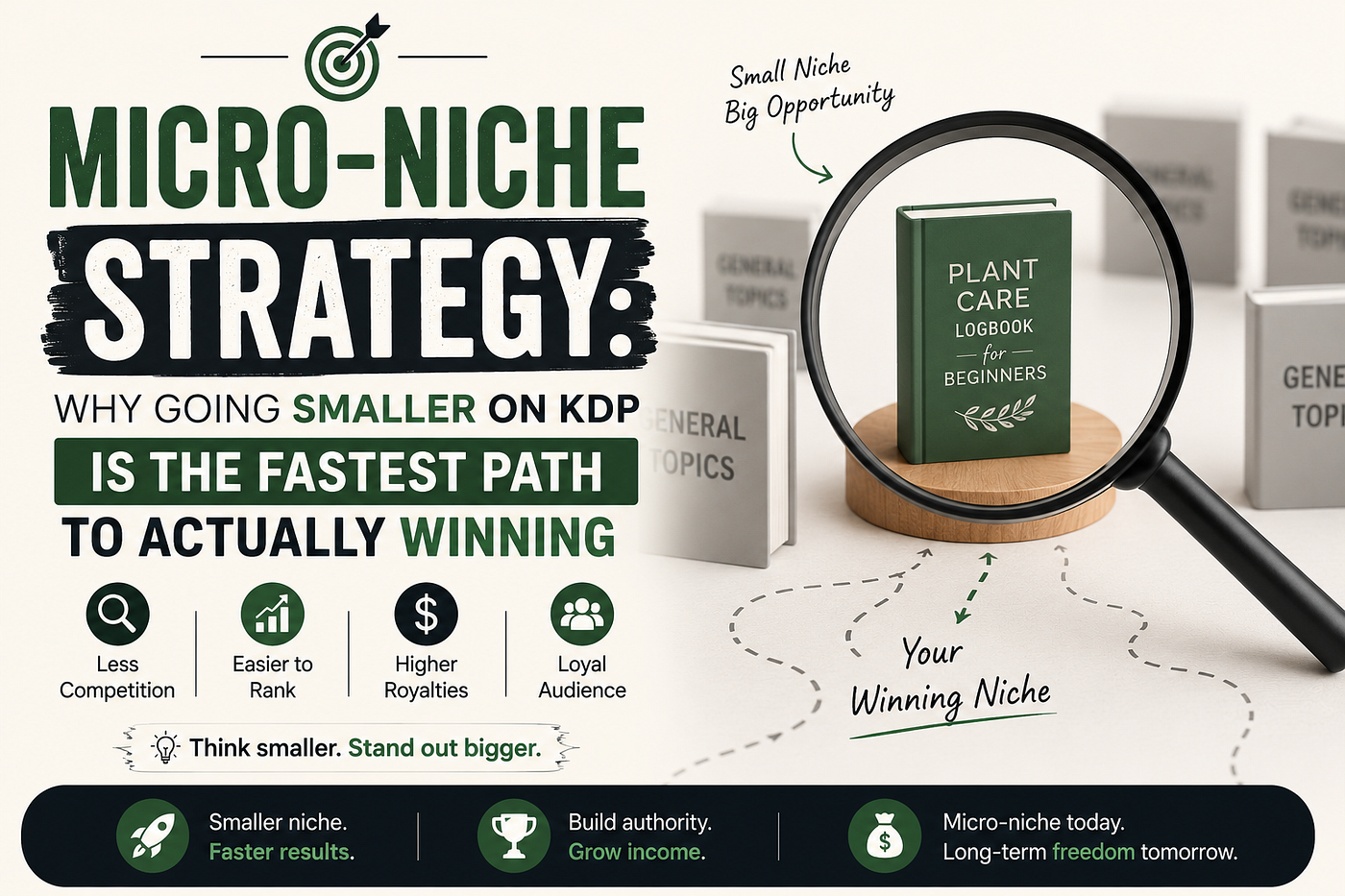
The instinct to go broad on KDP — to publish in the biggest possible category and reach the most buyers — is exactly backwards. The publishers quietly building consistent, growing income aren’t competing in “coloring books.” They’re dominating “cozy forest mushroom coloring books for adults who love autumn.” Smaller audience. Less competition. Higher conversion. More sales per title than a broad book ever generates.
The micro-niche strategy isn’t a consolation prize for people who can’t compete with the big players. It’s the smarter play — and once you see the math, you’ll never approach a new KDP book the same way again.
I learned this the hard way through a book I published in my second month — a general “nature coloring book for adults” that I was convinced would sell broadly because the audience was large. It didn’t. It sank. The search result page for “nature coloring book” had thousands of competitors, established titles with hundreds of reviews, and no obvious reason for a buyer to choose my new, zero-review listing over anything else on the page.
Two months later, I published a “cozy cottagecore wildflower coloring book for women who love slow living.” Forty-three results for that search term on Amazon. My book ranked in the top five within three weeks. Same production quality. Same category. Completely different outcome — because one book tried to speak to everyone and the other spoke directly to someone specific who was already looking for exactly that thing.
Why Broad Niches Are a Trap for New KDP Publishers
When new publishers think about niche selection, they often confuse large audience with high opportunity. The logic seems sound: more potential buyers means more potential sales. But on Amazon, a large audience means large competition — thousands of titles already indexed, reviewed, and ranked for every major keyword in that space. Your brand-new listing enters that race with no review history, no sales velocity, and no algorithm favorability. You’re sprinting against people who’ve been running the course for years.
Broad categories also produce weak buyer intent matching. A buyer searching “journal” could want a blank notebook, a gratitude journal, a bullet journal, a daily planner, a prayer journal, or a hundred other things. Your book can’t satisfy all of those intents simultaneously. A buyer searching “wildflower gratitude journal for women with prompts” knows exactly what they want and is primed to purchase the moment they find it. Specificity converts. Generality confuses.
There’s also a cover design problem baked into broad niches. When your category contains thousands of competitors, your cover has to speak to an enormous, undefined audience — which often results in safe, generic design that stands out to nobody. Micro-niche covers can lean fully into a specific aesthetic, color palette, and visual identity that resonates deeply with a narrow audience. That depth of resonance is what drives the click-through rate that feeds Amazon’s algorithm the signals it needs to rank your book higher.
The most discouraging outcome of broad niche publishing is the invisibility loop: you publish, see no meaningful sales in the first 30 days, assume the niche is saturated or your book isn’t good enough, and either give up or publish something else broad with the same result. The book wasn’t the problem. The targeting was. A well-made book in a micro-niche almost always outperforms a well-made book in a broad niche when both are published at the same time, by the same author, with the same resources.
The Shift: What Micro-Niche Thinking Actually Looks Like
A micro-niche isn’t just a narrower category. It’s the intersection of a topic, an aesthetic, a buyer identity, and a use case — all expressed in a single, specific product. “Coloring book” is a category. “Mushroom forest coloring book for adults who love fantasy and folklore” is a micro-niche. The difference isn’t just specificity — it’s the clarity of the buyer picture. You know who you’re making this for, what they value, and what language they use to search for it. That clarity flows through every decision you make about the book.
The size of a micro-niche audience is almost never the limiting factor on earnings. What matters is the ratio of demand to supply. A micro-niche with 500 monthly buyers and 40 competing titles is a better opportunity than a broad niche with 50,000 monthly buyers and 8,000 competing titles. Your share of a small, underserved market consistently beats a tiny share of an enormous, saturated one.
Micro-niches also stack. You don’t publish one micro-niche book and stop. You publish five to ten books within a tightly defined micro-niche cluster — different themes, same buyer identity and aesthetic — which builds author page authority, creates a cross-purchase ecosystem, and compounds your visibility within that specific corner of Amazon’s algorithm. A reader who finds your “cozy autumn mushroom coloring book” and loves it will immediately look for more from the same author. If your catalog has nine more books in the same aesthetic universe, that one buyer can become ten sales.
The sweet spot for micro-niche validation is a search result count between 50 and 300 on Amazon, with the top 20 titles showing bestseller ranks above 30,000. That combination tells you buyers exist (the existing titles are making sales) but competition is thin enough that a well-positioned new entry can reach the top 10 within its first month. Under 50 results can mean demand doesn’t yet exist at scale. Over 500 results means you’re edging back into broad territory where early-mover advantage is harder to establish.
How to Find and Validate Micro-Niches on KDP
Start with a broad niche you already understand — say, “coloring books for adults” — and use Amazon’s own autocomplete to drill down. Type your broad term into Amazon’s Books search bar and watch what suggestions appear. Those autocomplete suggestions are generated by real search queries from real buyers. “Coloring books for adults mushroom,” “coloring books for adults cottagecore,” “coloring books for adults anxiety relief” — each of these is a micro-niche with documented buyer intent. Write down every suggestion that appears and check each one for result count and bestseller ranks.
Cross-reference your shortlist against Pinterest and Google Trends using the process from the previous article in this series. A micro-niche with rising Pinterest engagement and a clean Google Trends growth curve is more valuable than one with flat or declining interest, even if its current Amazon result count is low. You want a small, growing pond — not a small, shrinking one.
Once you’ve identified two or three candidate micro-niches, evaluate them against these criteria before committing:
- Amazon search results between 50 and 300 for the exact phrase
- Top 20 titles showing bestseller ranks above 30,000 (confirming sales without extreme competition)
- A clearly defined buyer identity you can design a cover and interior for specifically
- Enough thematic variation within the niche to support five to ten distinct books
- At least one adjacent micro-niche you could expand into after establishing your first cluster
That last criterion matters more than it seems. Micro-niche publishing works best as a cluster strategy — three to five related micro-niches that share a broad aesthetic identity but each occupy their own specific corner of the market. “Cozy cottagecore,” “dark academia botanical,” and “whimsical forest folklore” are three distinct micro-niches that share a “nature-meets-aesthetic-identity” buyer overlap. A catalog covering all three feels coherent to buyers while giving you multiple low-competition entry points across a broader aesthetic territory.
For each micro-niche book you publish, your title and subtitle should include the full micro-niche phrase naturally — not keyword-stuffed, but genuinely descriptive. “Cozy Wildflower Cottage: A Botanical Coloring Book for Women Who Love Slow Living” is both a proper title and a search-optimized micro-niche signal. The buyer who searches for any component of that phrase is exactly the person you made the book for. That alignment between search intent and product identity is what drives the conversion rate that makes micro-niche publishing so effective.
How AI Tools Make Micro-Niche Publishing Sustainable at Scale
The beauty of micro-niche publishing is also its operational challenge: to capture the full income potential, you need multiple books per micro-niche, plus coverage across several related micro-niches. That’s a production demand that traditional workflows struggle to meet. The AI-powered publishing app I use daily handles writing, design, and the full publishing workflow in one system — which makes moving from one micro-niche book to the next a structured, repeatable process rather than starting from scratch every time. The same efficiency that lets me publish quickly also lets me maintain the thematic consistency that makes micro-niche clusters work.
For content generation within specific micro-niches, purpose-built prompt libraries are indispensable. My collection of over 500 hidden prompts designed specifically for children’s coloring books covers the full thematic range of micro-niches within that category — scene concepts, character variations, seasonal themes, and educational angles that would take days to brainstorm manually. For the broader catalog covering coloring books, fact books for kids, and books for women, my library of over 1,000 purpose-built prompts gives me a structured creative starting point for every micro-niche I enter — content designed for KDP formats and specific buyer aesthetics from the ground up.
→ Your product link goes hereReplace this block with your Prompt Bolt link. Suggested anchor text: “Explore the 1,200+ Cozy Cottagecore KDP Prompt Collection →” or “Get the full prompt library built for KDP micro-niche publishing”
Having a prompt library that’s already organized around specific aesthetics and buyer identities means I can enter a new micro-niche — “cozy rainy-day reading nook coloring book,” for instance — and have structured content concepts ready to work with the same day I decide to publish there. That speed-to-concept is what makes the cluster strategy viable as a solo publisher with limited hours.
What Micro-Niche Publishing Looks Like When It Works
Amara had tried broad niche publishing for five months before switching strategies. She’d published seven books across three large categories — “adult coloring books,” “women’s journals,” and “kids activity books” — and was earning a combined $190 per month from all seven titles. Reasonable for a beginner, but not growing. Every new book she added performed at roughly the same modest level because she was entering overcrowded spaces and relying on organic discovery in categories where she had no competitive advantage.
After learning about micro-niche strategy, she picked a single starting point: cozy kitchen herb garden coloring books for women who love cottagecore and cooking. Amazon showed 67 results for the phrase. The top 20 titles sat between rank 45,000 and 210,000. She published three books in that specific micro-niche over six weeks — different herb themes, same buyer aesthetic — and a fourth bridging into an adjacent micro-niche (cozy cottage garden coloring books). Month one across those four new titles: $280. Month three: $610. By month five, her four micro-niche books were earning more than her original seven broad-niche books combined, with a fraction of the competition and a clearly defined reader base who followed her from title to title.
The shift wasn’t dramatic — it was structural. She stopped competing for broad attention and started owning specific attention. In a small enough pond, you don’t need to be the best swimmer. You just need to be there.
On KDP, the publisher who owns a micro-niche of 500 buyers will always outperform the one competing for 50,000.
Your Next Step
Open Amazon Books right now and type one of your niche interests into the search bar. Watch the autocomplete suggestions appear and write down every specific phrase that surfaces. Then check the result counts for your top three suggestions — you’re looking for that 50-to-300 range. This ten-minute exercise will likely surface two or three micro-niche candidates you hadn’t considered, in categories you already know something about.
Pick the strongest candidate, validate it with a quick Pinterest and Google Trends check, and plan your first micro-niche cluster of five books. Don’t publish one and evaluate — commit to five from the start. The first book establishes you in the micro-niche. The second earns you an author page with depth. By the fifth, you have a cohesive catalog that search algorithms and repeat buyers both reward. Start small, go deep, and let the compound effects do what they’re designed to do.
Tools & resources
If you want to move through micro-niche clusters faster than a traditional publishing workflow allows, the AI-powered app I use daily handles writing, design, and the full publishing workflow in one place — so you can build a five-book micro-niche cluster in weeks, not months.
For niche-specific content generation aligned to specific buyer aesthetics, I work with two prompt libraries that have reshaped how I produce: a 500+ hidden prompt collection built specifically for children’s coloring books, and a 1,000+ prompt library covering coloring books, fact books for kids, and books for women. Purpose-built for KDP micro-niche publishing from the ground up.
Follow me here on Medium for weekly, practical guidance on KDP publishing, Etsy digital products, and building real income through AI-powered tools. Specific, honest, and new every week.
About the author
Self-publishing educator and digital product creator helping beginners build real, recurring income through Amazon KDP micro-niche strategy, Etsy digital products, and AI-powered tools. I’ve built a multi-cluster KDP catalog by going small and deep rather than broad and scattered — and I share the full system, prompt libraries, and production workflows here every week. Practical publishing guidance, always
메타데이터
- post_id
- 9b1ca24bc3eb
- slug
- micro-niche-strategy-why-going-smaller-on-kdp-is-the-fastest-path-to-actually-winning-9b1ca24bc3eb
- url
- https://medium.com/@LauraAdam1/micro-niche-strategy-why-going-smaller-on-kdp-is-the-fastest-path-to-actually-winning-9b1ca24bc3eb
- canonical_url
- https://medium.com/@LauraAdam1/micro-niche-strategy-why-going-smaller-on-kdp-is-the-fastest-path-to-actually-winning-9b1ca24bc3eb
- author_url
- https://medium.com/@LauraAdam1
- status
- ok
- fetched_at
- 2026-06-09 15:37:30