For the first time, a supersolid was created using laser light
Breakthrough in Quantum Matter: Supersolid Created with Laser Light for the First Time
For the first time, a supersolid was created using laser light
CR. phys.org
Breakthrough in Quantum Matter: Supersolid Created with Laser Light for the First Time
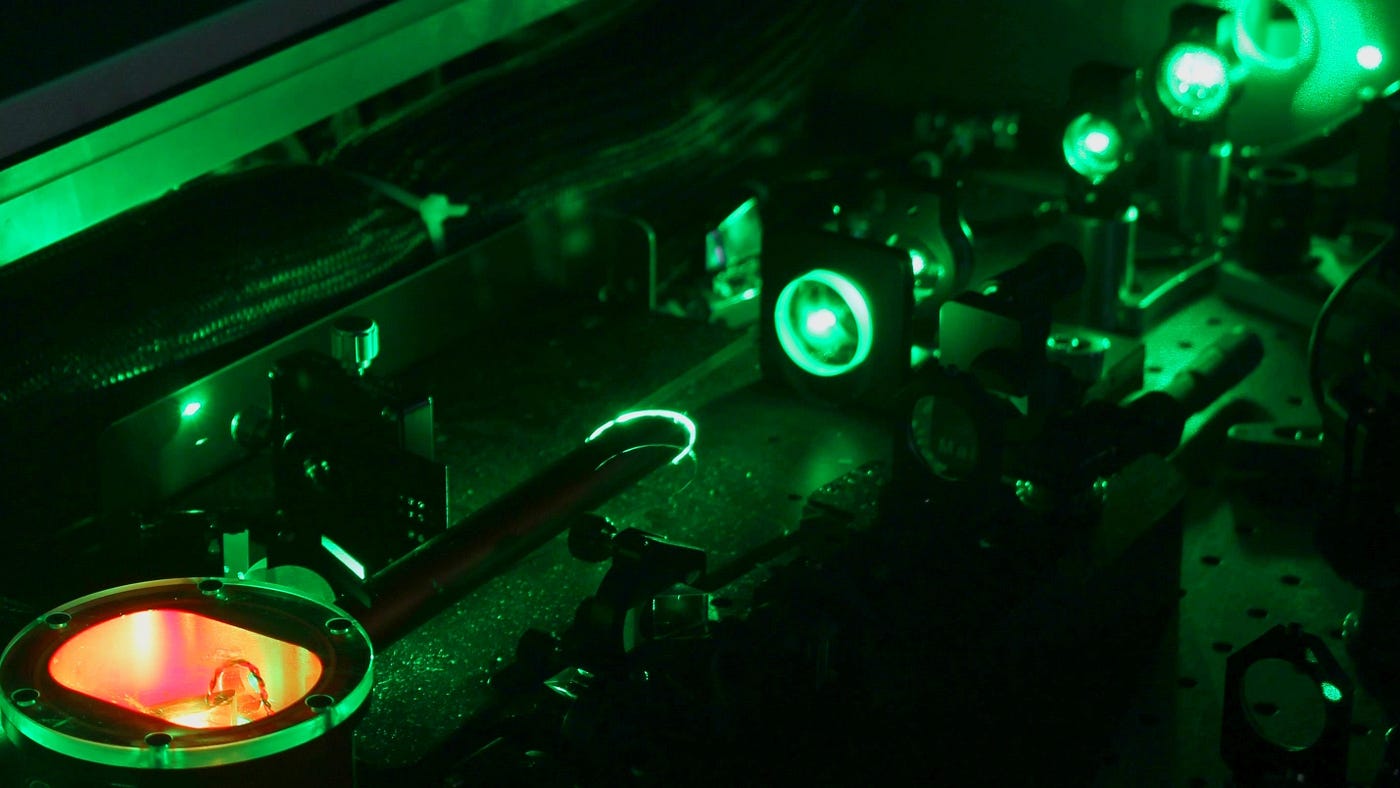
Supersolid was created using laser light to cool and trap ultracold atoms in a precise arrangement, allowing scientists to manipulate quantum states in unprecedented ways. This strange state of matter has the properties of both a solid and a superfluid at the same time. It was created using complex experiments with Bose-Einstein condensates (BECs). By carefully tuning the interactions between atoms using optical lattices and magnetic fields, researchers were able to make a phase transition in which the material had both crystalline order and smooth flow.
The concept of a supersolid had long been a subject of theoretical debate, with initial predictions dating back to the 1960s. Early studies suggested that helium-4, when cooled to extremely low temperatures, could potentially form a supersolid phase. However, experimental efforts to confirm the hypothesis were met with controversy and inconsistent results. Ultracold atomic systems, made possible by advanced laser cooling techniques, were the last piece of evidence scientists needed to prove for sure that supersolidity exists.
Using laser light to arrange the atoms in an optical lattice was the big step forward. Quantum fluctuations were critical in keeping the supersolid phase stable. Unlike conventional solids, where atoms are fixed in place, or superfluids, where particles flow without resistance, a supersolid maintains a rigid spatial structure while allowing elements to move freely through it. This dual nature opens up possibilities for new quantum phenomena and practical applications, ranging from quantum computing to precision measurement technologies.
Supersolids are still being studied to learn more about their complex physics, such as their unique excitation modes, the possibility of quantum vortices, and what their existence means for basic quantum mechanics. The ability to control and manipulate supersolids with laser light enhances our understanding of quantum states and paves the way for new technological advancements in material science and atomic physics.
Understanding Supersolids

CR. sci.news
Supersolids are materials that simultaneously possess the ordered structure of a solid and the frictionless flow characteristic of superfluids. This paradoxical state has intrigued physicists for decades. Traditionally, supersolids have been created using ultracold atomic gases, where atoms form a crystalline arrangement while maintaining superfluidity.
Achieving a Photonic Supersolid
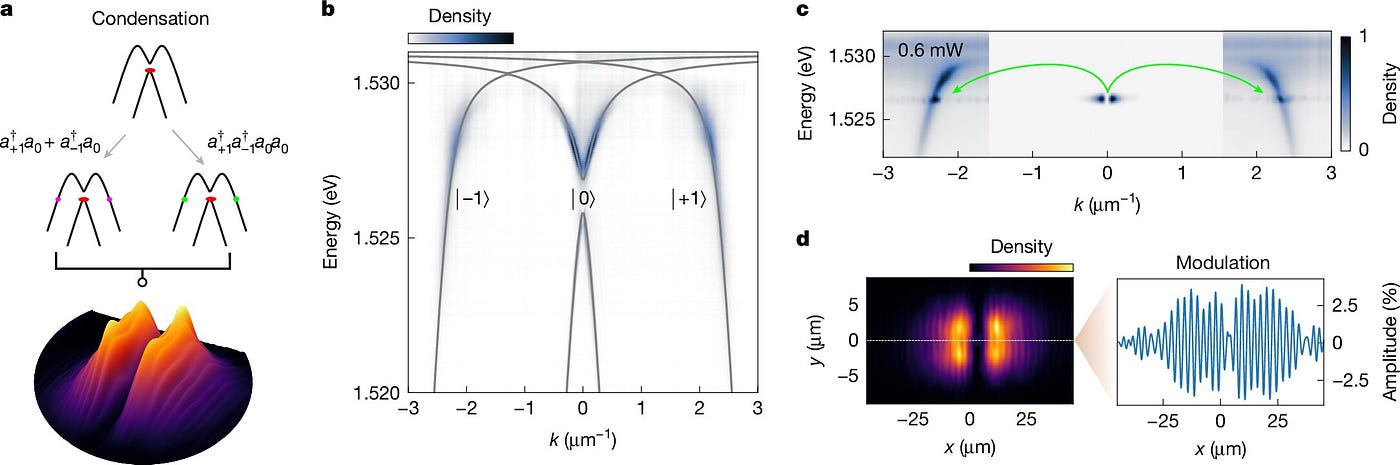
The research team employed a novel approach to induce supersolidity in light. They directed a laser beam at a specially fabricated piece of gallium arsenide, engineered with precise ridges. As the laser light hit the ridged material, polaritons were created. These are hybrid particles that are made when photons interact with excitons, which are pairs of electrons and holes in semiconductors. These polaritons were confined by the engineered structure, compelling them to organize into a supersolid state.
Verifying Supersolid Properties

CR. physicsworld.com
Confirming the supersolid nature of the light-based system presented unique challenges, as the experiment was the first instance of light exhibiting such properties. The scientists carefully designed experiments to show that the system had the structure of a solid and the behavior of a fluid with no viscosity, which are both characteristics of a supersolid.
Implications and Future Directions
This achievement marks a significant milestone in quantum physics and photonics. Supersolids made of light might be easier to study than atomic systems when it comes to quantum behavior, which could lead to new photonic technologies and devices. The research team plans to delve deeper into the structural characteristics of light-based supersolids to uncover further insights and applications.
The transformation of laser light into a supersolid challenges our understanding of light-matter interactions and paves the way for future innovations in controlling and manipulating light at the quantum level.
Historical Context: From Helium to Ultracold Gases
The concept of supersolidity was first proposed in the 1960s, primarily in the context of helium-4. Researchers hypothesized that at extremely low temperatures, helium-4 could enter a supersolid state. However, early experiments yielded inconclusive results, leading to debates and further investigations. It wasn’t until 2017 that definitive evidence emerged when two independent research groups from ETH Zurich and MIT created ultracold quantum gases exhibiting supersolid properties. The Zurich team put a Bose-Einstein condensate between two optical resonators. This caused the condensate to spontaneously crystallize while keeping its superfluidity. Concurrently, the MIT group utilized spin-orbit coupling in a Bose-Einstein condensate to achieve a similar state.
The Breakthrough: Light as a Supersolid
Traditionally, supersolids have been realized using atomic systems. The recent breakthrough deviates from this norm by using light itself to form a supersolid. A team of nanotechnologists, engineers, and physicists collaborated to achieve this feat, marking the first instance where light has been manipulated into a supersolid state.
Experimental Methodology
The researchers began by directing a laser beam at a specially fabricated piece of gallium arsenide (GaAs). This semiconductor material was engineered with precise ridges on its surface. When the laser light hit these ridges, polaritons were created. These are quasi-particles that are a mix of photons and excitons. These polaritons were then confined by the engineered structures, compelling them to organize into a supersolid arrangement.
Verification of Supersolid Properties
Confirming the supersolid nature of the light-based system posed significant challenges, primarily because such a state had never been observed with light before. Several tests were done by the team to make sure that the system had both a solid-like structure and superfluid-like, frictionless flow, which proved that it was supersolid.
Implications and Future Directions
This achievement has profound implications for both fundamental physics and potential applications:
- Quantum Simulations: Light-based supersolids could serve as platforms for simulating complex quantum systems, providing insights into phenomena that are otherwise challenging to study.
- Optoelectronic Devices: The unique properties of light supersolids might lead to the development of novel optoelectronic devices with enhanced functionalities, such as ultra-sensitive sensors or advanced communication systems.
- Fundamental Research: Understanding how light can be coerced into a supersolid state may shed light on unresolved questions in quantum mechanics and condensed matter physics
Conclusion
The successful creation of a light-based supersolid represents a monumental step in quantum physics and material science. By transcending traditional methods and utilizing light, researchers have opened new pathways for exploring the quantum realm and developing next-generation technologies. As investigations continue, we can anticipate a more profound understanding of supersolidity and its potential applications in various scientific and technological domains.
메타데이터
- post_id
- 9b43bf4ada5f
- slug
- for-the-first-time-a-supersolid-was-created-using-laser-light-9b43bf4ada5f
- url
- https://medium.com/@nareshshrestha107/for-the-first-time-a-supersolid-was-created-using-laser-light-9b43bf4ada5f
- canonical_url
- https://medium.com/@nareshshrestha107/for-the-first-time-a-supersolid-was-created-using-laser-light-9b43bf4ada5f
- author_url
- https://medium.com/@nareshshrestha107
- status
- ok
- fetched_at
- 2026-06-21 19:25:17