Devilman Remains The Best Subversion Of Spider Man
Two very different takes on how to write a teenage superhero
Devilman Remains The Best Subversion Of Spider Man
Two very different takes on how to write a teenage superhero

Go Nagai Author of Devilman by Sally Larsen (Creative Commons 3.0 License)
According to Comic Book Resources, the first teenage superhero that wasn’t a sidekick was Marvel Boy, who debuted in 1940. Of course, Marvel Boy didn’t grab the public’s imagination. No, the first hit teenage superhero was Spider-Man. Spider-Man is probably Marvel’s biggest character. He also has been since the 1960s, when he became the template for the teenage hero, replacing Robin.
In the public consciousness, at least, Spider-Man and his many imitators are known for a fairly specific format:
An unpopular teenager who has been bullied by their classmates obtains a superpower that turns them into a super cool hero. However, they must keep their superhero identity secret for some reason and thus remain to their classmates the same unpopular kid whom everyone thinks is a loser. Usually, there is a love interest who they assume they can only get in their cooler hero identity, although some takes like Danny Phantom make the love interest a friend from before they became a superhero.
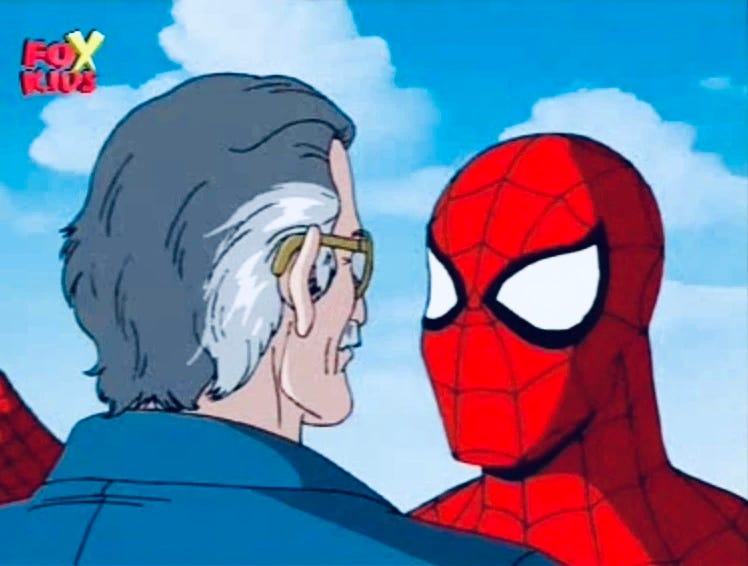
Spider Man and Stan Lee (Copyright Disney used under Fair Use)
This leads to the dual identity of navigating adolescence and fighting crime, which has become so commonplace in superhero stories with younger leads.
Just to be clear, I’m not knocking this premise. It is so prevalent and so popular because it’s both a fantasy for kids and a good way to teach morals and responsibility. Kids want to imagine themselves as secretly being Spider-Man and saving Mary-Jane to escape from the social pressures of adolescence, while adult writers want to teach a lesson in a way that’s applicable to both the fantasy world and reality.
And yet I don’t like it. For the longest time, I thought the very idea of a teenage superhero was lame, but honestly, I just didn’t connect with the Spider-Man format. Then I discovered Devilman.
There are a million different Devilman continuities, and most of them conflict with each other. In the 1973 cartoon, Devilman is a demon possessing a teenage tough who is overcome by the boy’s girlfriend’s goodness and decency, so he decides to fight against evil. A great plot, but not really a teenage superhero.
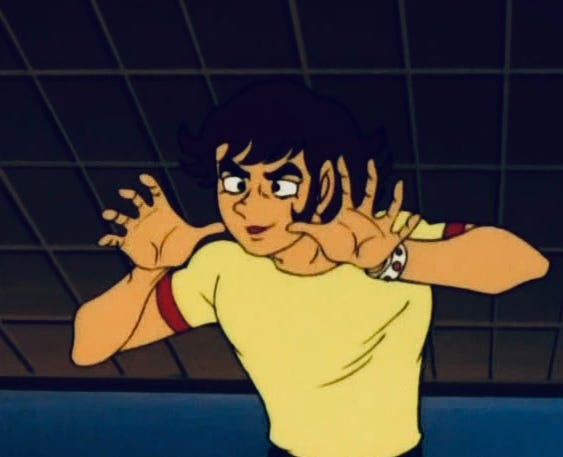
70s Akira was a rough draft abandoned really quickly (Copyright Discotek Media used under Fair Use)
In the comic book adaptation, this gets reversed. Akira Fudo, the host body, is so good and heroic that he fights off demonic possession himself and becomes a superhero to defeat Satan. However, the influence of the demon turns him into a violent thug, even if his motives are pure.
An even better plot, in my opinion, and one that is beginning to create an ethos that is vastly different from Spider-Man’s.
However, by the time the animated movies came out in 1989 and 1993, Devilman had settled on its most recognizable premise and attitude to the idea of the teenage superhero.
Movie Akira adopted many more classic superhero characteristics: he’s quippy for one. Like Spider-Man, he starts off as a bullied teenager, but the very first scene shows almost open contempt for the common format. Akira stands his ground against three gang members even after getting beaten up. The dub famously makes his last line to them. “Fuck you!”
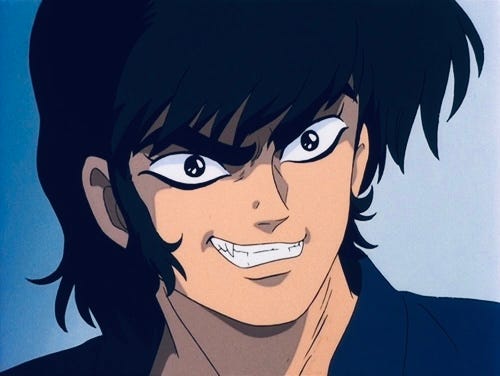
80s Akira about to say something quippy (Copyright Discotek Media used under Fair Use)
This tells you everything you need to know about Akira Fudo: even before gaining superpowers, he’s ready to throw down with bad guys, and he isn’t concerned with things like school popularity.
It’s very much Steve Rogers in The First Avenger and very much not Disney Spider-Man clones.
The Devilman movies also introduce Akira’s second most well-known and most copied attribute: he’s constantly second-guessing himself.
Akira’s life is constantly falling apart because he’s Devilman. The villains kill his mother at the beginning of the second film, and he does what would be expected in that situation. He curls up into a ball, cries, and later tells his boyfriend he wishes he’d never become Devilman. Later in the same film, he’s outsmarted and only survives because his boyfriend saves him instead of vice versa.
Not quite a power fantasy.
Admittedly, the idea that the hero’s job is to suffer comes from Kamen Rider, but the early Kamen Riders were adults in their thirties, and Akira is a high school student. In other words, he’s a hero, and the fact that he’s a kid is secondary.
This has, for the most part, become the common Japanese model for the teenage superhero. Early Sailor Moon certainly uses some of these tropes. There’s an entire scene dedicated to Usagi crying in despair when she had to become Sailor Moon again at the beginning of season 2.
So the next time you think about penning a superhero-themed YA story, take a moment to decide whether the Spider-Man format is really what you want or whether you wanna write something closer to Devilman.
메타데이터
- post_id
- 9b6b04215aa6
- slug
- devilman-remains-the-best-subversion-of-spider-man-9b6b04215aa6
- url
- https://medium.com/worldbuilding-wednesday/devilman-remains-the-best-subversion-of-spider-man-9b6b04215aa6
- canonical_url
- https://medium.com/worldbuilding-wednesday/devilman-remains-the-best-subversion-of-spider-man-9b6b04215aa6
- author_url
- https://medium.com/@moderndayseanchai
- status
- ok
- fetched_at
- 2026-06-25 07:00:49