RACH Failure Causes in LTE and 5G: Understanding the Root Causes of Random Access Failures
Introduction
RACH Failure Causes in LTE and 5G: Understanding the Root Causes of Random Access Failures
Introduction
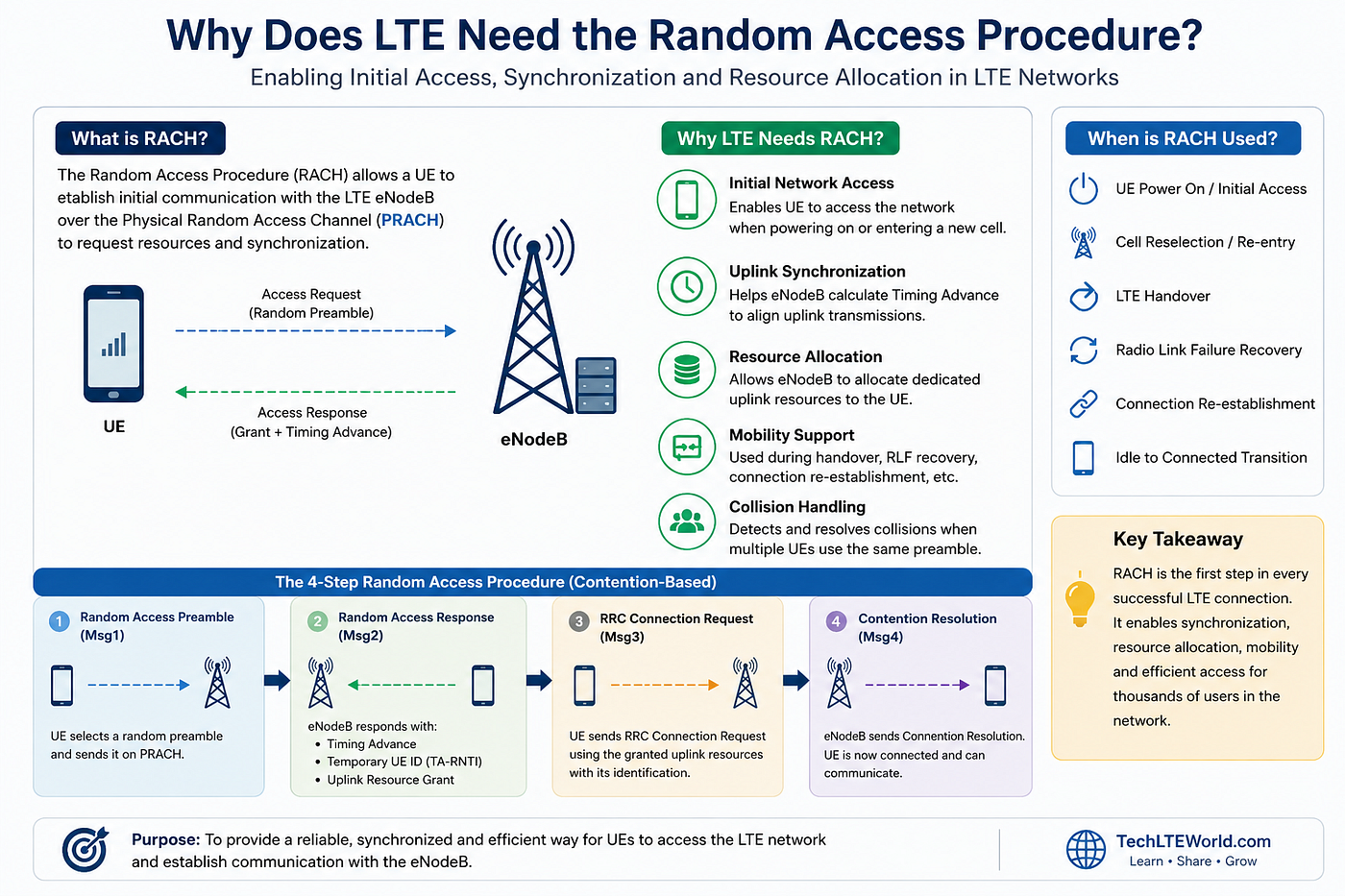
The Random Access Channel (RACH) procedure is one of the most critical processes in LTE and 5G networks. Before a User Equipment (UE) can establish communication with the network, it must successfully complete the Random Access Procedure.
When RACH fails, users may experience:
- Call setup failures
- Data session establishment issues
- Delayed network access
- Handover failures
- Radio Link Failure (RLF) recovery issues
Understanding the root causes of RACH failures is essential for telecom engineers involved in network optimization and troubleshooting.
What is RACH?
RACH (Random Access Channel) is used by the UE to initiate communication with the network.
1. Poor Uplink Coverage
One of the most common causes of RACH failure is weak uplink coverage.
If the preamble power received at the base station is too low:
- MSG1 may not be detected
- Network cannot send MSG2
- UE retransmits the preamble
Symptoms
- High RACH retransmissions
- Increased Access Delay
- Poor Cell Edge Performance
2. Preamble Collision
In Contention-Based Random Access (CBRA), multiple UEs may select the same preamble.
3. PRACH Configuration Issues
Incorrect PRACH configuration can significantly impact access success.
Examples:
- Wrong PRACH Configuration Index
- Insufficient RACH Opportunities
- Improper Root Sequence Planning
- Incorrect Zero Correlation Zone settings
Poor planning may lead to:
- Preamble detection failures
- Increased collision probability
- Access delays
4. MSG2 (RAR) Failure
After receiving MSG1, the network sends the Random Access Response (RAR).
5. MSG3 Decoding Failure
MSG3 carries important information required for connection establishment.
Typical Causes
- Low UL SINR
- High interference
- Power control issues
- Coverage limitations
Even when MSG1 and MSG2 are successful, MSG3 failure can terminate the entire procedure.
6. Contention Resolution Failure (MSG4 Failure)
The final step of CBRA is contention resolution.SG1 -> MSG2 -> MSG3 -> MSG4
If MSG4 is not received:
- UE assumes access failed
- RACH restarts
- Access delay increases
This issue is frequently observed under high network load.
7. High Interference Levels
Interference affects both uplink and downlink communication.
Sources include:
- Neighboring cells
- External RF sources
- Poor PCI planning
- Dense urban deployments
Impact:
- Poor preamble detection
- MSG3 decoding failures
- Increased retransmissions
8. Beam Alignment Issues in 5G
Unlike LTE, 5G NR relies heavily on beamforming.
If the UE selects an incorrect beam:
- PRACH transmission quality degrades
- Access attempts fail
- RACH Success Rate decreases
Troubleshooting Recommendations
To reduce RACH failures:
✔ Improve uplink coverage
✔ Optimize PRACH configuration
✔ Review Root Sequence planning
✔ Reduce interference
✔ Verify beam management in 5G
✔ Analyze MSG1–MSG4 success statistics
✔ Monitor RACH Success Rate regularly
Final Thoughts
RACH is the gateway for UE access in both LTE and 5G networks. Failures can occur due to poor radio conditions, preamble collisions, PRACH configuration issues, interference, beamforming problems, or message decoding failures.
By analyzing where the failure occurs — MSG1, MSG2, MSG3, or MSG4 — network engineers can quickly identify the root cause and improve overall access performance.
For a deeper understanding of the complete **RACH procedure in LTE, including CBRA, CFRA, MSG1–MSG4 flow, and LTE/5G access mechanisms, explore the detailed **5G-NR RACH Procedure guides from TechLTE World.
메타데이터
- post_id
- 9b6b7e9c9fce
- slug
- introduction-9b6b7e9c9fce
- url
- https://medium.com/@techltew/introduction-9b6b7e9c9fce
- canonical_url
- https://medium.com/@techltew/introduction-9b6b7e9c9fce
- author_url
- https://medium.com/@techltew
- status
- ok
- fetched_at
- 2026-06-09 15:37:30