5 Takeways Why Adoption is a Different Kind of Reality:
Introduction:
5 Takeways Why Adoption is a Different Kind of Reality:
Introduction:
The Gap Between Biology and Biography
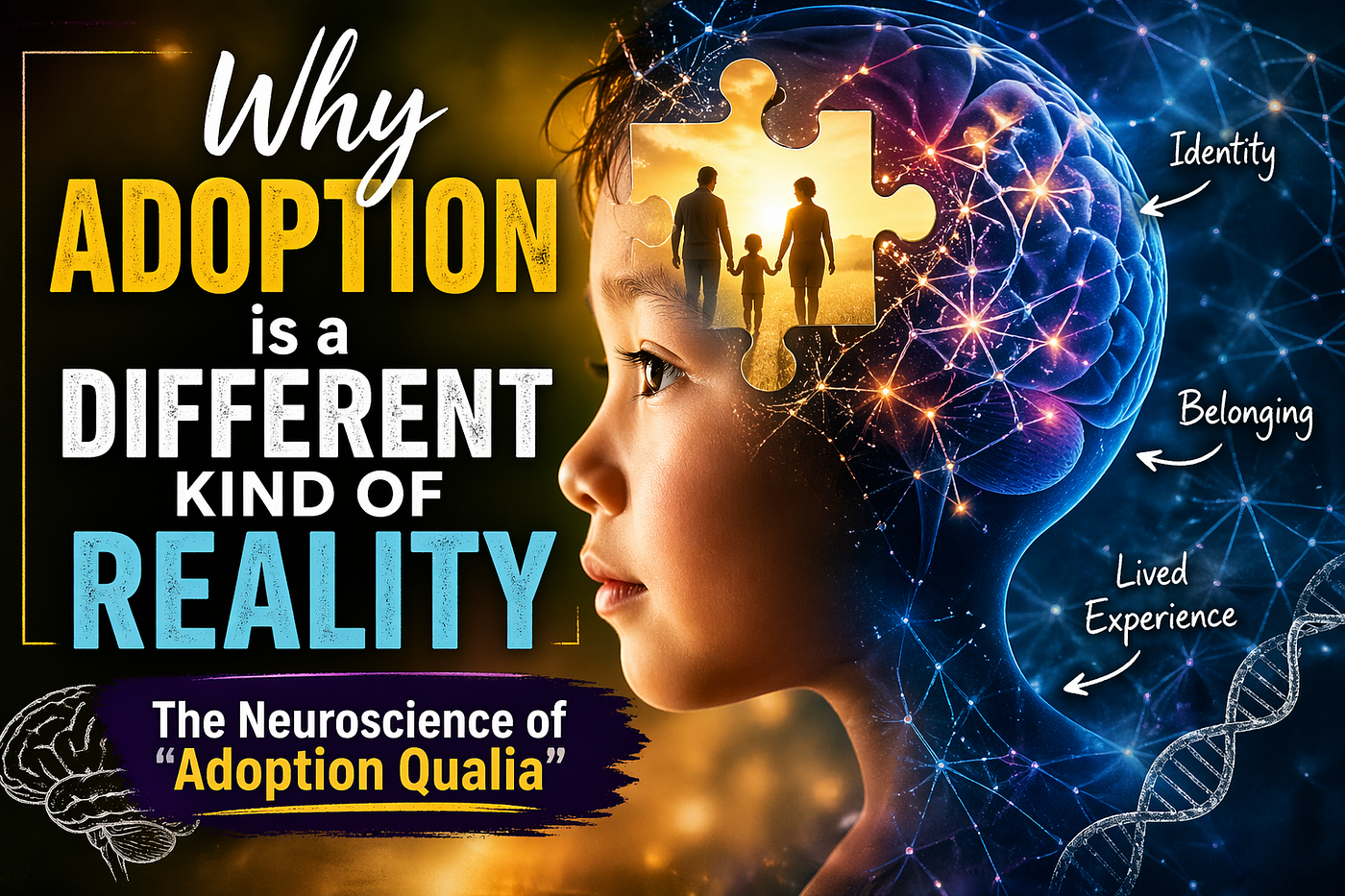
For decades, the study of adoption has been bifurcated into two mutually exclusive domains. One operates in the third-person — the clinical perspective of social work outcomes, attachment theory, and genetic sequencing. The other exists in the first-person — the ineffable, lived experience of displacement and lineage severance. In his groundbreaking work on the subject, author Shane Paul Bouel argues that traditional psychology fails to bridge what neuroscientist Richard Cytowic calls the “epistemological boundary”: the chasm between a third-person technical explanation and a first-person experience.
To understand the adoptee, we must recognize that the “map” (biology) and the “territory” (phenomenology) are inseparable. As the source material posits, “The map is molecular, but the territory is a life.” Adoption is not merely a psychosocial event or a history of trauma; it is a structural, neurological reorganization of consciousness — a distinct perceptual reality known as Adoption Qualia.
Podcast
[embed]
YouTube
[embed]
Introduction:
The Gap Between Biology and Biography
For decades, the study of adoption has been bifurcated into two mutually exclusive domains. One operates in the third-person — the clinical perspective of social work outcomes, attachment theory, and genetic sequencing. The other exists in the first-person — the ineffable, lived experience of displacement and lineage severance. In his groundbreaking work on the subject, author Shane Paul Bouel argues that traditional psychology fails to bridge what neuroscientist Richard Cytowic calls the “epistemological boundary”: the chasm between a third-person technical explanation and a first-person experience.
To understand the adoptee, we must recognize that the “map” (biology) and the “territory” (phenomenology) are inseparable. As the source material posits, “The map is molecular, but the territory is a life.” Adoption is not merely a psychosocial event or a history of trauma; it is a structural, neurological reorganization of consciousness — a distinct perceptual reality known as Adoption Qualia.
YouTube
[embed]
Takeaway 1:
It’s Not Just “Stress” — It’s a Perceptual Reality
The framework of Adoption Qualia suggests that the adoptee’s nervous system fundamentally reorganizes itself around the absence of “early lineage anchors.” In neurobiological terms, this is a disruption of Predictive Coding. Typically, a developing brain relies on biological mirrors — ancestral cues, shared gait, and familiar traits — to serve as foundational anchors for sensory processing. Without these anchors, the brain lacks the essential data required for standard orientation.
This is not a deficit, but a recalibration. The adoptee’s brain adapts to a world where the biological “default settings” are missing.
“This is not a metaphor; it is a structural reality. By reframing adoptee neurobiology as a series of functional adaptations rather than mere clinical deficits, we can transform how adoptee trauma is understood, validated, and treated.”
Takeaway 2:
Emotional Photism (When Feelings Change the Lighting)
A hallmark of this lived experience is Emotional Photism, a phenomenon where internal emotional states translate into literal sensory alterations. Drawing upon Richard Cytowic’s work on synesthesia, this is categorized as Acquired Ideasthesia. It is a cross-modal perceptual blending where relational uncertainty — such as the realization that no one in a room shares one’s biological history — manifests as a shift in environmental luminance, contrast, or spatial depth.
This is driven by a change in the signal-to-noise ratio within the visual cortex. When an adoptee experiences the distress of lineage displacement, the brain doesn’t just “feel” sad; it physically alters the way it processes light. This is a literal “visual hostility” or “environmental darkening” triggered by emotional states, proving that for the adoptee, the biological is the experiential.
Takeaway 3:
Spatial Liminality vs. Standard Dissociation
In clinical settings, adoptees are often misdiagnosed with standard Complex PTSD (CPTSD). However, the nature of their dissociation is fundamentally different. While standard dissociation presents as “numbing out,” “withdrawal,” or a “foggy” detachment, the adoptee experience is characterized by Spatial Liminality.
- Standard Dissociation (CPTSD): A diminishment of sensory engagement.
- Spatial Liminality (Adoption): The state of being overwhelmingly “too present.”
The adoptee exists in a state of hyper-acute, hyper-calculating awareness of physical geometry and exits. This is a subconscious, exhaustive cataloging of the environment to compensate for the absence of social and lineage anchoring. In what the source describes as “hostile space,” the adoptee is not checking out; they are intensely navigating.
Takeaway 4:
Re-reading “Comorbidities” as Sophisticated Adaptations
Common diagnoses associated with adoption are reframed here as logical cognitive signatures of a brain navigating a “Liminal Multiverse.” These are not “broken systems” but functional responses to a world where primary spatial and relational grammar was never fully available.
- Irlen Syndrome (Visual Stress): This is the subjective correlation of Emotional Photism. It is driven by HPA hyperarousal that affects the ciliary muscle and occipital processing, making the brain hyper-sensitive to visual glare.
- Auditory Processing Disorder (APD): This represents a “filtering failure” where the brain, deprived of familiar biological tones, shifts to an intense auditory vigilance, constantly scanning the environment for the “missing voice.”
- Nonverbal Learning Disorder (NVLD): This is interpreted as a direct consequence of spatial sequence disruption and right-hemisphere white matter alterations. While the adoptee may excel at rote verbal memory, they struggle to navigate the “relational maps” of physical and social space.
Takeaway 5:
The “Molecular Map” of the Adoptee Brain
The adoptee experience is underpinned by a specific Epigenetic Risk Architecture. These markers are not absolute destinies, but they create a “constrained flexibility” in the brain’s development:
- FKBP5 Hypomethylation: This alters the glucocorticoid receptors that regulate cortisol. It effectively removes the “chemical handbrake” on the stress response, resulting in a constitutively primed threat-detection architecture.
- BDNF Hypermethylation: Brain-Derived Neurotrophic Factor is essential for neuroplasticity. Hypermethylation suppresses this, “fortifying” existing trauma pathways and making it difficult for the brain to effortlessly grow new, rigid perceptual baselines.
- SLC6A4 Site-Specific Methylation: Disruptions in the serotonin transporter (SERT) result in a constitutional shift in the “emotional ground-state.” This is not standard depression, but a fundamental change in the baseline from which all affective experience is measured.
- KDM6A Loss: This loss of chromatin accessibility impacts the development of the prefrontal cortical architecture and limbic connectivity, affecting high-level spatial sequence reasoning.
- Visual Cortex Alteration: Prolonged cortisol elevation disrupts GABAergic interneurons (the brain’s inhibitory brakes) and NMDA receptors. This is the evidentiary bridge that links molecular stress to the literal sensory shifts of Acquired Ideasthesia.
Conclusion:
A New Vocabulary for Belonging
To move forward, we must adopt the methodology of Sovereign Inquiry, treating biological data and subjective lived experience with equal weight. This framework offers a “Call to Action” for three distinct groups:
Clinicians must move beyond generic trauma narratives and implement Sensory Mapping Inventories to differentiate Spatial Liminality from standard dissociation. Researchers must execute studies that isolate “lineage displacement” as a specific variable, testing the hypothesis of intergenerational transmission with rigorous epistemic humility. For the Adoptee Community, the message is one of validation: You are not broken; your nervous system is exquisitely calibrated to a different set of coordinates.
By embracing the “Liminal Multiverse,” we can finally provide a vocabulary for a demographic historically dismissed as suffering from vague psychological adjustment issues. How might we treat or support adoptees differently if we recognized their experience not as a pathology to be cured, but as a unique neurophenomenology — a structural and irreducible way of perceiving reality itself?
This Substack is reader-supported. To receive new posts and support my work, consider becoming a free or paid subscriber.
See My Resources on Substack
The framework presented in these sources introduces the Neurophenomenology of Displaced Lineage, a radical paradigm shift that reframes the adoption experience. Rather than viewing adoption solely as a psychosocial event or a standard trauma disorder, this framework defines it as a distinct Adoption Qualia — an irreducible, subjective architecture of consciousness.
Core Concepts of the Framework
At the heart of this theory is the idea that the absence of early lineage anchors (biological mirroring such as facial recognition and olfactory imprinting) forces the developing nervous system to fundamentally reorganize itself. This is not merely a psychological defense mechanism; it is a structural reality driven by specific epigenetic “risk architectures”.
Key concepts include:
- Sovereign Inquiry: A methodological stance that treats objective biological data and subjective lived experience with equal weight, refusing to let clinical metrics overwrite first-person truth.
- Acquired Ideasthesia: A phenomenon where emotional states (such as relational uncertainty or threat) translate into literal, cross-modal perceptual shifts.
- Emotional Photism: A specific form of ideasthesia where an adoptee may experience emotional distress as physical changes in environmental luminance, contrast, or spatial depth.
- Spatial Liminality: A hyper-acute, subconscious calculating of room geometry and exits. This serves as a compensatory mechanism for the lack of social and lineage anchoring, making the adoptee feel “too present” in a space rather than detached from it.
- The Liminal Multiverse: The ontological state inhabited by adoptees, characterized by a felt sense of belonging everywhere and nowhere simultaneously.

The Evidentiary Bridge
The framework establishes a physical mechanism linking emotional displacement to sensory alteration. It maps how FKBP5 hypomethylation (which removes the “chemical handbrake” on the stress response) leads to a brain perpetually saturated in cortisol. This cortisol overload eventually travels to the occipital lobe, disrupting the neural “brakes” (GABAergic interneurons) and physically altering how the brain processes light and space.
Available Resources
To explore these concepts further, you have access to three primary source documents and a suite of specialized artifacts:
Primary Sources:
- General Public White Paper: A foundational overview of Adoption Qualia and its key findings.
- Professional White Paper: A more technical document focusing on the diagnostic methodology for clinicians and researchers.
- Case Study (Technical Monograph): A rigorous academic analysis providing the “Evidentiary Bridge” between molecular biology and phenomenological reality.
Key Artifacts in Your Notebook:
- For Clinicians: A Clinical Manual for transitioning to the Adoption Qualia model and a Technical Monograph for neuroscientists.
- For General Learning: Several Audio Overviews and Videos (including “The Biology of Belonging”) that simplify complex jargon.
- Visual Aids: A Neurobiology of Displaced Lineage infographic and a comprehensive Slide Deck for presentations.
- Educational Reports: Guides that reframe conditions like Irlen Syndrome and Auditory Processing Disorder as “functional adaptations” rather than deficits.
Originally published at https://open.substack.com on April 20, 2026.
메타데이터
- post_id
- 9b6ef2f267f0
- slug
- 5-takeways-why-adoption-is-a-different-kind-of-reality-9b6ef2f267f0
- url
- https://medium.com/thoughtless-delineation/5-takeways-why-adoption-is-a-different-kind-of-reality-9b6ef2f267f0
- canonical_url
- https://medium.com/thoughtless-delineation/5-takeways-why-adoption-is-a-different-kind-of-reality-9b6ef2f267f0
- author_url
- https://medium.com/@thoughtless-del
- status
- ok
- fetched_at
- 2026-06-15 20:49:13