Grammarly vs ProWritingAid 2026: Which Writing Tool Goes Deeper?
An honest research-backed comparison of Grammarly vs ProWritingAid in 2026. Ambient correction vs deep document analysis — which tool your…
Grammarly vs ProWritingAid 2026: Which Writing Tool Goes Deeper?
An honest research-backed comparison of Grammarly vs ProWritingAid in 2026. Ambient correction vs deep document analysis — which tool your writing actually needs depends on one key question.

Both tools improve writing — but they operate at completely different depths and different stages of the writing process
Both tools improve writing. They do it differently, at different depths, and for meaningfully different types of writers.
The choice between Grammarly and ProWritingAid is clearer than most comparison articles suggest — once you understand what each is actually built to do and stop treating them as competing products in the same category.
Based on research across writing communities — fiction forums, long-form content discussions, professional writing groups, and verified review platforms — here’s what the people using these tools day-to-day consistently report in 2026.
The Core Distinction That Most Comparisons Miss
Grammarly is an ambient writing assistant. It works in real-time as you type, across every writing environment simultaneously — Gmail, Google Docs, Notion, LinkedIn, Slack, and any browser-based text field via extension. Its scope is deliberately wide. It catches errors the moment they occur, before you move on to the next sentence.
ProWritingAid is a document analysis tool. You write first — then submit the completed document for analysis. Its reports surface structural issues that real-time tools architecturally cannot catch: pacing problems across chapters, overused vocabulary patterns, sentence length variation across long passages, dialogue tag habits, cliché density, and readability consistency across an 80,000-word manuscript.
These two approaches serve different stages of the writing process — and that’s the frame that makes the decision obvious for most writers once they see it.
Grammarly in 2026 — What Community Research Shows
Real-time correction across all environments is Grammarly’s structural advantage over every alternative, and it’s the one no document-analysis tool can replicate. The browser extension covers every text field in every application you’re already working in. There’s no friction, no paste-and-submit workflow, no separate interface to open. It runs in the background and catches errors in the environment where those errors are being made.
For writers who move between email, documents, social platforms, and web-based tools throughout a working day, this ambient coverage is genuinely difficult to replace with a session-based alternative.
The tone detector is cited particularly by professional writers and anyone writing in a client-facing context. Knowing whether a specific email reads as too passive, too direct, or unintentionally curt before you send it is a different kind of value from prose analysis — and it shows up in verified reviews as one of the features users notice most after they have it and least when it’s missing.
Accessibility and low learning curve make Grammarly the natural entry point for writers who want AI assistance without investing time in understanding writing analysis methodology. The interface doesn’t require knowledge of craft concepts to use effectively — the corrections are immediate and self-explanatory.
Who benefits most from Grammarly: anyone writing across multiple environments throughout the day; professionals whose written English needs consistent support; non-native English speakers where article usage and preposition correction are recurring needs; writers who want ambient correction running without actively thinking about it.
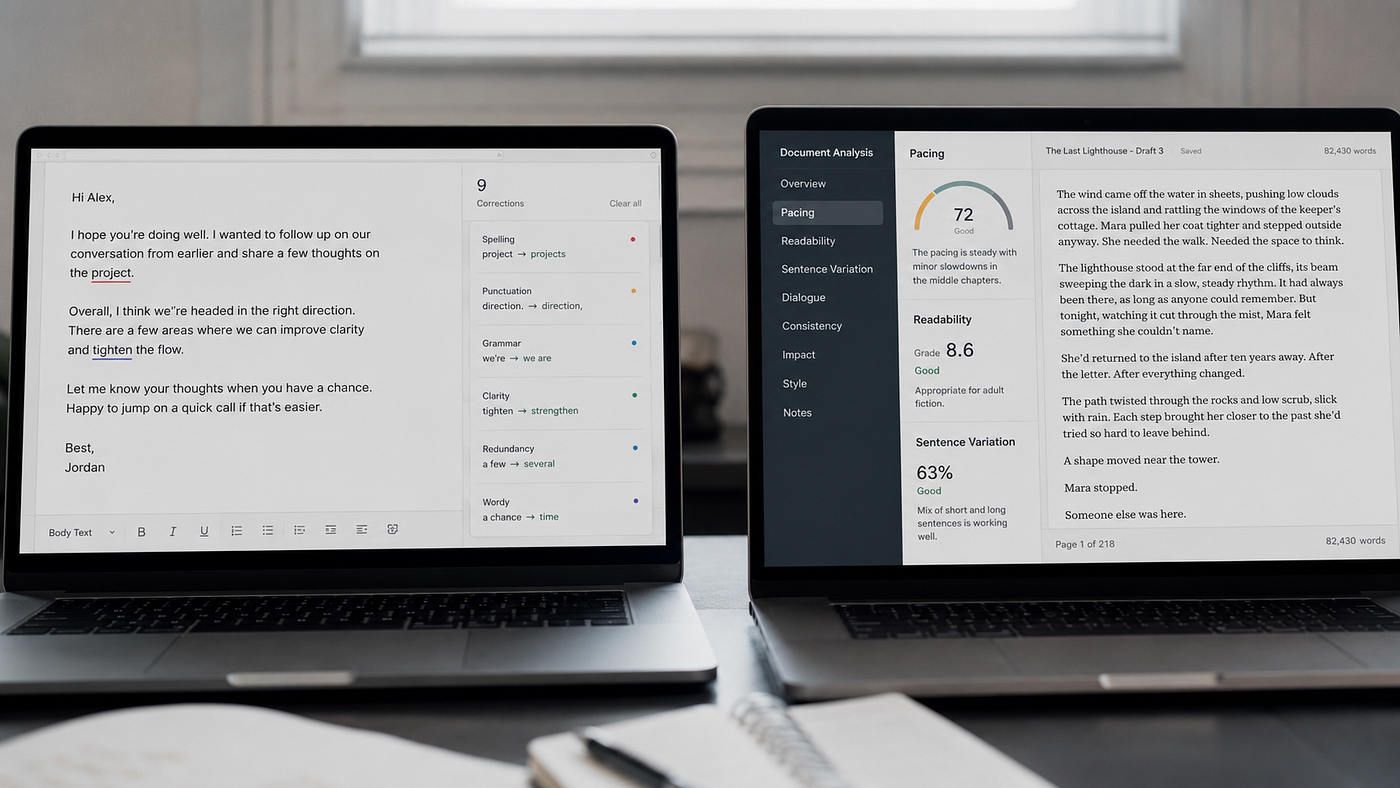
Real-time ambient correction on the left, deep structural document analysis on the right — two different tools solving two different writing problems
ProWritingAid in 2026 — What Community Research Shows
The Writing Reports are the primary reason serious writers consistently prefer ProWritingAid over Grammarly — and they’re worth being specific about, because this is where the tools diverge most significantly.
ProWritingAid’s analysis includes dedicated reports for Overwriting (identifying bloated, padded prose), Pacing (flagging sections where narrative momentum slows), Dialogue (analysing how characters speak and whether dialogue feels natural), Sentence Variation (identifying monotonous rhythm patterns across long passages), Clichés (surfacing overused phrases at document scale), and Readability consistency across chapters.
None of these exist in Grammarly. They can’t — they require whole-document context to generate meaningful analysis. A real-time tool operating sentence by sentence cannot assess whether chapter three’s pacing is slower than chapter two’s, or whether a writer uses the word “suddenly” 47 times across a manuscript.
Long-form document focus is where the community feedback is most emphatic. Reviewers consistently note that ProWritingAid’s value compounds with document length. For a 500-word email, Grammarly’s real-time correction is sufficient. For an 80,000-word novel or a 20,000-word research report, ProWritingAid’s systematic analysis addresses a genuinely different category of writing problems.
Scrivener integration is cited repeatedly in fiction writing communities as a meaningful workflow advantage. The ability to analyse a full manuscript directly within Scrivener — the writing environment most serious fiction writers use — eliminates the copy-paste workflow that breaks creative momentum when moving between tools.
Who benefits most from ProWritingAid: fiction writers working on book-length projects; non-fiction authors; long-form bloggers and essayists producing regular pieces above 3,000 words; any writer who wants systematic prose quality analysis beyond error correction and is willing to actively engage with writing reports.
Honest Limitations Worth Naming
Grammarly’s style suggestions can override intentional voice choices. This is the most consistently cited frustration in creative writing communities. Premium suggestions optimise for clarity and conventional correctness — which conflicts with deliberate stylistic decisions in fiction: intentional fragments, unconventional punctuation, stylised rhythm. Multiple fiction writers in community discussions note turning off specific suggestion categories for creative work specifically.
ProWritingAid has a meaningful learning curve. Understanding which reports are relevant for your specific writing context, how to interpret the analysis, and which suggestions to act on versus ignore requires genuine investment. It is not an ambient tool you set up once and forget. You need to actively engage with the analysis for it to improve your writing — and that engagement takes time to develop.
The Decision Framework
The decision comes down to writing context — ambient coverage for daily multi-environment writing, or deep analysis for long-form serious work
Choose Grammarly if: You write across many environments throughout the day and want always-on error correction without a separate workflow. Real-time feedback during the act of writing is more valuable to you than post-writing structural analysis. Your documents are predominantly under 5,000 words, where whole-document structural analysis matters less. English writing support — particularly article and preposition usage — is a consistent priority.
Choose ProWritingAid if: You write long-form documents regularly — books, long articles, structured reports. You write fiction and want systematic prose analysis that goes beyond grammar and spelling into craft-level feedback. You use Scrivener and want integrated manuscript analysis. You’re genuinely willing to invest time in understanding and acting on detailed writing reports rather than surface-level corrections.
Use both if: Your budget allows and your writing spans both daily short-form professional writing and regular long-form creative or content work. The tools cover entirely different stages and don’t overlap meaningfully — Grammarly handles the daily ambient layer, ProWritingAid handles the deep revision layer.
Full side-by-side comparison with verified pricing and use-case filters: *Grammarly vs ProWritingAid — AI Nexus Tools*
Also in the Grammarly comparison cluster: Grammarly vs QuillBot · Grammarly vs Writesonic · Best Grammarly Alternatives 2026
메타데이터
- post_id
- 9b8b0219e737
- slug
- grammarly-vs-prowritingaid-2026-which-writing-tool-goes-deeper-9b8b0219e737
- url
- https://medium.com/@navneetarya1989/grammarly-vs-prowritingaid-2026-which-writing-tool-goes-deeper-9b8b0219e737
- canonical_url
- https://medium.com/@navneetarya1989/grammarly-vs-prowritingaid-2026-which-writing-tool-goes-deeper-9b8b0219e737
- author_url
- https://medium.com/@navneetarya1989
- status
- ok
- fetched_at
- 2026-07-17 06:16:19