Political Landscapes and the Collapse of Local Representation
Modern politics is often described as democratic, representative, and grounded in the will of the people. In theory, elected officials…
Political Landscapes and the Collapse of Local Representation
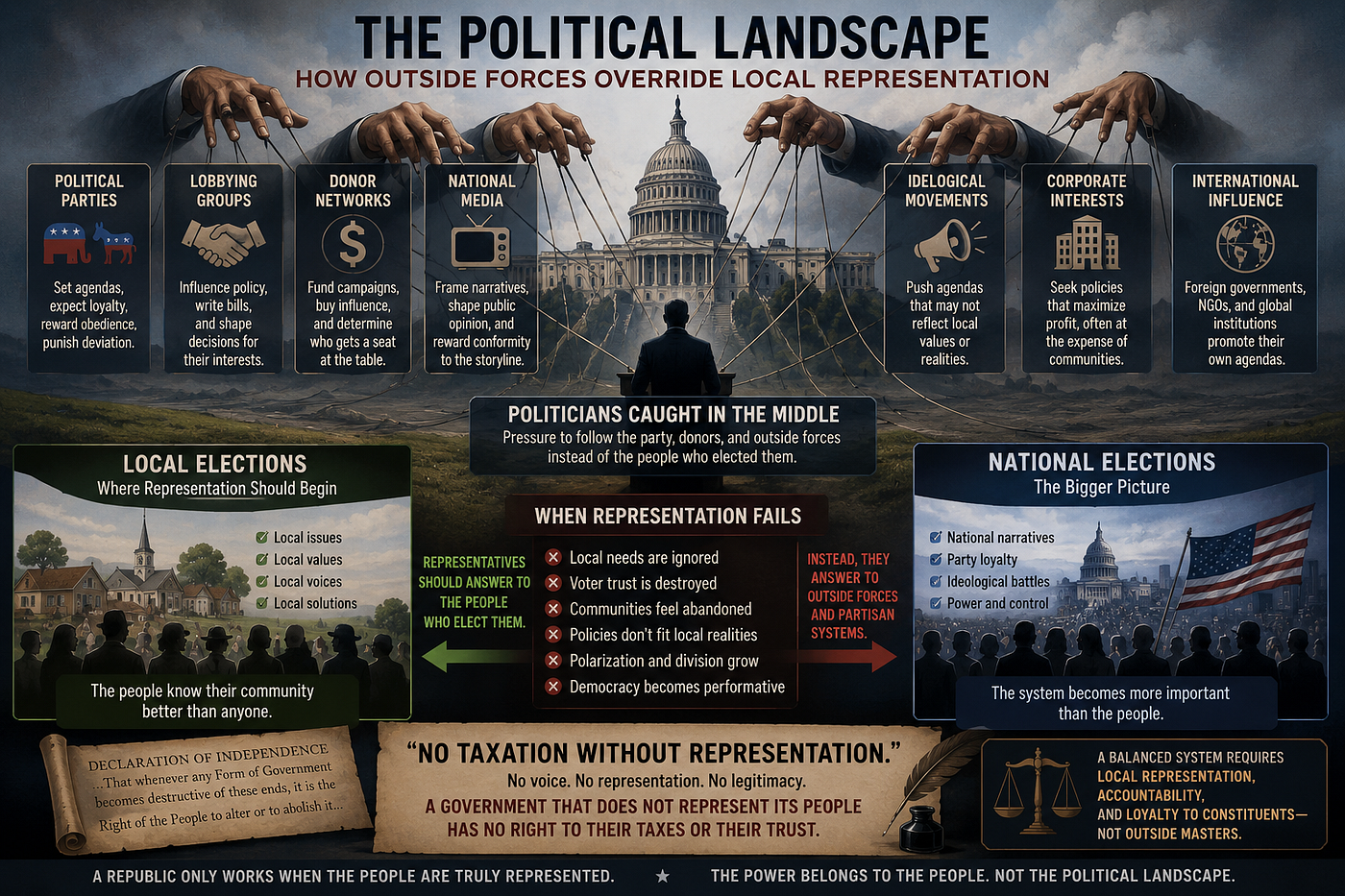
Modern politics is often described as democratic, representative, and grounded in the will of the people. In theory, elected officials exist to reflect the interests of the districts, states, and communities that choose them. In practice, the system increasingly behaves less like local representation and more like a centralized network of political incentives, where outside influence often outweighs local voice.
The result is what can only be described as a political landscape that operates alongside government, not within it. It is not formally part of the Constitution or the structure of representative democracy, yet it shapes outcomes more than many voters realize.
Political parties, lobbying groups, donor networks, media organizations, and ideological movements form an ecosystem that sits above local representation. While they do not directly govern, they influence who gets elected, how they behave once in office, and what positions are politically survivable. This creates a system where elected officials may technically represent their districts, but practically answer to a much broader set of incentives.
This is where the original purpose of representation begins to erode.
The Tension Between Representation and Political Systems
The idea of representation is simple: a politician should reflect the interests of the people who elected them. Yet in modern political systems, especially large federal governments, that relationship is constantly pressured by national narratives and institutional expectations.
Local concerns often get absorbed into larger ideological conflicts. A policy issue affecting a single district can quickly become part of a national debate, stripped of its local context. Once that happens, the question is no longer “what does this district need,” but “what position does my party require,” or “what will the national donor base tolerate.”
This creates a structural contradiction. Representatives are elected locally but evaluated nationally.
The consequence is predictable. Many elected officials begin prioritizing survival within the political system over direct responsiveness to their constituents. Party alignment, fundraising access, media positioning, and ideological branding gradually become more important than local accountability.
Independent Voices and Party Pressure
There are exceptions that illustrate the tension clearly.
Politicians such as Ron Paul, Rand Paul, and Thomas Massie have at various times positioned themselves outside the mainstream expectations of their party. While all are associated with the Republican Party, their political identities have often been defined by willingness to break with party consensus on issues involving spending, foreign policy, civil liberties, and constitutional interpretation.
Regardless of whether one agrees with their positions, their behavior highlights an important distinction: representation can be interpreted as loyalty to a party structure, or loyalty to a set of principles and a constituency.
In a Congress composed of 435 representatives and 100 senators, most legislators operate within strong party frameworks. These frameworks provide funding, committee access, electoral support, and institutional stability. In return, they often expect ideological alignment and voting discipline.
The result is a system where deviation from party expectations is frequently treated not as independent judgment, but as internal disruption.
This raises a deeper question: if elected officials are structurally pressured to prioritize party expectations over local concerns, how meaningful is local representation in practice?
Representation, Consent, and Political Legitimacy
The foundation of representative government rests on a basic principle: political authority must be connected to consent.
This idea is not new. It is deeply embedded in the political philosophy that shaped the United States. The United States Declaration of Independence articulated a system of grievances against governance without meaningful consent or representation. Out of that framework emerged one of the most recognizable political principles in history: no taxation without representation.
While often simplified, the idea carries a broader implication. A government cannot consistently extract resources, enforce laws, and demand compliance from a population while simultaneously failing to represent that population’s interests.
If a district contributes economically and socially to a state or nation, it must also possess a meaningful voice within that system. Otherwise, the relationship between governed and governing becomes fundamentally imbalanced.
When Representation Becomes Outsourced
The modern political landscape introduces another complication: outside influence.
Large lobbying organizations, corporate donors, ideological institutions, national party committees, media ecosystems, and even international advocacy networks can exert significant pressure on local political outcomes. These forces can fund campaigns, shape narratives, and elevate or destroy political careers independent of local opinion.
As a result, voters may still participate in elections, but the field of options is increasingly shaped by forces outside their community.
This produces a subtle but important shift. The representative no longer primarily answers to the district that elected them. Instead, they must also navigate expectations from institutions that operate far above the local level.
Over time, this weakens the connection between representative and represented.
The Historical Problem of Outsiders in Local Politics
Concerns about outside influence in local governance are not new.
Following the American Civil War, the term “carpetbagger” emerged to describe individuals who moved into regions — particularly in the South — with little established connection to local communities but significant political or economic ambitions.
While the historical context is complex and often debated, the underlying concern reflects a consistent theme in political systems: legitimacy is closely tied to perceived connection with the community being governed.
People tend to distrust leaders who appear disconnected from local realities, whether those leaders are physically outsiders or politically detached through external influence.
The broader principle remains relevant even outside its historical setting. Communities generally expect representation from individuals who understand their conditions, share their lived experience, or at minimum are accountable to their specific needs.
The Collapse of Local Voice
When local representation is overridden by national political incentives, several consequences emerge.
First, political accountability shifts upward rather than downward. Representatives become more responsive to party leadership, donors, or ideological movements than to constituents.
Second, local issues become secondary to national narratives. Community-specific concerns are often reframed or ignored if they do not align with broader political messaging.
Third, voter trust erodes. Citizens begin to perceive elections as selections between competing national systems rather than meaningful local representation.
Fourth, political polarization increases, because local nuance is replaced by national ideological conflict.
Over time, this produces a system where citizens feel increasingly distant from the institutions that claim to represent them.
Conclusion: A System Out of Balance
Representative government depends on a delicate balance between structure and locality. Some level of national coordination is necessary for stability, governance, and large-scale policy. But when that coordination becomes dominant enough to override local voice, the system begins to drift away from its foundational purpose.
A district is not merely a geographic designation. It is a collection of people with specific needs, values, and lived realities. If those realities are not reflected in governance, then representation becomes symbolic rather than functional.
The political system may continue to operate, elections may continue to occur, and institutions may continue to function, but the connection between people and government becomes increasingly abstract.
And once representation becomes abstract enough, the original promise of representative government starts to blur into something far less grounded in the people it was designed to serve.
메타데이터
- post_id
- 9ba6e42bdbe5
- slug
- political-landscapes-and-the-collapse-of-local-representation-9ba6e42bdbe5
- url
- https://medium.com/@ricky_1146/political-landscapes-and-the-collapse-of-local-representation-9ba6e42bdbe5
- canonical_url
- https://medium.com/@ricky_1146/political-landscapes-and-the-collapse-of-local-representation-9ba6e42bdbe5
- author_url
- https://medium.com/@ricky_1146
- status
- ok
- fetched_at
- 2026-06-09 15:37:30