The Self-Help Idea I Trusted Most Was Keeping Me Stuck
We all quote the same line from Epictetus. We forgot the half that actually sets you free.
The wrong mindset can become a prison.
The Self-Help Idea I Trusted Most Was Keeping Me Stuck
We all quote the same line from Epictetus. We forgot the half that actually sets you free.

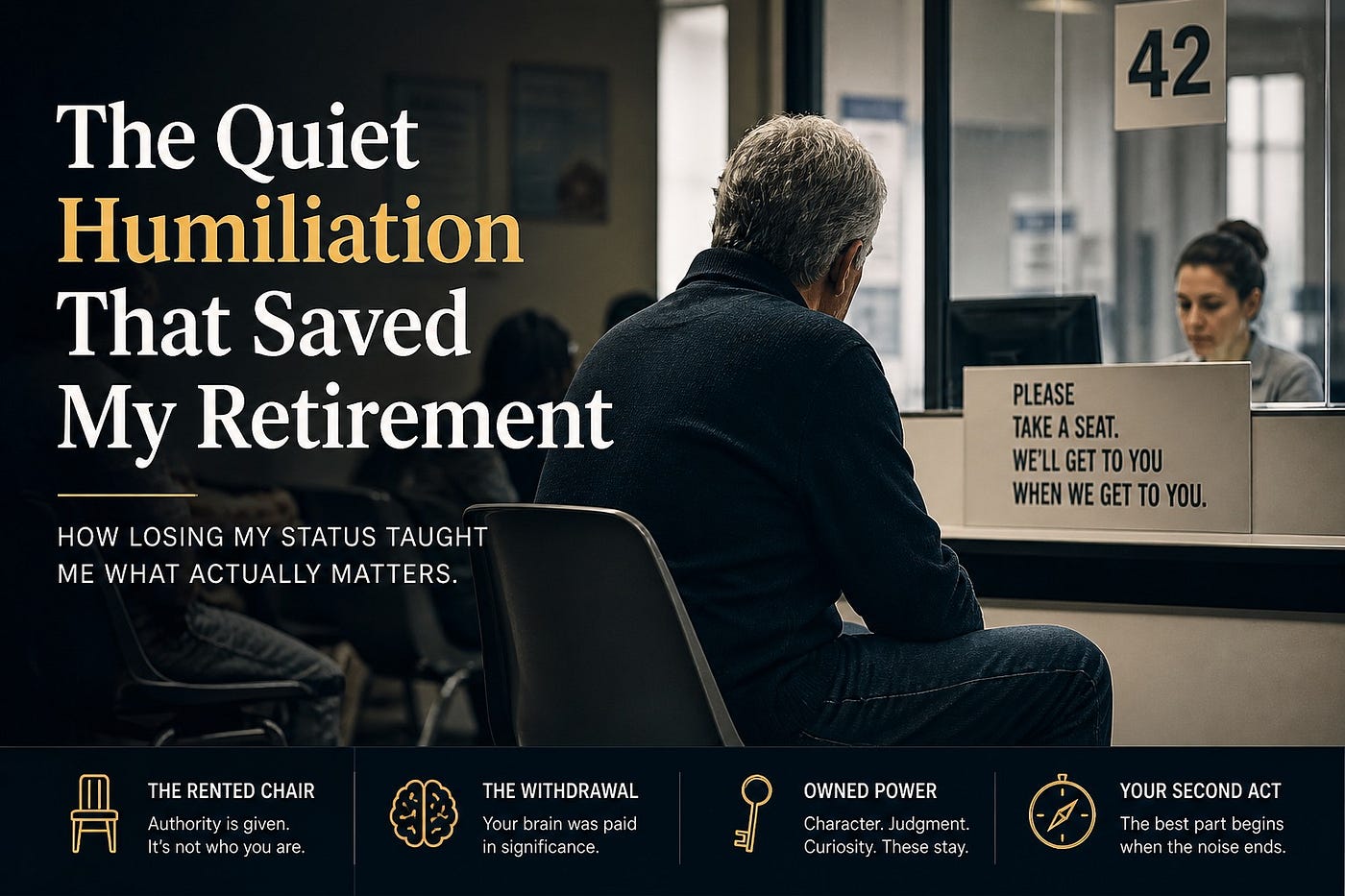
Sometimes the most powerful self-help tools become the very thing keeping us stuck. Real freedom begins when we stop endlessly reframing what hurts — and finally change what we can. / Author created image using AI
I have been a seeker my whole life.
If there is a book promising the system, the morning routine, the mindset, the one habit that separates the people who get there from the people who don’t, I have read it, underlined it, and believed it.
For most of my life, I’ve been certain that the answer was out there, one more framework away, and that if I could just grab the right thing and hold on tightly enough, everything would finally click.
So I grabbed. I held on hard. And each time, for a while, it felt like the key. Then the shine wore off, and I went looking for the next one, never quite noticing the pattern: that I kept finding keys, gripping them with everything I had, and staying more or less exactly where I was.
The thing I gripped longest, the one I was most sure about, came dressed as ancient wisdom. And it is the one that cost me the most, because unlike the others, it actually worked. That’s what made it a trap.
The most trusted idea in self-improvement
Here is the sentence, the one I held onto for years.
“It’s not events that disturb us, but our judgments about them.”
It comes from Epictetus, a Stoic who had been a slave before he was a philosopher, and it is probably the most influential idea in the entire history of self-help. I don’t mean that loosely. When a young Albert Ellis came across that line, it struck him hard enough that he built a whole school of therapy on it. Aaron Beck did much the same a few years later. Between them, Ellis and Beck founded cognitive behavioral therapy, the most rigorously validated talk therapy on earth, and both men traced its roots straight back to the Stoics. The handout a CBT patient gets on day one still often carries that exact sentence near the top.
So this was no mug slogan I’d fallen for. It was the cornerstone of modern psychology. And the promise inside it is real; the brain scans confirm it: change the story you tell about an event, and you genuinely change how it lands in your body.
I believed it completely. For years, it ran my life. And that, it turns out, was the problem.
The version of this idea you already know
Let me give the promise its due, because it’s true.
Something happens. Before you’ve decided anything, the amygdala, the brain’s old alarm bell, fires fast and loud and floods the body with alert. You don’t choose that first jolt. But then, if you deliberately reinterpret what just happened, your prefrontal cortex, the slow, deliberate part, comes online, and the amygdala quiets. Psychologists call this cognitive reappraisal. It’s the skill underneath that Epictetus line, and it works. Reframe a rejection as redirection, a panic as excitement, a delay as rest, and you really do feel different, because at the level of neurons, you are different.
This is the part every article tells you. It’s genuinely good news, and I’m not here to take it from you.
I’m here to tell you what happens when you get too good at it.
What I was actually doing
For a long stretch, I had a job that was slowly hollowing me out. Nothing dramatic. No villain, no single terrible day. Just a steady, low drain, the Sunday-night dread, the meetings that left me emptier than they found me, a quiet voice underneath it all that kept saying this isn’t right.
And I had finally found a tool equal to that voice. I was magnificent at managing it.
Every time the dread rose, I reframed it. I was being dramatic. Everyone hates their job sometimes. I was lucky to be employed at all. Think of people with real problems. I told myself a hundred reasonable, accurate, beautifully constructed stories, and every one of them worked. The dread quieted. The alarm went down. I had gotten so good at adjusting my judgment of the situation that I never once asked the more dangerous question: whether the situation needed adjusting.
This was the seeking pattern in its purest form. I had grabbed the most powerful key I’d ever found and used it to lock myself more securely in place. And I want to show you this wasn’t a personal failing or a misuse of the tool. It was the tool working exactly as designed, aimed at the wrong target. The science predicts it precisely.
The study almost nobody quotes
In 2013, the psychologist Allison Troy ran an experiment that should be far more famous than it is. She measured how good people were at cognitive reappraisal, measured how much stress they were under, and crucially, whether that stress was something they could control. Then she looked at who was depressed.
For people facing stress they couldn’t control, a sick loved one, a loss, a situation with no exit, the result was exactly what you’d hope. The better they were at reframing, the less depressed they were. Reappraisal was a lifeline.
But for people whose stress was controllable, the result flipped completely. Among them, the better someone was at reframing, the more depressed they tended to be. Troy’s own words are blunt: when a stressor is in your control, the ability to reframe “isn’t just less beneficial; it may be harmful.”
The very skill that heals you in a situation you cannot change can corrode you in one you can.
Read that again, because it’s the whole thing. Reframing becomes what you do instead of leaving. It’s the story you tell, so you don’t have to act. You get so fluent at making peace with the wall that you stop seeing the door.
That was me. A controllable problem, and a world-class talent for treating it like an uncontrollable one.
The other face of the same trap
There’s a second way this goes wrong, quieter, because it doesn’t even leave you a problem to point at.
Used relentlessly, reframing flattens the signal out of your feelings altogether. Emotions aren’t just noise to be managed down. The dread was data. The flash of anger when you’re talked over is information about a boundary. The grief that won’t reframe is sometimes grief that shouldn’t be reframed, because it’s measuring something that genuinely mattered.
A mind that reflexively converts every uncomfortable feeling into something more tolerable isn’t at peace. It’s gone numb and learned to call the numbness wisdom.
The research bears this out, too. Across studies, acceptance, letting a feeling simply be what it is, often beats reappraisal at calming the body’s stress response, and the most relentless reframers are not reliably the happiest people. There is such a thing as too much management of your own interior. Past a point, “it’s only my judgment” becomes a way of never letting anything reach you.
The line Epictetus actually cared about
Here’s the irony that turns the whole thing on its head, and the moment I finally let go of the wrong key.
That famous quote, the one Ellis built a therapy on, the one I gripped for years, is not actually Epictetus’s most important teaching. The scholars who read him closely will tell you it’s maybe his second. The idea he opened with, the one he treated as the foundation of everything, is different and far more useful. It’s the distinction between what is up to us and what is not.
The self-help world fell in love with the second idea and forgot the first. I had done exactly the same. And the first idea is precisely the one that springs the trap. Before you reframe a feeling, the genuinely Stoic move, the one Epictetus actually led with, is to ask: Is this something I can change, or not?
Because the answer tells you which tool you’re allowed to reach for.
If it’s truly not up to you- the illness, the loss, the past, the traffic- then reframe with everything you’ve got. Reappraisal is the right and merciful response to a wall, and it can save your life.
But if it is up to you, the job, the relationship, the boundary, the thing the dread keeps pointing at, then the feeling isn’t a problem to be reframed. It’s a signal to be obeyed. The skill was never changing your judgment of the situation. It was changing the situation.
What to do with the jolt
So the real practice is one extra step, and it comes before the reframe, not after.
Next time something disturbs you, don’t immediately reach for thinking about it differently. First, ask the older question. Is this up to me? Sit with it honestly, because the whole trap is the temptation to call a controllable thing uncontrollable, so you’re allowed to make peace instead of making a change.
If the honest answer is no, then reframe freely and let it bring you peace.
If the answer is yes, don’t soothe the feeling. Let it stay loud enough to move you. Then move.
I eventually left that job. Not because the dread finally won, but because I stopped reframing it long enough to hear what it had been telling me all along. And somewhere in there, I think I stopped being quite so frantic a seeker, because I’d finally understood the shape of my own mistake. For most of my life, I’d been grabbing keys and holding on with everything I had. The whole time, the actual skill was knowing which door each key was for and being willing to set the wrong one down.
It was never only about the quality of your thoughts. It was about knowing, first, which of your troubles your thoughts were ever meant to touch.
Further Reading to Consider:
About the Author
Gary L. Fretwell is a #1 international best-selling author and a student of “Intentional Living.” By blending the rigors of neuroscience with the timeless wisdom of Stoic philosophy, Gary helps creators and leaders build a cognitive architecture of true significance.
As the author of the #1 International Best Seller: *The Magic of a Moment, and best-sellers [Intentional Retirement](https://amzn.to/4d3n0ZB) and [Embracing Retirement](https://amzn.to/4tdXh6L), Gary provides definitive field guides for those ready to move from “Output” to “Influence.” His research-driven approach extends into personal wellness in [Rewiring the Ring](https://amzn.to/492OUUp)*, available for pre-order now. This book explores the intersection of personal experience and cognitive science to understand and overcome Tinnitus. Rewiring the Ring will be available in all forms on June 16.
Whether he is serving as Board President for Prescott Meals on Wheels or mentoring the next generation of MBA thinkers at Western Governors University, Gary’s mission is to help others navigate the “Identity Ghost” and design a life of purpose.
Explore the Second Mile: garyfretwell.com Weekly Deep Dives: Subscribe to *The Wise Effort* on Substack. Latest Articles: Follow on Medium.
메타데이터
- post_id
- 9bab30e35c1d
- slug
- the-self-help-idea-i-trusted-most-was-keeping-me-stuck-9bab30e35c1d
- url
- https://medium.com/illumination-curated/the-self-help-idea-i-trusted-most-was-keeping-me-stuck-9bab30e35c1d
- canonical_url
- https://medium.com/illumination-curated/the-self-help-idea-i-trusted-most-was-keeping-me-stuck-9bab30e35c1d
- author_url
- https://medium.com/@gary_fretwell
- status
- ok
- fetched_at
- 2026-06-09 14:34:10