What’s that charge?
Have you ever looked at your taxi, Uber, or Lyft receipt and wondered what all the surcharges are for? Along with the base fare, which is…
What’s that charge?
Have you ever looked at your taxi, Uber, or Lyft receipt and wondered what all the surcharges are for? Along with the base fare, which is calculated from your trip’s distance and duration, there’s usually a host of fees, some of which aren’t exactly self-explanatory. In this article, we’ll discuss those fees to help you better understand where your money is going each time you take a trip and offer a bit of the history and rationale behind the policy decisions that prompted them. We’ll only be covering government fees imposed by laws or regulations, not charges companies apply at their discretion. Where the money goes varies depending on the type of fee: some of these fees support the driver, while others support specific policy goals.
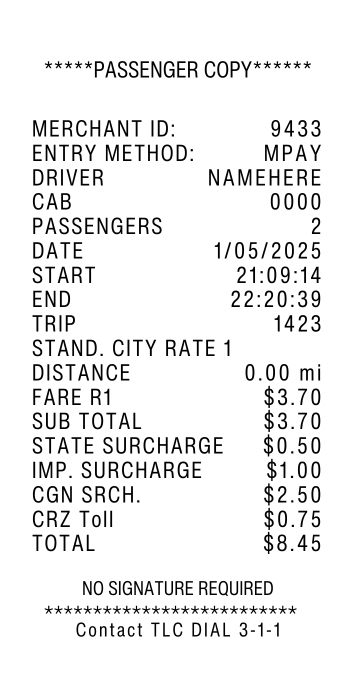
Not all fees apply to every type of ride. Some may apply only to the city’s yellow taxis and green cabs, while some apply to for-hire vehicles (FHVs), which include livery trips as well as app-based trips through services like Uber and Lyft.
Fees to support policy goals
NY Congestion Surcharge (Manhattan below 96th Street) (Taxi + FHV)
If you take a trip that starts, ends, or passes through Manhattan below 96th street in a taxi or for-hire vehicle, you will pay a Congestion Surcharge, which is mandated by NY state law. The surcharge is:
· $2.50 for taxicabs
· $2.75 for green cabs and for-hire vehicles
· $0.75 per shared ride
This fee began back in 2019 as a part of the State budget to address congestion in Manhattan and raise about $1 billion per year to pay for subway repairs.[1] The fee is meant to discourage passengers from taking trips in transit-rich areas of Manhattan, while also raising funds for the subway. The surcharge is remitted to the NY State Department of Taxation and Finance and must be paid by the passenger (it cannot be taken out of driver’s pay).
This fee is different from congestion pricing, which we discuss below.
Too long; didn’t read (tl;dr): There is a $2.50 charge for taxis and $2.75 charge for green cabs and FHVs when the trip starts, ends, or passes through Manhattan below 96th St.
Trips traveling in the Congestion Relief Zone (Taxi + FHV)
As part of the MTA’s Central Business District Tolling Program, also known as congestion pricing, vehicles that travel through or within the Congestion Relief Zone — local streets and avenues in Manhattan south of and including 60th St — pay a toll beginning January 5th, 2025. The purpose of the tolling program is to reduce the number of vehicles in the area and fund transit capital projects.
Taxis and for-hire vehicles that operate in the Congestion Relief Zone will be charged on a per-trip basis at the rates below.
· High-volume for-hire vehicles (Uber and Lyft): $1.50
· Taxis, green cabs, and other for-hire vehicles: $0.75
More information about congestion pricing is available at congestionreliefzone.mta.info, and more information about the taxi and FHV tolling policy can be found here.
[embed]
Airport Fees (Taxi + FHV)
The Port Authority of New York and New Jersey, which operates New York City’s airports, charges passengers a fee for pickups and drop offs at John F. Kennedy (JFK) and LaGuardia (LGA) Airports. These fees are imposed by the airports for the privilege of conducting business on their premises. Pickups in a taxi at LGA or JFK incur a $1.75 fee, and FHV trips have a $2.50 fee for both drop-offs and pickups at the airports.
In addition to other applicable fees and tolls, trips to and from LGA include a surcharge of $5, while trips to Newark Airport are subject to a surcharge of $20. These surcharges compensate the driver for the additional travel and waiting time associated with these trips.
NY State tax — MTA (Taxi)
If you are taking a taxi in NYC, you will see on your receipt a $0.50 charge for the NY State MTA tax. The New York State Legislature added this tax in 2009 as part of an effort to provide funding for MTA subways and buses. This fee applies to all trips beginning in NYC and ending in the MTA service territory, which includes NYC as well as Nassau, Suffolk, Westchester, Rockland, Dutchess, Orange, and Putnam counties.
tl;dr: There is $0.50 surcharge for taxi trips within the New York metro area that supports the MTA.
Tolls (Taxi + FHV)
Many of the bridges and tunnels in the region are maintained through toll revenue. When a taxi or for-hire vehicle passes through a toll, this cost is passed on to the passenger. TLC-licensed drivers are required to use an E-ZPass, which collects tolls automatically and at a discounted rate. Below you will see a map of all the toll bridges and tunnels in the city and their various fee structures.
[embed]
When taking a for-hire ride, there are few things that may impact the tolls you pay, such as the direction of travel, the destination, and the type of crossing. For example, passengers may need to pay tolls to and from a destination in order to cover a driver’s return toll when traveling to an area where the driver is unlikely to have a passenger on their return trip. The following sections explain the toll structure in more depth.

A note on New Jersey/New York crossings
Bridges and tunnels to and from New Jersey are operated by the Port Authority, which only collects tolls for trips entering New York (they do not charge a toll to enter New Jersey). Although TLC’s jurisdiction only covers trips that start within the five boroughs of NYC, tolls to enter the city are relevant for TLC-regulated trips that end at Newark Airport, as the passenger is required to cover the driver’s return toll for these trips.
Tolls are based on vehicle size and the time of crossing. For more information on these crossings, click here. For more information on MTA-maintained bridges and tunnels, click here.
Sales Tax
FHV riders are charged 8.875% of the trip’s fare to cover NYC sales tax. Yellow taxis do not have an additional sales tax.
Fees to support drivers
NY State Black Car Fund (FHV)
Since most drivers are independent contractors, they may not have access to the benefits and worker protections provided by a typical employer. To address this gap, the Black Car Fund was set up in 1999 as a way for black car and limousine drivers to access workers’ compensation benefits. Since then, the Fund has grown and now covers or discounts health and wellness benefits for drivers, including those driving for Uber and Lyft. Enrollment in the program is free for drivers. The Fund is covered by a 3% surcharge on FHV fares. In 2020, the surcharge was raised half a percent up from 2.5% to help drivers through the COVID-19 pandemic.
Read more about the history of the Black Car Fund here.
tl;dr: There is a 3% surcharge on FHV trips to support driver benefits access.
Taxi Improvement Fund (TIF) (Taxi)
Taxis play an important role in the city’s transportation system. Given that role, accessibility for wheelchair users is a key concern. Compared to non-accessible vehicles, wheelchair accessible vehicles (WAVs) often require thousands of dollars of added costs to ‘hack up’ the vehicle with a ramp and securements. To bridge this financial gap and increase the number of WAVs in the city, TLC created the Taxi Improvement Fund (TIF) in 2014 to support taxi WAV owners and drivers.
A $1 per-trip fee on all taxi trips supports the TIF. The money goes into vehicle investments that improve accessibility and helps incentivize drivers to operate WAVs. More information on TIF and TIF payments can be found on the TLC website here.
tl;dr: $1.00 surcharge on taxi trips to support investments in accessible vehicles across the taxi fleet.
Time-based surcharges (Taxi)
At certain times of day, time-based surcharges may apply. These charges go directly to the driver. On weekdays from 4pm to 8pm (excluding holidays) there is a rush hour surcharge of $2.50. This surcharge is an attempt to increase the supply of taxis available when demand for vehicles is high.
Overnight trips between 8pm and 6am will accrue a $1.00 overnight surcharge. This fee is to encourage more drivers to be on the road at night when there are fewer public transportation options.
End of your trip
The next time you look at your trip receipt, we hope you will have a better understanding of each fee and why it’s there. If after your trip you realize you left something behind in the vehicle, either contact Uber or Lyft through the app or follow these instructions on how to recover your items from a yellow or green cab.
[1] https://abcnews.go.com/Business/judge-approves-congestion-pricing-york-city-taxi-uber/story?id=60778450
메타데이터
- post_id
- 9bc4d4aff0ca
- slug
- whats-that-charge-9bc4d4aff0ca
- url
- https://medium.com/@NYCTLC/whats-that-charge-9bc4d4aff0ca
- canonical_url
- https://medium.com/@NYCTLC/whats-that-charge-9bc4d4aff0ca
- author_url
- https://medium.com/@NYCTLC
- status
- ok
- fetched_at
- 2026-07-21 07:28:30