Carbon Steel vs. Stainless Steel
Choosing the Right Knife in Japanese Knife Culture
Carbon Steel vs. Stainless Steel
Choosing the Right Knife in Japanese Knife Culture
The question sounds simple enough.
Carbon steel or stainless?
But ask a Japanese knife maker that question, and they’ll probably pause before answering.
Not because it’s complicated — but because they know the answer says more about you than it does about the steel.
1. Two Different Relationships With a Knife
Leave it wet — especially after cutting something acidic like citrus, tomato, or onion — and you may see it begin to change within minutes.
The speed depends on what’s on the blade: plain water is relatively forgiving; acidic foods are not.
To a newcomer, this sounds like a flaw. To someone who has cooked with carbon steel for years, it feels like communication.
Because that reactivity is also what makes carbon steel alive in a way stainless isn’t.
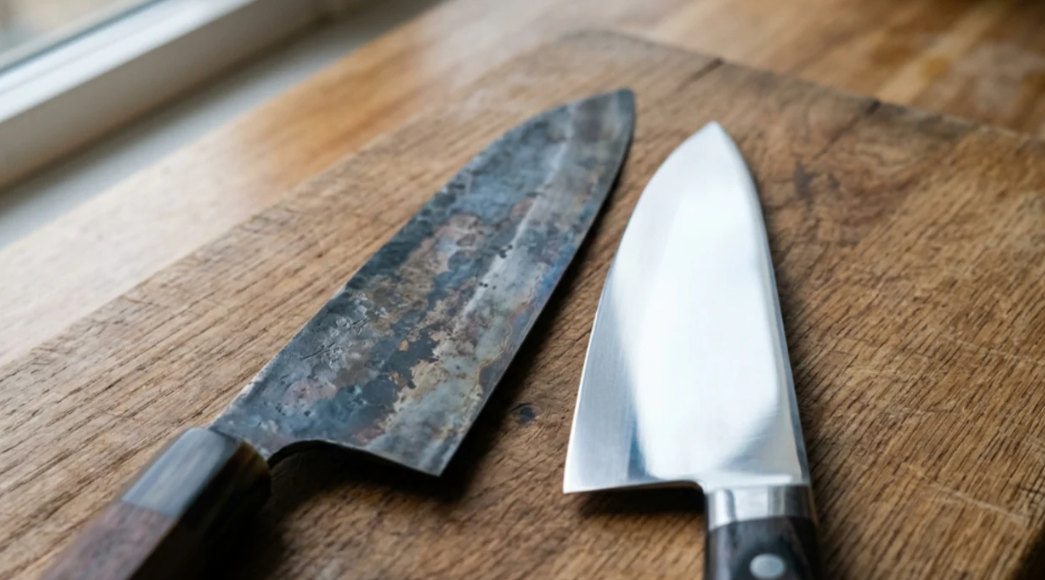
It responds immediately to the whetstone, develops an edge quickly, and over time builds a patina — a darkened, layered surface that forms naturally from use.
Eggs, proteins, acids, oils — each leaves a trace.
The patina that develops on a well-used carbon knife is effectively a record of everything it has cut.
Many cooks find this deeply satisfying.
The knife becomes theirs in a way that a stainless blade rarely does.
Stainless steel asks nothing of you.
Chromium in the alloy forms an invisible protective layer that resists rust without intervention.
You can set it down wet. You can leave it overnight.
It will be fine.
That reliability is genuinely valuable — particularly in professional kitchens where speed matters more than ritual, or for home cooks who want performance without the upkeep.
Carbon steel builds a relationship. Stainless steel stays out of your way.
Both are legitimate choices. They just suit different people.

2. At the Whetstone
This is where carbon steel earns its reputation.
Even on a basic whetstone, carbon steel responds quickly — biting into the abrasive, shedding material evenly, refining to a keen edge with a directness that experienced sharpeners describe as satisfying.
There’s a feedback in the process: you feel the edge forming.
Harder stainless steels behave differently.
They resist the stone, require more precise angles, and demand better equipment to achieve the same level of refinement.
The margin for error is narrower.
This is not an argument against stainless. It’s an argument for knowing what you’re signing up for.
If sharpening is something you enjoy — a meditative practice at the end of a cooking session — carbon steel will reward you.
If sharpening is maintenance you’d rather minimize, a well-made stainless knife, kept in reasonable shape, will serve you well for years.
3. Sharpness, Edge Retention, and What “Sharp” Actually Means
Carbon steel tends to produce what knife users call bite — an edge that grips the surface of food before cutting through it.
For slippery ingredients — tomato skin, fish skin, the waxy surface of a bell pepper — that grip is exactly what you want.
Finer-grained steels, including some stainless alloys, produce a different quality of sharpness:
Smoother, more gliding. Less grip, more separation.
In delicate work — thin-slicing fish for sashimi, paper-thin vegetable cuts — this can actually preserve texture and flavor better than an aggressive edge.
Edge retention follows a similar logic.
In traditional carbon steels, higher carbon generally means longer edge life.
But in stainless, fine grain structure can compensate for lower hardness — some stainless knives hold a working edge surprisingly well, even if re-sharpening requires more effort when the time comes.
The honest answer:
Both can be exceptionally sharp.
The difference is in character, not capability.
4. The Rust Question — More Nuanced Than It Sounds
Carbon steel rusts visibly and predictably.
Surface oxidation, easily spotted, easily addressed — a light pass with a rust eraser or fine abrasive, and you’re back to clean steel.
With a developed patina, even this becomes rare; the patina itself acts as a partial barrier against further corrosion.
Stainless steel is more resistant — but not immune.
When its protective chromium layer is compromised by salt, prolonged moisture, or improper sharpening technique, stainless can develop pitting corrosion:
Small, deep rust spots that penetrate the steel rather than sitting on its surface.
These are harder to remove and, left untreated, more damaging.
The practical takeaway:
Carbon steel demands consistent daily care. Stainless demands less frequent but more attentive intervention when something does go wrong.
Neither is truly low-maintenance.
They just require different kinds of attention.
So, Which Do You Choose?
Choose carbon steel if:
You want a knife that sharpens easily, develops character over time, and rewards the habit of care.
You enjoy the process — the wiping, the oiling, the occasional touch-up at the stone.
You want a knife that feels like it belongs to you.
Choose stainless steel if:
You want performance without ritual.
You cook in conditions where stopping to wipe and dry isn’t always realistic.
You want a knife that’s ready when you are, without negotiation.
Japanese knife culture has never insisted on one answer.
What it has always insisted on is this:
Know what you’re choosing, and choose it deliberately.
A carbon steel knife neglected is a disappointment. A stainless knife maintained with care is a pleasure.
The steel doesn’t make the cook. But the right steel, chosen honestly, makes the cooking better.
메타데이터
- post_id
- 9bcbee15715e
- slug
- carbon-steel-vs-stainless-steel-9bcbee15715e
- url
- https://medium.com/@torui/carbon-steel-vs-stainless-steel-9bcbee15715e
- canonical_url
- https://medium.com/@torui/carbon-steel-vs-stainless-steel-9bcbee15715e
- author_url
- https://medium.com/@torui
- status
- ok
- fetched_at
- 2026-06-10 08:17:25





