If AI Disappeared Tomorrow, Most of These Problems Would Still Exist
We’ve played these games before.
If AI Disappeared Tomorrow, Most of These Problems Would Still Exist
We’ve played these games before.
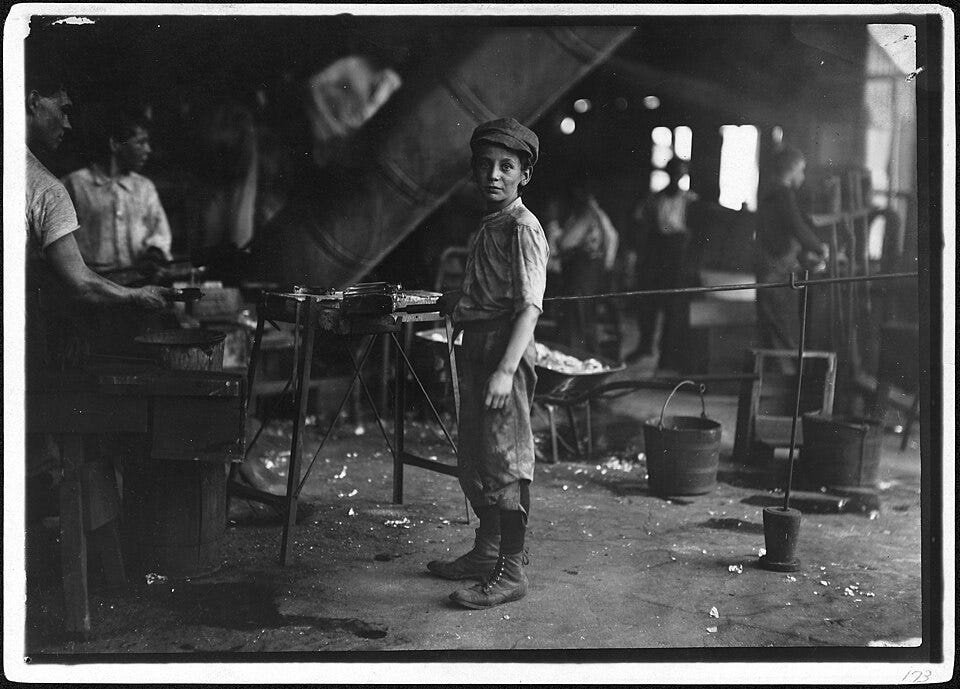
Rob Kidd working in an Indiana glass factory in 1908. More than a century before AI, industrial technologies were already transforming jobs, production, and working conditions. (Image by Lewis Hine, from Wikimedia Commons | Public domain image courtesy of the U.S. National Archives and Records Administration — NAID 523439)
I don’t really think that AI is turning the Corporate world towards evil. I think “evil” is the wrong word, and honestly, “turning” is also the wrong word. I also don’t think AI is the reason corporations are doing mass layoffs, reducing salaries, suspending raises, cutting benefits, or trying to squeeze more work out of fewer people.
I’m not kidding. I usually make jokes, but this isn’t one of them.
Corporations are only playing a game that has existed for a very long time, and that game is called capitalism.
Before anybody starts preparing a response accusing me of either defending capitalism or plotting its destruction, relax. This article isn’t really about whether capitalism is good or bad.
What interests me more is how quickly people have started talking about AI as though it suddenly introduced a new steroid and anti-biotic jacked breed of greed into the world. It didn’t.
Trust me, we’ve seen this before
The pursuit of profit was here long before AI. The search for efficiency was here long before AI. Cost-cutting, labor-saving technologies, automation, outsourcing, and every other method businesses have used to increase productivity have existed for generations. The only thing that changed is the technology currently sitting at the center of the discussion.
I don’t really know why people quickly forget that we’ve been here before. Every generation seems convinced that it is witnessing a completely unprecedented transformation of all transformations. Sometimes that’s true. Most of the time it isn’t. The names change, the machines change, the industries change, but the underlying contradiction often remains familiar.
Wait a minute. I understand the temptation. Nobody wants to be the person saying, “I’ve played these games before,” a la Squid Game’s Player 456, while a shiny new technology is busy rewriting industries and generating headlines. It’s much more exciting to believe that history has finally decided to throw away the script and improvise.
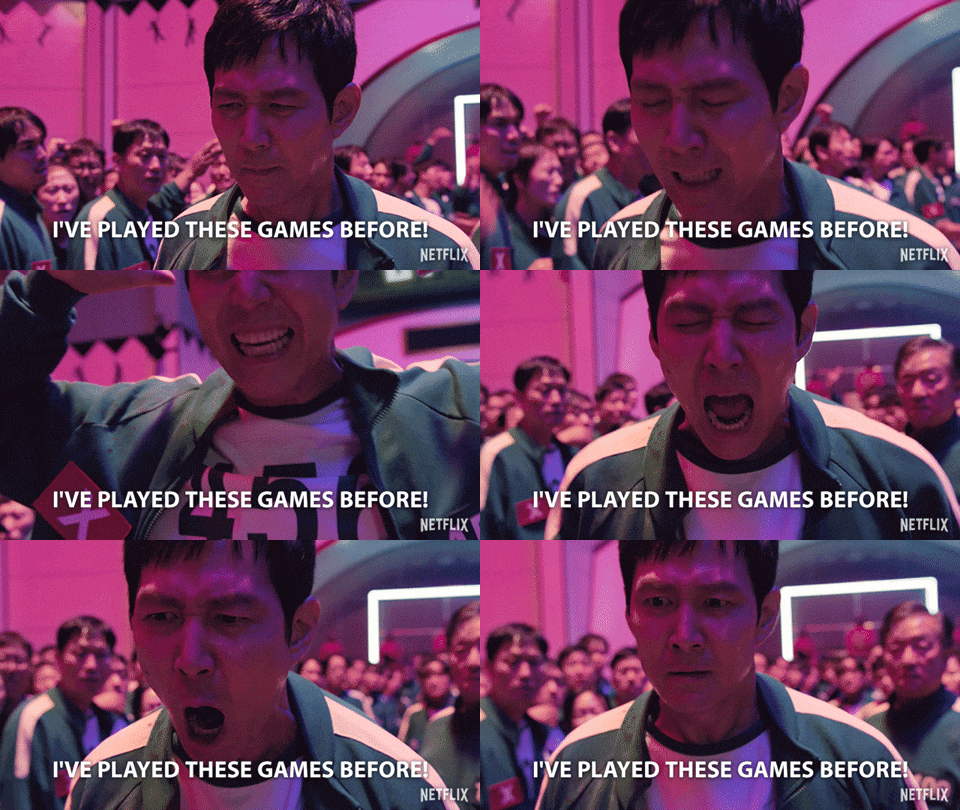
(GIF by NETFLIX, from GIPHY)
I don’t think history simply repeats itself. The world is not stuck in some cosmic copy-paste machine. It moves forward. But it often moves forward in a spiral, which means that every so often we find ourselves staring at a familiar problem from a different angle. The technology changes, the scale changes, and the consequences change, but the arguments often sound familiar.
Today it’s AI. Twenty years ago, people were worried about outsourcing. Before that it was software. Before that it was industrial automation. Before that it was mechanized manufacturing. If you go back far enough, you’ll find people having arguments that sound similar to the ones we are having now.
I ain’t putting a freaking halo on AI. It will create real disruptions and real problems. I just don’t think it invented the pressures that people are blaming it for.
Rage against the machine
The Industrial Revolution dramatically increased productivity while creating working conditions that could be absolutely brutal both to man and nature. Mechanization displaced workers and transformed entire industries. The automobile revolutionized transportation while helping redesign cities around cars. The internet connected billions of people while also creating entirely new problems involving surveillance, misinformation, and digital addiction.
Technology has always had a habit of solving one set of problems while introducing another. AI appears to be following a very old pattern.
The reason I bring this up is because a lot of current discussion treats AI as though it is the central actor in the story. A company announces layoffs, and boom! AI! A corporation freezes hiring, AI! Somebody loses freelance work, AI! Sometimes the discussion starts sounding as if executives, investors, shareholders, and managers have all become passive spectators while a machine takes control of events.
I don’t think that’s what’s happening. The machine is real. The incentives are obviously freaking real too. The problem is that people keep talking about one while largely ignoring the other.
A good example is the way people often talk about the Luddites. Most people know them as workers who smashed machines during the early stages of industrialization. The popular version of the story portrays them as backward people who hated technology and tried to stop progress. It’s a convenient interpretation because it allows everyone to laugh at them from a safe historical distance.
But hear me out.
Many of those workers understood exactly what was happening. They saw new machinery changing the relationship between workers, employers, wages, and production. They knew that technological progress did not automatically mean everybody would benefit equally from it. Obviously, that’s why they “raged against the machine.” Most of them were reacting to genuine economic pressures rather than simply being afraid of machines or being “contra-progress.”
I don’t agree with the caption, but this is a cute drawing (Image by tamingtheaibeast.org, from Wikimedia Commons)
The problem was that destroying machines did not remove the forces that encouraged people to build and adopt those machines in the first place.
Now imagine two competing factories.
One invests heavily in new machinery, increases output, lowers costs, and becomes more productive. The other decides not to. Maybe the owner of the second factory genuinely believes preserving jobs is more important than squeezing every possible efficiency out of the business. Maybe he believes loyalty matters. Maybe it is against his principles both political or religious, to give more consideration to his workers. Maybe he thinks workers should not be treated as disposable line items on a spreadsheet.
Those are admirable beliefs, but eventually, both factories still have to compete in the same market.
If one factory can produce the same product more cheaply, that difference eventually starts affecting everyone involved. Investors start paying attention. Customers compare prices. Suppliers make decisions. Banks evaluate risk. Competitors respond. Nobody needs to gather in a smoke-filled boiler room and plot the destruction of workers for these pressures to exist. They emerge naturally from the incentives built into the system itself.
This is one reason I think discussions about capitalism often become trapped in questions of morality. People imagine the system as a collection of good people and bad people making good or bad choices. Greed certainly exists. There are executives who deserve criticism, corporations that deserve scrutiny, and investors who would probably sell their grandmother if the quarterly returns looked attractive enough.
But greed alone has never fully explained what we are looking at. If greed were the entire explanation, the solution would be relatively simple: “Good people would make better decisions and the problem would gradually disappear” kind of thing. History suggests the situation is waaaaaaay more complicated than that.
What we often see instead are individuals responding to incentives that existed before they arrived and will continue to exist after they leave. Companies compete against other companies. Investors seek returns. Firms search for efficiencies. Managers are judged on performance.
Businesses that fail to adapt to major economic changes often disappear and get replaced by those that do. Sometimes people willingly embrace those pressures. Sometimes they hate them. Either way, they still have to deal with them.
(GIF from GIPHY)
This is why I keep coming back to Capital. It moves across borders, reorganizes industries, destroys some professions, creates others, and constantly seeks opportunities for expansion. Entire governments spend enormous amounts of time trying to attract it, regulate it, redirect it, or shield themselves from its effects.
Most ordinary people don’t encounter capital as an abstract economic concept. They encounter it through consequences. A factory closes, and an entire town starts shrinking. A company relocates production, and a profession that supported thousands of families slowly disappears.
A new technology arrives, some jobs vanish, others emerge, and twenty years later, people are still arguing about whether the change was inevitable or whether somebody should have intervened or whether the people should have stood their ground against it. By then, the economy has usually moved on to the next disruption.
From that perspective, I can say that for me, AI is not a revolutionary break from history. It is more like the newest chapter in a very old story. A significant chapter, perhaps even one of the most significant in recent decades, but still part of a process that began long before anybody had heard of Silicon Valley’s latest promises.
This is also why I think framing AI as a kind of technological Antichrist is ultimately unhelpful. Even if every AI company vanished tomorrow, the underlying pressures would remain. Corporations would still pursue profit. Investors would still seek returns. Managers would still search for efficiencies. A different technology would eventually emerge, and many of the same arguments would begin all over again because the incentives that drive those decisions would still be there.
Beyond good and evil
Whether AI is good or evil was never the primary question. The question we need to focus on is who benefits from the productivity it creates, who bears the costs of the disruption it causes, and who ultimately controls the technology once the hype and momentum die down and the real benefits and consequences rain down on the world.
At least to me, that seems like a more useful conversation than pretending the machine itself is the main character. But I don’t want to carve my words into stone. Maybe in the future, machines will be “characters” in the same way that we, as sentient living beings, are. But that doesn’t really knock me off course, with my brain more fixated on the system in which all of us are submerged.
Yes, I may yap again and again about systems, and about how I don’t really like talking about good and evil when it comes to this. But I would like to say that this does not mean that if some agent, let’s say a CEO, really does mess the shit out of his employees, he is not liable for his actions. We are going to enter a bloody determinism-versus-free-will kind of discussion there, and that may be for another time.
Disclaimer: Before anyone starts sharpening pitchforks, no, this isn’t an AI defense piece. I’m just talking about how we’re blaming the machine for problems that existed before the machine showed up.
메타데이터
- post_id
- 9bdc840ab86a
- slug
- if-ai-disappeared-tomorrow-most-of-these-problems-would-still-exist-9bdc840ab86a
- url
- https://medium.com/ai-ai-oh/if-ai-disappeared-tomorrow-most-of-these-problems-would-still-exist-9bdc840ab86a
- canonical_url
- https://medium.com/ai-ai-oh/if-ai-disappeared-tomorrow-most-of-these-problems-would-still-exist-9bdc840ab86a
- author_url
- https://medium.com/@BlackPigrolac
- status
- ok
- fetched_at
- 2026-06-10 08:17:25