The Great AI Data Heist Nobody Wants to Talk About
The models didn’t build themselves. You did — and nobody asked.
The Great AI Data Heist Nobody Wants to Talk About
The models didn’t build themselves. You did — and nobody asked.

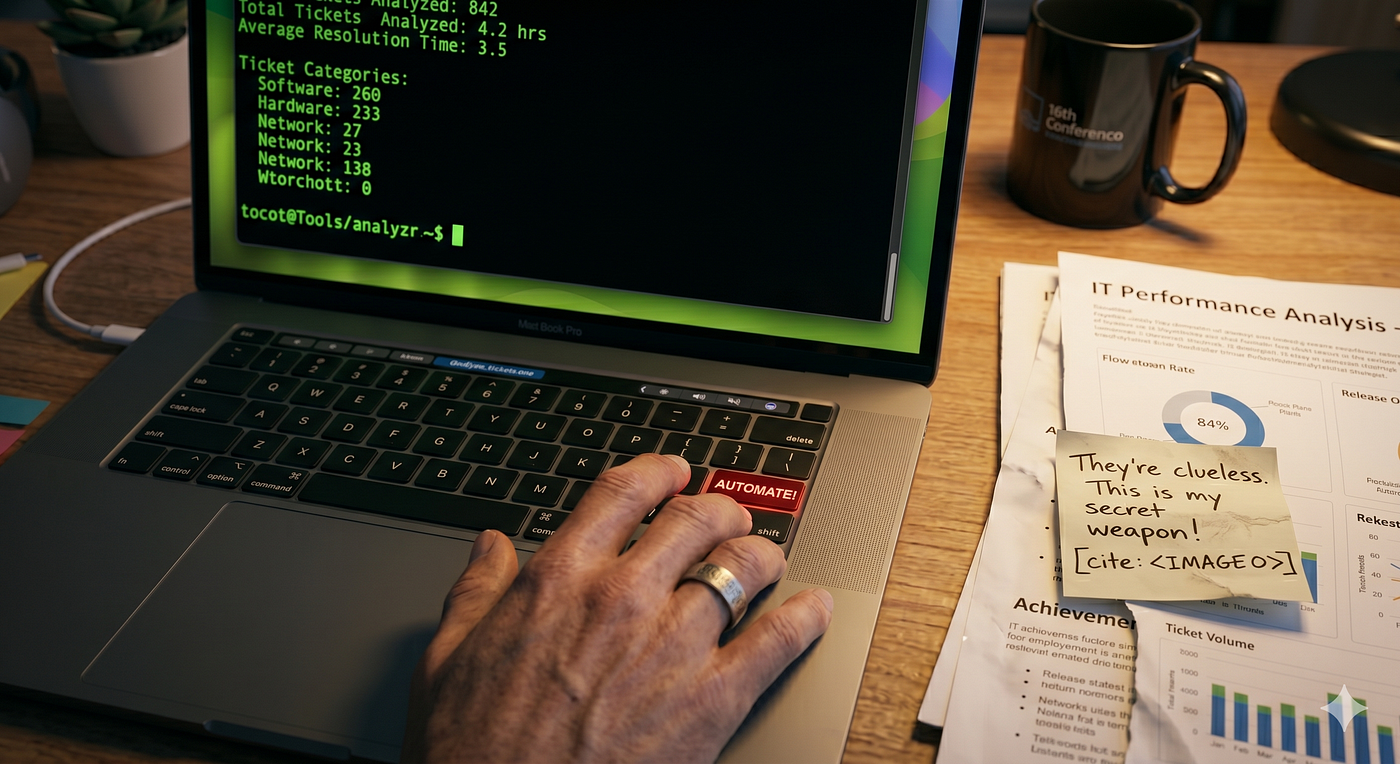
✨ AI Prompt: Photorealistic hands pulling glowing strands of code from a server rack, dark background, cold blue-gold tones, cinematic lighting, high detail
Sam Altman expressed “so much gratitude” to the developers who wrote the foundational code, character by character, that made modern AI possible.
“A thank you note to the people you just robbed.”
Years of work shared on GitHub and Stack Overflow — problems solved, patterns documented, answers posted for free to help strangers — were scraped, ingested, and used as training data. No opt-in. No compensation. No conversation.
The developers who built that foundation are now competing against the very tools trained on their work. Thousands are struggling to find employment as the systems built on their own code are used to replace their roles in the workforce.
Altman’s gratitude isn’t wrong. It’s just missing the part that matters.
The distinction isn’t between useful and not useful. It’s between a tool and a thank you note to the people you just robbed.
Brain Rape, Industrial Scale
[embed]Silicon Valley — Brain Rape scene
There’s a scene in Silicon Valley where Richard Hendricks walks into what he thinks is a VC meeting. It’s not. The “investors” are engineers from a competing company. They steer him away from go-to-market questions, keep him in the technical weeds, and get him to nearly whiteboard the core logic of his proprietary algorithm on their behalf.
Erlich pulls him out of the room. Too late.
That’s AI’s origin story — just without the dramatic exit.
- AI companies crawled the web at scale — once primarily, then periodically — ingesting the internet’s collective output
- Code repositories, creative portfolios, published research, news archives, forum posts — all consumed as training data
- Nobody asked the people who created it
- The legal fights are just getting started: Reddit vs. Perplexity, NYT vs. OpenAI, Getty vs. Stability AI — and the list is growing
The meeting was never due diligence. It was extraction.
The difference between that Silicon Valley scene and AI training? Scale. And deniability. When one company extracts your algorithm in a meeting room, it’s corporate espionage. When a hundred companies scrape your life’s work at web scale, it’s called “training data.”
It’s Not Just Code

✨ AI Prompt: funnel of human creative domains — art, music, code, writing, law, medicine — converging into a single AI model, symbolic illustration, dark background, high contrast, digital art style
This isn’t a developer problem. It’s a creator problem.
The same extraction applies across every domain where human expertise left a digital footprint:

Every domain where humans externalized their expertise digitally — that expertise became someone else’s product.
The model didn’t learn to paint. It learned from painters.
The artist who says AI “stole my style” and the developer whose Stack Overflow answers ended up in an LLM are making the exact same argument. They’re both right. The format of the complaint differs. The underlying injury is identical.
The Claude Code Irony
[embed]Claude code is 98% not AI — Parthknowsai
Researchers analyzed 500,000 lines of leaked Claude Code source code. The finding was stark.
The actual AI decision-making logic: 1.6% of the entire codebase.
The remaining 98.4% is human-engineered infrastructure:
- Seven permission modes checking whether an action is even allowed before the model can proceed
- A five-layer conversation compression pipeline to prevent context loss mid-task
- 54 distinct execution tools handling the actual command execution
- Multiple recovery systems for when things break along the way
The AI itself sits inside a while loop. It receives context, calls a tool, returns output. It’s the consultant in the room — fast, capable, occasionally confidently wrong. The harness surrounding it is what makes it functional, safe, and production-ready.
The intelligence is 2%. The infrastructure holding it together? That’s all human.
This isn’t a coincidence or a quirk of Anthropic’s implementation. It’s the pattern.
Until real AGI arrives, every serious AI deployment will look like this: a probabilistic engine wrapped in deterministic guardrails, supervised by someone who understands what “done” looks like. The models from OpenAI, Google, and Anthropic are converging on similar capability levels. The differentiator was never the model.
It’s the pipeline. The orchestration. The human in the loop.
This is what I argued in *The AI Free Lunch Is Over — And the Bill Is Steep*: the orchestrators win. Not because they’re smarter than the model — but because they know when to trust it, when to override it, and when to pull it out of the room before it gives away the algorithm.
Claude Code itself — the tool that sparked a user revolt when Anthropic tried to quietly remove it from the $20/month plan — is proof. Strip the human-engineered harness, and what’s left is a while loop with a subscription price tag.
The Silver Lining (Linus Was Right)
[embed]Linus Torvalds about Vibe codeing — manishsir7417
Linus Torvalds doesn’t use AI for kernel development. His reasoning is precise: the Linux kernel is “insular and different enough” that vibe coding isn’t practical for it. Each problem is effectively unique. Insufficient historical training data means there’s nothing solid to pattern-match against. When a codebase is that specialized, AI can’t substitute for the architectural reasoning of a human maintainer.
But he frames AI the way he frames compilers.
Compilers didn’t kill programmers. They freed them from writing assembly by hand. Productivity exploded — and so did the complexity of what programmers were expected to build. The bar rose. The demand for human judgment rose with it.
“AI is here to handle the minutia. Not to be the architect.”
His gut: the industry will still require the same level of human maintainers. AI writes code faster. Maintaining, debugging, and evolving that code still requires someone who understands what they’re looking at — someone who can spot when the model’s output is structurally sound but contextually wrong.
The people whose work was scraped — whose expertise was ingested without consent — aren’t obsolete. They are, in every functional AI deployment, the harness. They understand what “done” looks like, they catch the confident mistakes, and they own the quality gate.
The giants whose shoulders AI stands on aren’t gone.
They’re just waiting to send the invoice.
메타데이터
- post_id
- 9bde34589644
- slug
- ai-data-heist-nobody-wants-to-talk-about-9bde34589644
- url
- https://medium.com/@5a9awneh/ai-data-heist-nobody-wants-to-talk-about-9bde34589644
- canonical_url
- https://medium.com/@5a9awneh/ai-data-heist-nobody-wants-to-talk-about-9bde34589644
- author_url
- https://medium.com/@5a9awneh
- status
- ok
- fetched_at
- 2026-06-16 19:09:56