The Lost City of Giants and the Memory of a Drowned World
The Lost City of Giants and the Memory of a Drowned World
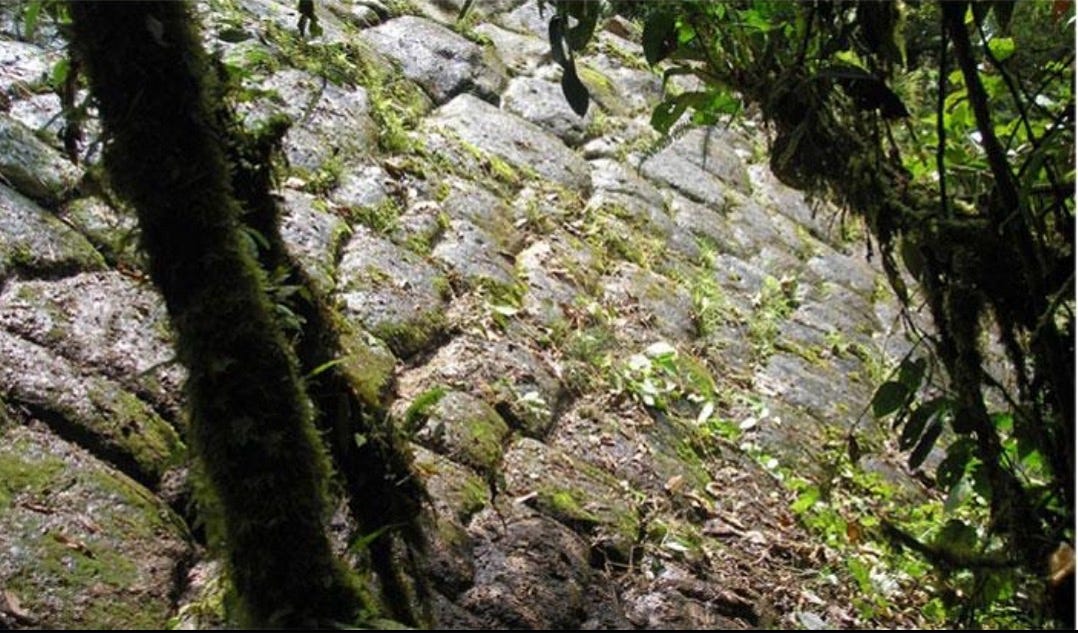
Image taken from https://www.human-resonance.org
Deep within Ecuador’s Llanganates National Park lies one of South America’s least understood mysteries.
The Llanganates are a land of clouds, rain, and endless green mountains. Dense jungle covers steep ridges. Fog drifts through valleys that have remained largely unexplored even in modern times. For centuries the region has been associated with legends of hidden treasure, lost cities, and forgotten peoples.
It was here that explorers reported the discovery of a massive stone formation unlike anything expected in such a remote location.
The structure, sometimes called the “Lost City of Giants,” consists of enormous stone blocks arranged into what appears to be a terraced formation. Rising roughly 80 meters high, its steep walls and geometric appearance immediately sparked debate. To some observers, it looked unmistakably artificial. To others, it resembled a natural formation that had been shaped by geological processes.
The mystery remains unresolved.
No definitive excavation has been conducted. No accepted dating has been produced. No consensus exists regarding who built it, when it was built, or whether it was entirely built at all.
Yet artifacts reportedly discovered near the summit suggest that humans visited the site at some point in history.
The questions remain.
Who built it?
How old is it?
And why was it built in one of the most inaccessible regions of Ecuador?
The uncertainty surrounding the site has led many researchers to search beyond archaeology and into the realm of history, folklore, and ancient memory.
There they encounter a remarkable collection of stories.
The Giants Who Came From the Sea
Long before anyone had heard of the Llanganates ruins, Indigenous peoples along Ecuador’s coast told stories about giants.
These were not modern legends invented after archaeological discoveries. They were recorded centuries ago by some of the earliest Spanish chroniclers in the Americas.
One of the most important accounts comes from Pedro Cieza de León, who traveled throughout the Andes during the sixteenth century. He recorded traditions told by Indigenous communities describing an ancient race of enormous beings who arrived from the ocean.
According to these stories, the giants came in large vessels made from reeds.
They landed on the coast of what is now Ecuador.
The newcomers were said to be immensely tall and physically powerful. They built structures, dug wells, and established settlements. Their arrival was remembered as a dramatic event unlike anything local populations had witnessed before.
Other chroniclers recorded similar traditions.
The stories vary in their details, but several themes appear repeatedly:
The giants came from the sea.
They were larger than ordinary humans.
They possessed unusual capabilities.
Their civilization eventually disappeared.
In many versions they were destroyed by divine punishment, often described as fire descending from the heavens.
Whether these stories describe actual people, mythological beings, or symbolic memories of some forgotten event remains unknown.
What makes them fascinating is not that they prove giants existed.
They do not.
What makes them fascinating is that they preserve a consistent memory: strangers arriving from the ocean long before recorded history.
A World Before the Flood
Today, when we look west from Ecuador, we see only open ocean stretching toward the horizon.
But the world looked very different during the Ice Age.
Twenty thousand years ago, enormous ice sheets covered much of North America and Eurasia. So much water was locked away in glaciers that sea levels around the world were dramatically lower than they are today.
The oceans stood roughly 120 meters lower than modern levels.
Entire coastlines that are now submerged were exposed.
Large areas of continental shelf became dry land.
Around the world, islands grew larger.
The Galápagos Islands, located approximately 1,000 kilometers west of Ecuador, would have expanded significantly. Islands separated today by water may have been connected by broad plains or narrow land bridges. Habitable areas would have increased. Freshwater catchments would have expanded.
The archipelago would not have been connected to South America. The ocean between them remained vast.
Yet the islands would have represented a much larger and potentially more hospitable environment than they do today.
As glaciers melted and sea levels rose, coastlines around the world disappeared beneath advancing waters.
Entire landscapes vanished.
Rivers changed course.
Habitats disappeared.
Human populations everywhere were forced to adapt.
For many ancient peoples, rising seas would have transformed familiar homelands into memories.
The Possibility of Cultural Memory
Could stories of arrivals from the sea preserve memories reaching back thousands of years?
The idea is controversial but not impossible.
Many Indigenous cultures preserve oral traditions that describe events later confirmed by geology.
Australian Aboriginal stories appear to remember coastlines that existed thousands of years ago.
Pacific Island traditions describe volcanic eruptions and floods that modern science has verified.
Native American traditions preserve memories of environmental changes dating back many generations.
Human societies are capable of carrying stories across remarkable spans of time.
The details change.
The symbolism evolves.
Yet a core memory sometimes survives.
If ancient populations once inhabited larger islands or coastal regions that were later flooded, it is conceivable that memories of migration could survive in oral traditions.
Over thousands of years, settlers become ancestors.
Ancestors become heroes.
Heroes become giants.
Eventually history becomes mythology.
The Reed Boats
One detail in the Ecuadorian giant stories stands out.
The giants reportedly arrived in vessels made from reeds.
This is not as strange as it might first appear.
Reed boats have a long history around the world.
Ancient peoples used them on lakes, rivers, and coastal waters.
The famous explorer Thor Heyerdahl demonstrated that large reed vessels are capable of surprisingly long voyages. His experimental boats crossed vast stretches of ocean using ancient construction methods.
To ancient storytellers, an unfamiliar group arriving on large reed vessels could easily become the foundation of legends that endured for centuries.
Were they giants?
Perhaps not.
Could they have seemed giant-like compared to local populations?
Possibly.
Human height varies significantly between populations. A group of unusually tall visitors arriving unexpectedly might leave a lasting impression that grows with retelling.
A six-foot-six sailor can become an eight-foot giant after a thousand years of storytelling.
An extraordinary voyage can become a supernatural journey.
A foreign people can become gods.
The Ruins Reconsidered
This brings us back to the Llanganates.
The existence of giant legends does not prove that giants built the structure.
Nor does the existence of the structure prove the legends are historical.
Yet the convergence of the two is difficult to ignore.
We have:
A mysterious stone complex of uncertain origin.
Ancient traditions describing unusual visitors from the sea.
A world that looked dramatically different during the Ice Age.
A period of rising oceans that displaced populations around the globe.
And a region whose history remains only partially explored.
None of these facts prove the others.
But together they form an intriguing puzzle.
Between Myth and History
Perhaps the ruins are entirely natural.
Perhaps they were built by a previously unknown culture.
Perhaps the giant stories are purely symbolic.
Perhaps they preserve distant memories of migration, contact, or environmental change.
At present, no one knows.
What is clear is that the story of the Lost City of Giants is not really about giants.
It is about memory.
It is about how fragments of the past survive.
It is about the possibility that somewhere within myth, archaeology, and geology there may exist traces of events so ancient that their original forms have long been forgotten.
The people who first told these stories may not have been trying to preserve history.
Yet history sometimes survives anyway.
Not as dates.
Not as measurements.
But as legends.
And deep within the cloud-covered mountains of Ecuador, among stone terraces and unexplored valleys, those legends continue to whisper of a world that may once have been very different from our own.
메타데이터
- post_id
- 9bea3fdb21b3
- slug
- the-lost-city-of-giants-and-the-memory-of-a-drowned-world-9bea3fdb21b3
- url
- https://medium.com/@joshlevin10/the-lost-city-of-giants-and-the-memory-of-a-drowned-world-9bea3fdb21b3
- canonical_url
- https://medium.com/@joshlevin10/the-lost-city-of-giants-and-the-memory-of-a-drowned-world-9bea3fdb21b3
- author_url
- https://medium.com/@joshlevin10
- status
- ok
- fetched_at
- 2026-07-10 03:40:03