Best Stock Valuation Tools: Why Every Investor Should Try a DCF Calculator
The stock market in 2026 is full of opportunity, but it is also full of noise. Investors see daily headlines about artificial intelligence…
Best Stock Valuation Tools: Why Every Investor Should Try a DCF Calculator
The stock market in 2026 is full of opportunity, but it is also full of noise. Investors see daily headlines about artificial intelligence, interest rates, earnings growth, IPOs, global markets, and sector rotation. Some stocks look expensive but keep rising. Some stocks look cheap but remain weak for years. In this environment, one question becomes very important: how can an investor know whether a stock is actually worth buying?
DCF Calculator
That is where stock valuation tools become useful. A good valuation tool does not promise perfect prediction. Instead, it helps investors think clearly. It gives structure to the decision-making process. Among all valuation methods, the DCF calculator stands out because it focuses on the real foundation of business value: future cash flow.
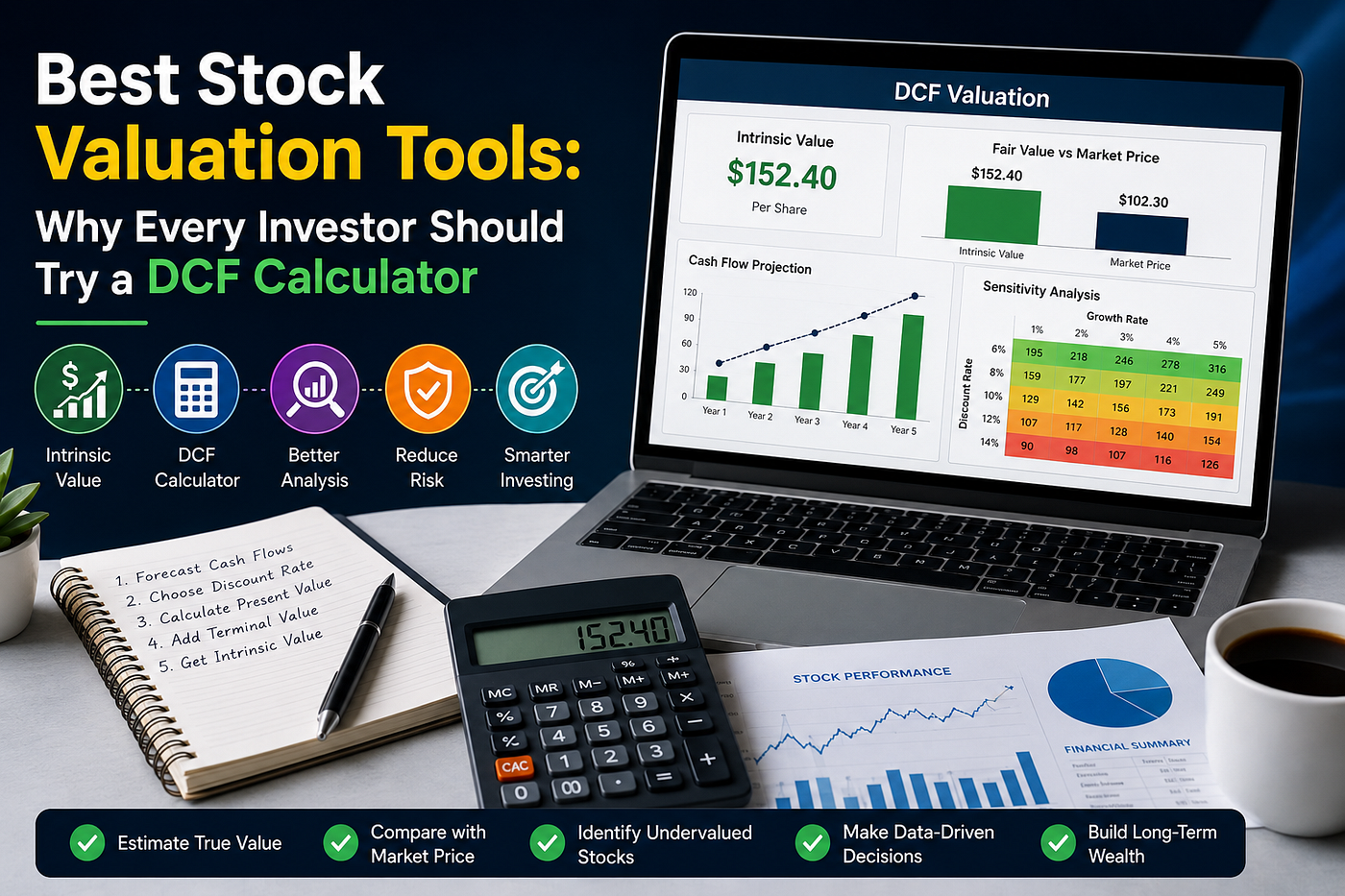
A DCF calculator, also known as a discounted cash flow calculator, helps estimate the intrinsic value of a company by discounting expected future cash flows back to today’s value. In simple words, it asks: “How much is this business worth today based on the cash it may generate in the future?” This makes it one of the most practical tools for serious investors.
In modern markets, investors often depend on price charts, social media tips, valuation ratios, analyst ratings, and news headlines. These can be useful, but they are not enough. A DCF calculator brings the investor back to the core of investing: business value, cash generation, risk, and patience.
Why Stock Valuation Tools Matter More Today
Stock valuation tools matter because markets can become emotional. When a sector is trending, prices can rise much faster than profits. When fear enters the market, even strong companies can trade below fair value. Without valuation discipline, investors may buy too late, sell too early, or hold weak companies only because the price once looked attractive.
In recent years, artificial intelligence, energy transition, semiconductor demand, cloud computing, defence spending, and financial technology have created strong investor interest. Many companies connected to these themes trade at high valuations because investors expect strong future growth. At the same time, high interest rates and changing liquidity conditions can reduce the present value of future earnings. This makes valuation more important, not less important.
A stock valuation tool helps investors compare market price with estimated fair value. It also helps them test different assumptions. For example, what happens if revenue growth slows? What happens if margins improve? What happens if the discount rate rises? These questions matter because stock investing is not only about finding good companies. It is also about buying them at sensible prices.
The best stock valuation tools help investors move from emotion to analysis. They do not remove uncertainty, but they make uncertainty visible.
What Is a DCF Calculator?
A DCF calculator is a financial tool that estimates the value of a company based on expected future cash flows. The idea is simple. Money received in the future is worth less than money received today. Therefore, future cash flows must be discounted to calculate their present value.
For example, if a business is expected to generate strong free cash flow over the next five or ten years, a DCF calculator can estimate what those cash flows are worth today. It also includes a terminal value, which represents the value of the business after the forecast period. The total of these discounted cash flows gives an estimated intrinsic value.
If the intrinsic value is higher than the current market price, the stock may be undervalued. If the intrinsic value is lower than the market price, the stock may be overvalued. However, investors should not treat the result as a final truth. A DCF result depends heavily on assumptions such as growth rate, margin, discount rate, and terminal growth.
This is why a DCF calculator is powerful. It does not just give a number. It teaches investors how valuation works.
Why Every Investor Should Try a DCF Calculator
Every investor should try a DCF calculator because it improves thinking. Even if an investor does not use DCF for every stock, the process builds discipline. It forces the investor to ask useful questions.
Is the company generating real cash flow? Can it grow that cash flow in the future? Is the current price already reflecting too much optimism? What return does the investor need for the risk taken? How much safety margin exists between fair value and market price?
These questions protect investors from hype. A company can have a popular brand, strong revenue growth, and exciting future potential, but still be a poor investment if the stock price is too high. Similarly, a boring company with stable cash flow can become attractive if the market price is low enough.
A DCF calculator helps investors understand this difference. It makes investing more business-focused and less price-focused.
DCF Calculator vs Simple Valuation Ratios
Many investors use simple valuation ratios like P/E ratio, P/B ratio, EV/EBITDA, dividend yield, and price-to-sales ratio. These tools are useful because they are quick and easy. However, they have limits.
The P/E ratio compares stock price with earnings. It can help investors see whether a company looks expensive or cheap compared with its own history or peers. But earnings can be affected by accounting rules, one-time gains, non-cash expenses, and business cycles. A low P/E stock is not always undervalued. A high P/E stock is not always overvalued.
The price-to-sales ratio is often used for growth companies, especially when profits are low or negative. However, sales alone do not create shareholder value. A company must eventually convert sales into cash flow.
EV/EBITDA is useful for comparing companies with different capital structures, but it still does not fully capture capital expenditure needs, working capital changes, and long-term reinvestment.
A DCF calculator goes deeper. It focuses on free cash flow and discounts future value to the present. This makes it more complete, especially for long-term investors. However, it also requires better assumptions. That is why DCF should work with other valuation tools, not replace them entirely.
The Role of Free Cash Flow in Stock Valuation
Free cash flow is one of the most important numbers in investing. It shows how much cash a business generates after spending money needed to maintain and grow operations. A company with strong free cash flow has more flexibility. It can repay debt, pay dividends, buy back shares, invest in growth, or survive difficult periods.
A DCF calculator depends heavily on free cash flow because cash flow is the economic engine of valuation. Revenue growth is good, but it must convert into cash. Profit growth is good, but it must be supported by real business strength. Free cash flow gives investors a clearer view of quality.
For example, a company may report strong earnings, but if it needs heavy capital expenditure every year, its free cash flow may remain weak. Another company may grow slowly but generate steady cash, making it valuable for long-term investors. A DCF calculator helps compare these realities.
In a market where many companies invest heavily in technology, AI infrastructure, cloud systems, and expansion, free cash flow becomes even more important. Investors need to know whether growth is creating value or consuming too much cash.
Why Intrinsic Value Is Different from Market Price
Market price is what investors are willing to pay today. Intrinsic value is what a business may be worth based on its future cash flows. These two numbers are often different.
Market price changes every trading day. It reacts to news, sentiment, liquidity, earnings surprises, geopolitical events, interest rates, and investor psychology. Intrinsic value changes more slowly because it depends on the long-term ability of the business to generate cash.
This difference creates opportunity. When market price falls below intrinsic value, investors may get a chance to buy quality assets at attractive prices. When market price rises far above intrinsic value, investors may need caution.
A DCF calculator helps investors identify this gap. It gives a structured estimate of fair value. It also helps investors avoid buying only because a stock is popular or selling only because a stock is temporarily weak.
How Discount Rate Affects Valuation
The discount rate is one of the most important inputs in a DCF calculator. It reflects the required return investors expect for taking risk. A higher discount rate reduces the present value of future cash flows. A lower discount rate increases the present value.
This is why interest rates matter so much for stock valuation. When risk-free rates rise, investors often demand higher returns from stocks. This can reduce fair value, especially for companies whose expected cash flows are far in the future. Growth stocks are often more sensitive to discount rate changes because much of their value depends on future earnings.
For stable companies with near-term cash flow, the impact may be smaller. For early-stage or high-growth companies, the impact can be large. A DCF calculator helps investors test this sensitivity.
For example, a stock may look undervalued at an 8% discount rate but overvalued at a 12% discount rate. This does not mean the calculator is wrong. It means the investor must understand the risk.
Terminal Value: The Hidden Driver of DCF Valuation
Terminal value is the estimated value of a business beyond the forecast period. In many DCF models, terminal value can form a large part of the final valuation. This makes it very important.
Investors often forecast cash flows for five or ten years. But a strong business may continue operating far beyond that period. The terminal value captures this continuing value. It is usually calculated using a long-term growth rate or an exit multiple.
However, terminal value can also create mistakes. If the investor uses an unrealistic long-term growth rate, the valuation can become too high. A company cannot grow faster than the economy forever. Therefore, terminal growth assumptions should remain realistic.
A DCF calculator helps investors see how much of the valuation depends on terminal value. This is useful because it shows whether the stock’s fair value depends on near-term cash flow or very optimistic long-term assumptions.
DCF Calculator for Growth Stocks
Growth stocks often attract investors because they promise future expansion. These companies may operate in technology, AI, electric vehicles, cloud software, healthcare innovation, or digital platforms. However, growth alone is not enough. The key question is whether growth will eventually produce strong free cash flow.
A DCF calculator is useful for growth stocks because it allows investors to model future scenarios. The investor can estimate revenue growth, margin improvement, reinvestment needs, and long-term cash flow conversion.
However, growth stock valuation requires caution. Small changes in assumptions can create large changes in fair value. If the investor assumes very high growth for too many years, the model may produce an unrealistic valuation. If the investor is too conservative, the model may ignore real potential.
The best approach is to create multiple scenarios. A base case, optimistic case, and conservative case can give a better valuation range. This helps investors avoid false precision.
DCF Calculator for Dividend Stocks
Dividend stocks are often easier to value than early-stage growth companies because they may have stable earnings and cash flows. A DCF calculator can help investors estimate whether the current stock price is justified by future cash generation.
For dividend investors, DCF analysis is useful because dividends must come from cash flow. A high dividend yield can look attractive, but if free cash flow is weak, the dividend may not be sustainable. A DCF calculator helps investors focus on the company’s ability to generate long-term cash.
Dividend stocks in sectors like utilities, consumer staples, energy, banking, and infrastructure may suit DCF valuation because their cash flows can be more predictable. However, investors still need to consider debt, regulation, commodity prices, and business cycles.
DCF Calculator for IPO Investing
IPO investing is exciting, but it can be risky. New listings often attract attention because of growth stories, media coverage, and investor excitement. However, IPO stocks may not have long public market histories. This makes valuation harder.
A DCF calculator can help IPO investors think more clearly. Instead of buying only because demand is high, investors can estimate future cash flows and compare them with the IPO valuation. This can reveal whether the company needs very strong growth to justify its price.
For IPOs, assumptions must be conservative. Investors should study revenue quality, profitability path, customer concentration, industry growth, and capital needs. A DCF calculator cannot remove IPO risk, but it can reduce emotional decision-making.
DCF Calculator for Long-Term Investors
Long-term investors benefit greatly from DCF analysis because it matches their investment horizon. Short-term traders may focus on price action, momentum, and market timing. Long-term investors need to understand business value.
A DCF calculator supports long-term thinking. It shows whether today’s price makes sense based on future cash flows. It also helps investors stay calm during volatility. If the company’s intrinsic value remains strong, a temporary price fall may become an opportunity. If the company’s valuation is stretched, a rising price may require caution.
Long-term investors should not use DCF as a one-time exercise. They should update assumptions when business conditions change. Earnings results, margin trends, debt levels, capital expenditure, industry growth, and interest rates can all affect valuation.
Best Stock Valuation Tools Investors Can Use
The best stock valuation process uses more than one tool. A DCF calculator is powerful, but it becomes even more useful when combined with other tools.
Investors can use financial statement analysis to understand revenue, profit, debt, margins, and cash flow. They can use ratio analysis to compare valuation with peers. They can use technical analysis to study price trends and entry zones. They can use portfolio tools to manage risk and allocation. They can use macro indicators to understand interest rates, inflation, and liquidity.
However, the DCF calculator remains central because it connects all these factors to fair value. It turns business assumptions into a valuation estimate. This makes it one of the most important tools for investors who want to think independently.
Why DCF Helps Investors Avoid Overpaying
Overpaying is one of the biggest risks in investing. Even a great company can produce poor returns if bought at an extremely high price. A DCF calculator helps investors understand what expectations are already built into the stock price.
For example, if a stock trades far above estimated fair value, the market may already expect rapid growth, high margins, and low risk. If the company fails to meet those expectations, the stock can fall sharply. On the other hand, if a stock trades below fair value because of temporary fear, patient investors may find opportunity.
DCF analysis creates valuation discipline. It reminds investors that price and value are not the same. This is especially important in trending markets where excitement can push prices beyond reasonable levels.
Common Mistakes Investors Make While Using DCF
The first mistake is using unrealistic growth assumptions. Many investors project high growth for too long. This can make almost any stock look undervalued.
The second mistake is ignoring capital expenditure. A business may grow revenue, but if it requires heavy reinvestment, free cash flow may remain limited.
The third mistake is choosing the wrong discount rate. If the discount rate is too low, the valuation becomes inflated. If it is too high, the valuation may become too conservative.
The fourth mistake is trusting one exact value. DCF should give a valuation range, not a perfect number. Investors should use scenario analysis.
The fifth mistake is ignoring business quality. A DCF calculator is only as useful as the assumptions behind it. Investors still need to study management, competition, balance sheet strength, industry trends, and risk.
How Beginners Can Use a DCF Calculator
Beginners should start simple. They should choose companies with stable cash flows, clear business models, and available financial data. Large companies with consistent earnings are easier to analyze than highly uncertain startups.
The investor can begin by estimating future free cash flow growth for the next five years. Then they can choose a reasonable discount rate and terminal growth rate. After calculating fair value, they can compare it with market price.
More importantly, beginners should adjust assumptions and observe how the valuation changes. This teaches the relationship between growth, risk, and fair value. Over time, this practice improves investment judgment.
A beginner should not use DCF alone for final decisions. It should be combined with business research, risk analysis, and market context.
Why DCF Is Becoming More Relevant in 2026
DCF is becoming more relevant because investors face a market where expectations are high. Many companies are priced based on future growth, especially in AI, technology, automation, energy transition, and digital infrastructure. When expectations rise, valuation discipline becomes critical.
At the same time, interest rates, inflation trends, currency movements, and global liquidity continue to affect asset prices. These factors influence discount rates and investor required returns. A DCF calculator helps connect macro conditions with stock valuation.
In 2026, investors need tools that go beyond headlines. They need tools that help them ask whether future cash flows justify current prices. That is exactly what a DCF calculator does.
DCF Calculator and Smart Investment Decisions
A smart investment decision combines quality, value, timing, and risk. A company may be high quality, but not attractively valued. A stock may be cheap, but the business may be weak. A chart may look strong, but the valuation may already be stretched.
A DCF calculator improves the value part of the decision. It does not replace judgment, but it strengthens it. It helps investors understand what they are paying for and what future performance is required to earn a good return.
When investors use DCF along with financial ratios, technical levels, earnings analysis, and risk management, they build a stronger process. This process is more reliable than depending on tips or short-term excitement.
Conclusion
The best stock valuation tools help investors make better decisions in uncertain markets. Among them, the DCF calculator remains one of the most valuable because it focuses on the real source of business value: future cash flow.
A DCF calculator helps investors estimate intrinsic value, compare it with market price, test assumptions, understand risk, and avoid overpaying. It is useful for growth stocks, dividend stocks, IPOs, long-term investing, and value investing. It also teaches investors to think like business owners rather than short-term speculators.
No calculator can predict the future perfectly. However, a DCF calculator gives investors a disciplined framework. It turns market noise into structured analysis. In a market full of trends, hype, and fast-moving prices, that discipline can make a major difference.
To analyse stock fair value more clearly, try the DCF Calculator here: https://finance.rajeevprakash.com/calculators/dcf/
메타데이터
- post_id
- 9bed25c6dabc
- slug
- best-stock-valuation-tools-why-every-investor-should-try-a-dcf-calculator-9bed25c6dabc
- url
- https://medium.com/@astroqai.ltd/best-stock-valuation-tools-why-every-investor-should-try-a-dcf-calculator-9bed25c6dabc
- canonical_url
- https://medium.com/@astroqai.ltd/best-stock-valuation-tools-why-every-investor-should-try-a-dcf-calculator-9bed25c6dabc
- author_url
- https://medium.com/@astroqai.ltd
- status
- ok
- fetched_at
- 2026-07-28 16:51:50