Paternalism Revisited
“Paternalism” means an adult acting in the capacity of a parent toward other adults. Almost uniformly, individualistic Americans have long…
Paternalism Revisited
“Paternalism” means an adult acting in the capacity of a parent toward other adults. Almost uniformly, individualistic Americans have long denounced paternalism. For example, in 1928, President Herbert Hoover specifically contrasted American “rugged individualism” as “diametrically opposed” to the “paternalistic and state socialism” found in Europe. The Great Depression would soon qualify this sentiment in a major way. Today, Americans are far less individualistic in practice than in ideology.
In certain academic circles, denouncing paternalism is one of those shallow fads that fails to grasp the unavoidable context of humanity as a social species. All social species feature individuals with different abilities, interests, ambitions, et cetera. That some adults would end up functioning as quasi-parents and others as quasi-dependents is practically inevitable. The better philosophies involving paternalism acknowledge the basic limitations regarding individual freedom within societies.
Regarding one of my earlier works about interracial friendship, a couple of critics falsely assumed that some of those relationships were paternalistic. Ironically or not, that inspired me to explore the topic much further in a lengthy article called “Problematic Paternalism.” But here I just wish to make a few personal observations.
By the way, even though they are loathe to call it paternalism, a wide spectrum of people and entities rely on the federal government for corporate bailouts, agriculture subsidies, protective tariffs, and the like. Individuals who live beyond their means sometimes look to governmental paternalism to bail them out of financial trouble, as widely occurred in the aftermath of the 2007–10 Subprime Mortgage crisis. Granted, the Subprime Mortgage crisis was a complex phenomenon involving predatory lending practices, racism, a house-flipping craze, inflated property appraisals, and many other factors — but some bailout recipients included homeowners who had voluntarily bought upscale houses they could barely afford, then subsequently benefited from federal paternalism via the 2009 Homeowners Affordability and Stability Plan. In any case, unquestionably, there are many elements of paternalism in the current political economy.
There are also entire sectors of the population in the United States who cannot or do not live without paternalism. These include military lifers, repeat offender inmates, and portions of the homeless population.
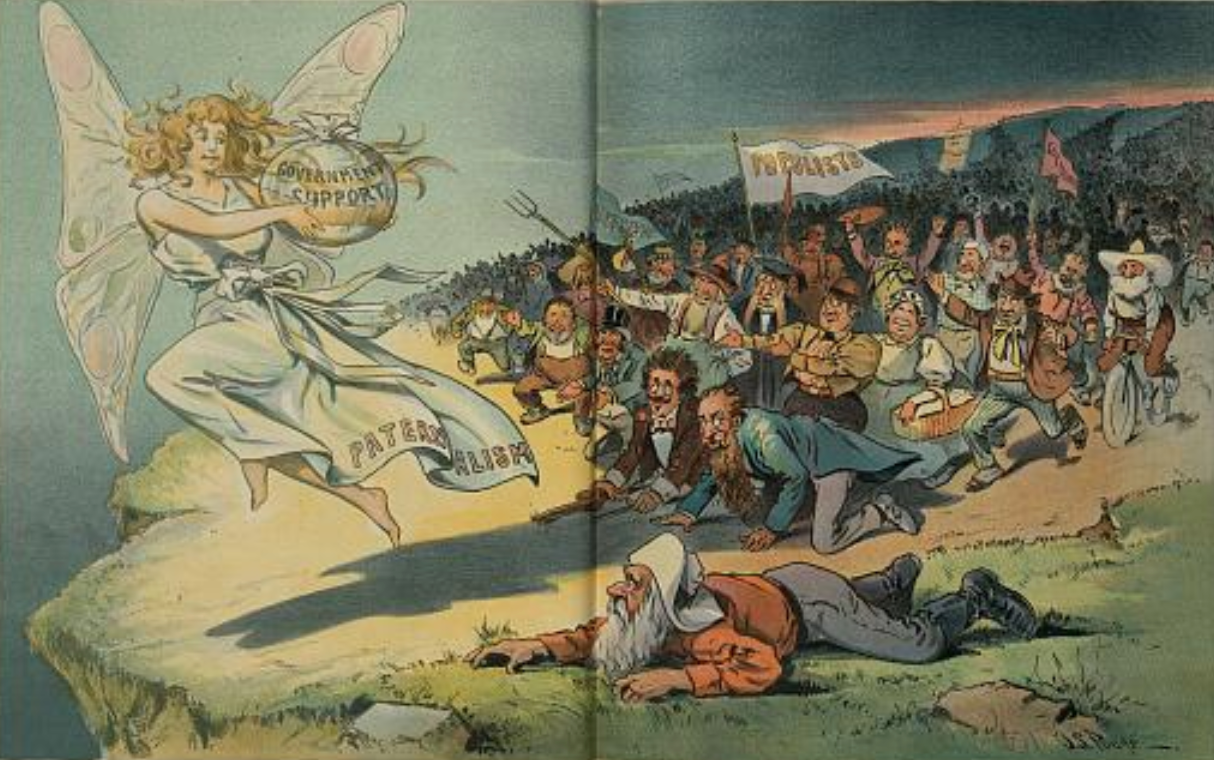
Above, an 1897 cartoon “On To The Abyss,” from the satirical magazine, Puck, depicting socialists and populists following the fairy of paternalism toward doom. Below, an 1899 cartoon from Puck entitled “Deserting the Old Idol,” here meaning William Jennings Bryan and his populist platform built in part upon paternalism. Both cartoons reflected a long and deep American distaste for paternalism going back to the nation’s founding and continuing today, at least in rhetoric. (Both images from the Library of Congress).

I’ve now lived long enough to watch the entire lives of particular individuals who never escaped their own voluntary subjugation to paternalism, mainly because the big wide world out there bewildered them. Supposedly this is now a growing problem with young people “addicted” to their screens and unable or unwilling to find jobs, attend college, learn social skills, and otherwise gain some degree of personal autonomy. The comparative few I remember from the analog age remained dependent upon family, social services, and the charity of strangers. They were homeless sometimes and only semi-functioning on the fringes of a community. Not to romanticize the Old World clan, but I used to imagine them doing better within an extended family.
One of my maternal grandfathers was a military lifer, and he often referred to the Navy as his “surrogate mother,” for he had been a homeless orphan child-laborer sleeping on the Philadelphia hosiery factory floor where he worked. He paid a price, though; by the time the Japanese attacked Pearl Harbor he was a middle-aged man in the reserves and got called back into active duty. He then had to survive some of the most horrific Pacific Theater fighting during World War II.
Military lifers sometimes compare their institutional dependence to repeat-offender inmates. My father observed this during his own U.S. Navy tour, 1941–45. He met old salts who still had H-O-L-D F-A-S-T tattooed on their eight fingers, a “superstition” related to climbing ship rigging. He also remembered that some of them, old enough to be his father, blew their entire paychecks during weekend shore leaves. At that point they would have become homeless were it not for the Navy providing them food, shelter, medicine, and clothing.
As for inmate lifers, Morgan Freeman’s character “Red” captured this sentiment perfectly in the 1994 film, Shawshank Redemption, when he spoke of prison: “These walls are funny. First you hate ’em, then you get used to ’em. After long enough, you get so you depend on ’em.”
One of my high school classmates led such a life; in and out of incarceration until ill health from chronic alcohol abuse killed him at the young age 54. The county jailers all knew him, generally liked him, and regularly made him a trusty. He was amiable and passive when locked up. Outside, he could not hold a steady job and his daily plans never seemed to go beyond finding enough money to buy that night’s worth of alcohol. It always struck me as a tragic life that might have benefited from the right kind of paternalism. Perhaps he would have fared better had he grown up in China.
Among the most ancient political concepts in China is the idea of a ruler having moral responsibility to and for the people. We could call this “Confucian paternalism.” An early example comes from the 5th century BCE treatise, Doctrine of the Mean, which includes the idea of the emperor regarding the masses as dependents. Some American academics would decry this as paternalism extraordinaire, but that would reflect the aforementioned American cultural bias. It would also reflect the fallacy of ethnomorphism. Not everyone is a fan of American-style individualism.
After World War II, many western European governments imitated the American model of anti-paternalism. Then some of them abandoned it as a failed experiment, especially when diminished social services coincided with higher incarceration rates. After that, some turned to what Dutch researchers Evelien Tonkens and Jan Willem Duyvendak called “caring paternalism.” Social workers in this context try to avoid punitive measures toward their clients’ non-conformist behavior, and instead focus on supporting or improving their clients’ quality of life. In doing so, they also acknowledge something pervasive about paternalism and our social species.
Copyright © 2026 Will Sarvis. All rights reserved.
REFERENCES
For some examples of “Confucian paternalism,” see William Theodore de Bary, et al, comps., Sources of Chinese Tradition, vol. 1 (NY: Columbia University Pr., 1960), 7, 8, 18, 87, 161–65, 174–82, 412.
The reference from the Doctrine of the Mean (or Zhoung yong) is from its chapter 21. This and tons of other ancient documents are available at the Chinese Text Project.
The Hoover quote comes from Herbert Hoover, “Rugged Individualism,” in A Documentary History of the United States, Richard D. Heffner, ed. (New American Library, 2002), 309.
For an interesting comparison of the U.S. and China, see Eric X. Li, “A Tale of Two Political Systems,” *TED Talk* (July 2013).
Evelien Tonkens and Jan Willem Duyvendak, “Paternalism — Caught Between Rejection and Acceptance: Taking Care and Taking Control in Community Work,” Community Development Journal 38 (Jan. 2003); see pages 11–15.
메타데이터
- post_id
- 9c044e169769
- slug
- paternalism-revisited-9c044e169769
- url
- https://medium.com/@willsarvis/paternalism-revisited-9c044e169769
- canonical_url
- https://medium.com/@willsarvis/paternalism-revisited-9c044e169769
- author_url
- https://medium.com/@willsarvis
- status
- ok
- fetched_at
- 2026-06-09 15:37:30