German Grammar Isn’t About Rules. It’s About How You Think.
German Grammar Isn’t About Rules. It’s About How You Think.
Why adjectives like bewusst, würdig, mächtig, and schuldig still preserve the Genitive — and what this reveals about the architecture of the German mind.
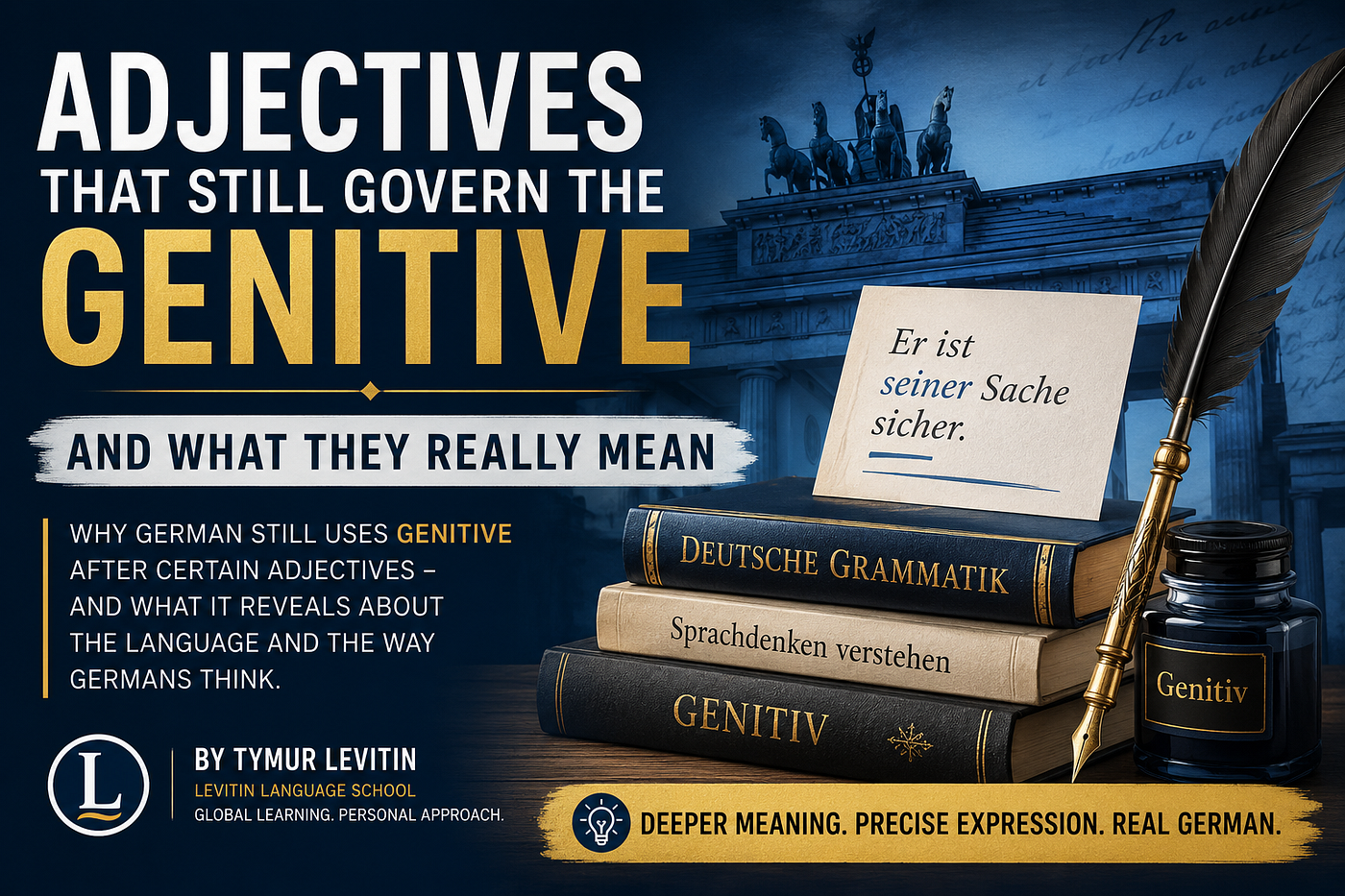
Every few years someone announces that the German genitive is dying.
And every few years real German quietly proves the opposite.
Open a novel by Thomas Mann, read a legal document, browse an academic article, or simply pay attention to educated speech, and you’ll encounter expressions like:
- der Sprache mächtig
- des Preises würdig
- der Tat schuldig
- seiner Verantwortung bewusst
These are not relics.
They are living examples of how German uses grammar to organize thought.
The genitive here is not about possession.
It is about relationship.
It tells us that an idea, a responsibility, a value, or an ability belongs to someone’s inner cognitive world.
That is exactly why learning these constructions should never be reduced to memorizing a list of adjectives.
It is much more important to understand the underlying logic.
When students recognize that bewusst, würdig, fähig, mächtig, and many similar adjectives describe internal awareness, evaluation, mastery, or essential qualities, grammar suddenly becomes meaningful.
Instead of asking:
“Which case should I use?”
they begin asking:
“What kind of relationship am I expressing?”
And that is the moment when language learning changes completely.
Real fluency begins not when you remember more rules.
It begins when your brain starts organizing reality the way the language itself does.
That idea has been at the heart of my teaching philosophy for many years.
Language is not a collection of endings.
Language is a model of thinking.
If we teach students to understand that model, they stop translating word by word and start communicating naturally.
For readers who would like to explore this topic in depth, I have prepared a complete multilingual project that includes a full analytical article, detailed video lessons, and short educational videos in multiple languages.
Full article
🇬🇧 English https://levitintymur.com/german/adjectives-that-still-govern-the-genitive-and-what-they-really-mean/
Read in your language
🇩🇪 Deutsch https://languagethinkinglab-de.blogspot.com/2026/05/adjektive-die-noch-immer-den-genitiv.html
🇷🇺 Русский https://languagethinkinglab-ru.blogspot.com/2026/05/genitiv.html
🇺🇦 Українська https://languagethinkinglab-ua.blogspot.com/2026/05/blog-post_25.html
🇪🇸 Español https://languagethinkinglab-es.blogspot.com/2026/05/adjetivos-que-todavia-rigen-el-genitivo.html
🇫🇷 Français https://languagethinkinglab-fr.blogspot.com/2026/05/les-adjectifs-qui-regissent-encore-le.html
🇮🇹 Italiano https://languagethinkinglab-it.blogspot.com/2026/05/gli-aggettivi-che-reggono-ancora-il.html
🇵🇱 Polski https://languagethinkinglab-pl.blogspot.com/2026/05/przymiotniki-ktore-nadal-rzadza.html
🇨🇳 中文 https://languagethinkinglab-zh.blogspot.com/2026/05/genitiv.html
🇮🇱 עברית https://languagethinkinglab-he.blogspot.com/2026/05/blog-post_25.html
Watch the complete video lesson
English https://youtu.be/j-PEbaZAuX4?si=GdW1LFyxqlGaYOT2
[embed]
German https://youtu.be/nKpiilLzmWM
[embed]
Russian https://youtu.be/l-Di0dQzTr8
[embed]
Ukrainian https://youtu.be/Js4F5FpH7WQ
[embed]
Spanish https://youtu.be/TASu8AwZMqw
[embed]
French https://youtu.be/b2aSqVMKx90
[embed]
Italian https://youtu.be/sq_OEm4kRU4
[embed]
Polish https://youtu.be/Zls0Ecaj3Ac
[embed]
Chinese https://youtu.be/yv0c2zmD8FA
[embed]
Watch the one-minute Shorts version
English https://youtube.com/shorts/cuEVc9PfPkg?feature=share
[embed]
German https://youtube.com/shorts/c1KjDwCZOxA?feature=share
[embed]
Russian https://youtube.com/shorts/0J6XQ2yBYc8?feature=share
[embed]
Ukrainian https://youtube.com/shorts/CnQq8cf2i4g?feature=share
[embed]
Spanish https://youtube.com/shorts/jLPHT1ZpgNU?feature=share
[embed]
French https://youtube.com/shorts/5BTK5zhMlrU?feature=share
[embed]
Italian https://youtube.com/shorts/gPBoWlUtc50?feature=share
[embed]
Polish https://youtube.com/shorts/-lSK6QkF-bY?feature=share
[embed]
Chinese https://youtube.com/shorts/l0BLUyRC_S8?feature=share
[embed]
Language becomes fascinating the moment we stop treating grammar as a set of rules and start seeing it as a map of human thought.
That is exactly where real learning begins.
Author: Tymur Levitin Founder & Director Levitin Language School / Language Learnings
Global Learning. Personal Approach.
© Tymur Levitin
메타데이터
- post_id
- 9c10a1264a34
- slug
- german-grammar-isnt-about-rules-it-s-about-how-you-think-9c10a1264a34
- url
- https://medium.com/@timurlevitin/german-grammar-isnt-about-rules-it-s-about-how-you-think-9c10a1264a34
- canonical_url
- https://medium.com/@timurlevitin/german-grammar-isnt-about-rules-it-s-about-how-you-think-9c10a1264a34
- author_url
- https://medium.com/@timurlevitin
- status
- ok
- fetched_at
- 2026-07-13 09:04:33