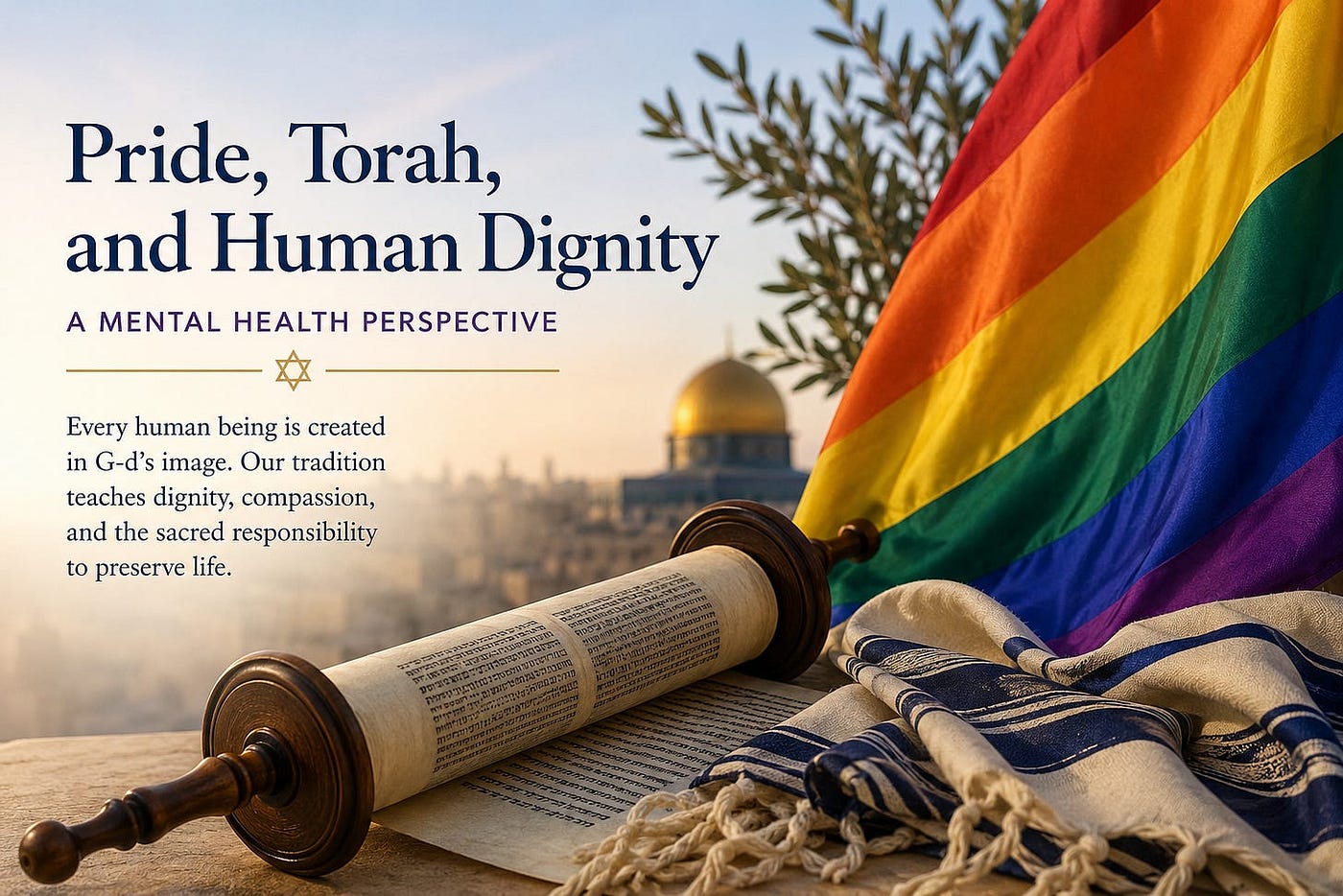
Pride, Torah, and Human Dignity: A Mental Health Perspective
This article was originally published on my Substack
Pride, Torah, and Human Dignity: A Mental Health Perspective
This article was originally published on my Substack
The other day, after reading the news that Italy’s only Jewish LGBTQ group was banned from a Pride event, I found myself in a conversation with my husband about Pride Month
.
We spoke about a tension that exists in many religious spaces: Jewish law’s clear prohibition of homosexuality, and at the same time, the deep truth we are also taught that every human being is created in G-d’s image.
Both are present in our tradition. And both demand to be held honestly.
Leviticus 20:13 states, “If a man lies with a male as with a woman, both of them have committed an abomination…” and yet Jewish law itself builds layers upon layers of legal requirement before any punishment could ever be considered.
To impose capital punishment for any act, the following would be required:
Two valid eyewitnesses must testify to the act.
A clear warning (hatra’ah) immediately before the act.
The offender must acknowledge the warning and proceed anyway.
A functioning Sanhedrin must exist.
This system no longer exists.
The Talmud itself recognizes how nearly impossible it is for capital punishment to ever be carried out in practice in such cases.
At the same time, our tradition is filled with competing and equally powerful truths.
Genesis 1:27 teaches, “G-d created humankind in G-d’s image.”
In Sanhedrin 44a, we learn that even when the Jewish people sin, they are still called “Israel.”
As the Talmud says, “Even when a myrtle is found among thorns, its name is myrtle.”
Pirkei Avot teaches, “Who is honored? One who honors fellow human beings.”
And Berachot 19b states: “Great is human dignity, as it overrides a prohibition in the Torah.”
These are not abstract ideas. They define how human beings are meant to be treated.
At the same time, science today challenges many older assumptions.
Unlike earlier generations, who believed sexual orientation is a choice, large-scale genetic research suggests it is not.
A 2019 genome-wide association study in Science, analyzing nearly half a million individuals, found no single “gay gene,” but rather a complex combination of genetic and environmental influences.
A 2021 study from the Karolinska Institutet, using MRI and genetic data from more than 18,000 individuals, found structural differences in the brains of non-heterosexual participants, suggesting biological complexity in sexual orientation.
The conclusion across modern research is consistent: sexual orientation is not a simple choice.
As an observant Jew raised in the worldview of Torah Umadda, the belief that Torah and secular knowledge are meant to be in conversation, and as a social worker who has treated clients struggling with their faith and sexual identity, this is not theoretical for me.
For some individuals, these struggles touch something far deeper: dignity, belonging, and in some cases, pikuach nefesh: matters of life and emotional survival.
Science and Torah have always coexisted in Jewish history, exemplified by figures such as Maimonides, who embodied both Torah scholarship and medicine.
When religious spaces condemn individuals based on sexual orientation, they risk violating core Torah principles that are just as central as legal texts.
We are commanded to preserve life.
We are commanded to love our neighbor as ourselves.
We are warned that humiliating another human being is akin to spilling blood.
We are told that every human being is created in G-d’s image.
These are not secondary values. They are foundational.
The Torah was never meant to diminish life, it was meant to sustain it.
For thousands of years, it has carried the Jewish people through exile, persecution, and survival.
But survival alone is not the goal.
We are meant to be a “light unto the nations.”
And that requires something difficult and deeply honest: holding tension without erasing human dignity in the process.
In my work as a clinical social worker, I have sat with individuals who feel they must choose between their identity and their faith.
Some believe their pain means they are spiritually broken.
Some believe they are beyond belonging.
That belief alone can become dangerous.
Judaism teaches that all people struggle, all people fall short, and all people stand alone before G-d.
But it also teaches that no human being is disposable.
Not spiritually.
Not emotionally.
Not communally.
This is the tension I return to again and again:
How do we remain faithful to Torah while also remaining faithful to the divine image in every human being?
How do we build communities where people do not feel erased?
How do we speak truth without abandoning dignity?
I don’t believe these questions are simple.
But I do believe they are necessary.
And I believe we cannot afford to stop asking them.
메타데이터
- post_id
- 9c1b88e157c8
- slug
- pride-torah-and-human-dignity-a-mental-health-perspective-9c1b88e157c8
- url
- https://medium.com/@ariel.r.goldstein/pride-torah-and-human-dignity-a-mental-health-perspective-9c1b88e157c8
- canonical_url
- https://medium.com/@ariel.r.goldstein/pride-torah-and-human-dignity-a-mental-health-perspective-9c1b88e157c8
- author_url
- https://medium.com/@ariel.r.goldstein
- status
- ok
- fetched_at
- 2026-06-17 12:55:42