People in Focus: Inside Justen Walker’s First 90 Days, A Reflection on Creativity, Curiosity, and…
In this edition of People in Focus, we’re excited to introduce Justen Walker, our new Staff Software Engineer on the Cloud team. He shares…
People in Focus: Inside Justen Walker’s First 90 Days, A Reflection on Creativity, Curiosity, and Code
In this edition of People in Focus, we’re excited to introduce Justen Walker, our new Staff Software Engineer on the Cloud team. He shares his early experiences, what surprised him most, and how he sees Plotly’s core values — Creativity, Scrappiness, Innovation, Curiosity, Honesty, and Execution — come to life.
What first drew you to Plotly, and what did you hope to find here?
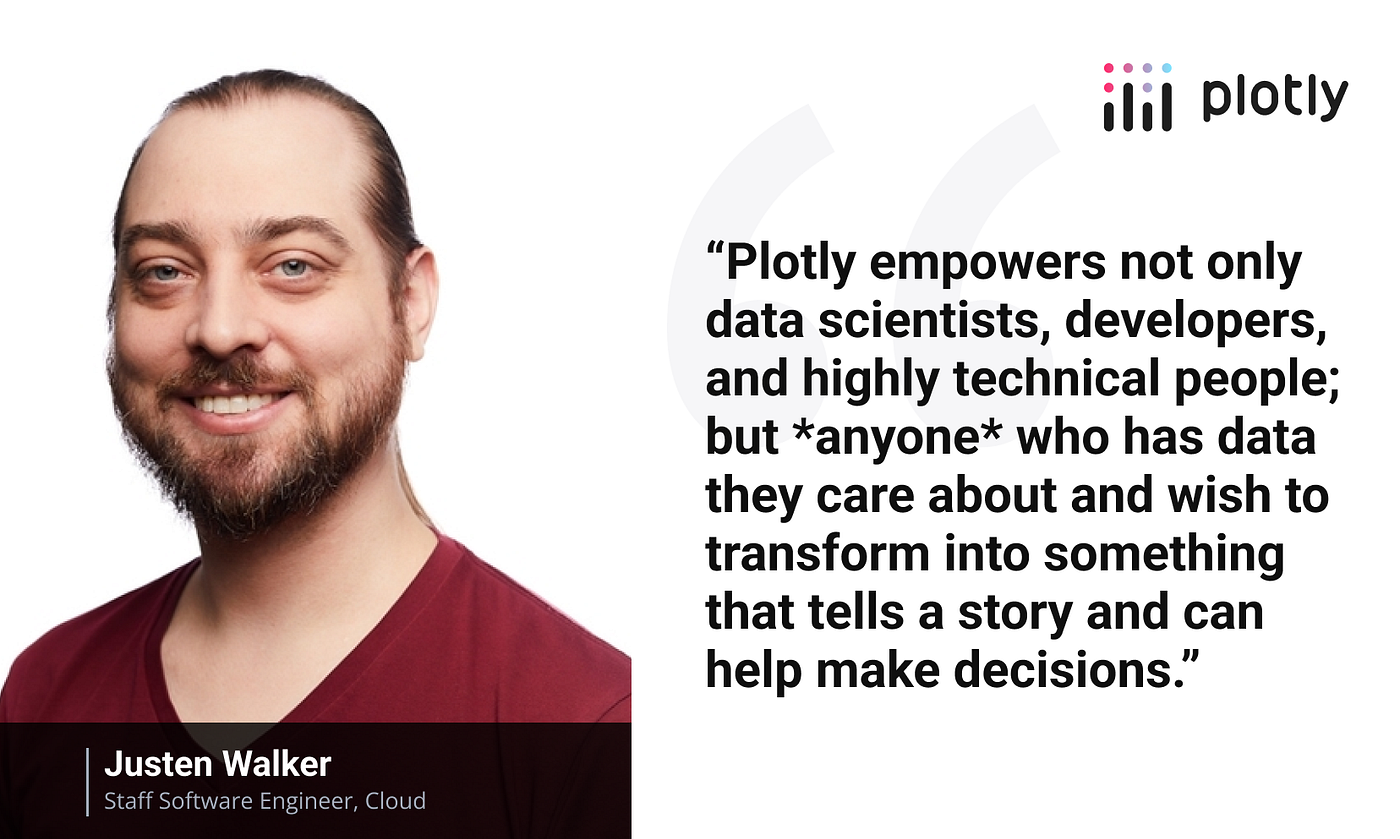
I was drawn to an opportunity to work with a small team and make a large impact. Plotly empowers not only data scientists, developers, and highly technical people; but anyone who has data they care about and wish to transform into something that tells a story and can help make decisions. I hoped to find a place where I can apply my experience with cloud infrastructure over the past decade and make a meaningful impact in days, not weeks or months. I believe that is what I found.
When you think back to your first few weeks, what stands out most: a moment, a feeling, or a realization?
The immediate trust placed in me. Rather than being tasked with reading documentation or onboarding tasks for weeks, I was solving real problems.
By the end of my first week, I was presenting technical proposals to the team and writing design documentation for my first project. The team gave me trust and ownership from day one, which was exhilarating.
What was your very first project at Plotly, and which company value do you think it best represents?
My first major project was building secrets management infrastructure — the secure foundation that allows applications to safely connect to databases and external services. This project embodies innovation and being scrappy while working together.
Innovation because we were developing a new capability that could be applicable to different kinds of customers, not just cloud users. We evaluated modern alternatives, designed for future scale and multi-tenancy, and thought carefully about how this infrastructure would serve different deployment models.
Scrappy because we had to move fast and deliver value early. I had done a similar project at a previous company and we didn’t really deliver value until about a year later; At Plotly, we pushed to make this available to Plotly Studio in an accelerated timeline.
Learn more about Plotly’s values: plotly.com/about-us.
How did your first project challenge you to be Creative, to think beyond the obvious, or combine imagination with technical skill?
Secrets management has a classic “chicken and egg” problem: you need secrets to be secure before you can use them, but you need the system running to secure them. I designed a solution that could bootstrap itself by automatically initializing the secure vault, and applying configuration. All of this is done without human intervention, and is now a common part of every environment.
In what ways did you need to be “Scrappy”, working smart, adapting fast, or finding a creative solution with limited time or resources?
Scrappy is not just about working with limited resources, but also reading the situation and focusing on what delivers the most value right now, not just completing what you started. I was deep into one project when a more urgent infrastructure change became critical. I parked what I was working on, executed the removal quickly and safely, and then resumed my original work.
How have you experienced “Innovation” firsthand at Plotly, whether through AI integration, team experimentation, or problem-solving?
I’ve both contributed to and witnessed innovation here. One example: I saw an opportunity to use AI to improve our deployment process. Before rolling changes to production, the system now automatically summarizes what’s about to deploy in plain language, making it easier for everyone to understand the impact before approving. This wasn’t requested; I saw a problem (lack of visibility) and built a solution using modern AI capabilities.
Another example: One of my teammates saw an opportunity to optimize some of our cloud costs. He created a design doc, we iterated on the solution, and he was able to deploy this into production in a matter of weeks; channeling our spend towards efforts that give our customers the ability to deploy more applications.
The team culture supports this kind of experimentation. We’re encouraged to prototype ideas, gather feedback, and iterate.
How has your “Curiosity” helped you learn or connect more deeply with your team or the product?
My curiosity drove me to understand the entire system, not just my immediate work. Early on, I sought out conversations with engineers across teams in order to understand how our enterprise product works, how different teams think about similar problems, and where the real pain points are. Each conversation was driven by genuine curiosity about how others think and work, which built relationships and made me more effective.
I also dove into problems outside my immediate scope. When I noticed something wasn’t working as expected, I’d dig in even if it wasn’t my assigned task. That curiosity often led to improvements that benefited the whole team.
What does “Honesty” look like to you in the way Plotly teams communicate or make decisions?
Honesty shows up in how we assess ourselves. Early in my time here, the team openly acknowledged that parts of the stack needed investment and that knowledge of certain parts of our code-base wasn’t as distributed equally. That kind of honest self-assessment is how teams get better.
It also shows up in code reviews and technical discussions. Feedback is direct and focused on making the work better, not on politics or ego. When things break in production, the communication is about resolution, not blame. That mutual honesty makes collaboration work.
Where have you seen “Execution” come to life, moving ideas into action quickly but thoughtfully?
Ideas don’t languish in planning here. The pattern I’ve experienced: write a design document, gather feedback, build a proof of concept, iterate, ship. All within weeks, not months.
One rather large project went from initial proposal to production deployment in about six weeks, with proper validation and team review along the way: quick, but thoughtful.
When priorities shift, the team can pivot fast without losing momentum.
What’s one thing you’ve learned about yourself since joining Plotly?
I’ve learned that I naturally think about how to make the team more effective, not just complete my own tasks. Creating debugging tools, implementing workflow improvements, writing documentation that saves others time. These were not pre-planned assignments. They emerged from my instinct to make everyone more capable. I want to be a force multiplier, not just an individual contributor.
How has your understanding of Plotly’s mission or culture evolved over your first 90 days?
Initially, I understood Plotly as a data visualization company. Over 90 days, I’ve come to see it as a platform company building the infrastructure that empowers people to build data applications. Everything connects: secrets management enables secure data connections, workflow systems enable reliable builds, AI integration enables Dash apps to be created in seconds instead of days.
Plotly’s mission is about removing friction so people can focus on building great data applications, not fighting programming language constructs or infrastructure concerns.
What’s a proud moment or milestone that captures what these 90 days have meant to you?
If I had to pick one milestone that captures it all, it’s this. On my first day, I was running a migration script. Today, I’m merging infrastructure improvements, implementing changes, and automating parts of our build process, removing legacy code, and responding to production incidents. The journey from “new person running a script” to “trusted owner of critical infrastructure” in such a short time is proof that when you join a team that trusts you with real ownership, you can accomplish a great deal.
These 90 days have been about building: building infrastructure, building trust, and building a foundation for what comes next.
메타데이터
- post_id
- 9c2d052956be
- slug
- people-in-focus-inside-justen-walkers-first-90-days-a-reflection-on-creativity-curiosity-and-9c2d052956be
- url
- https://medium.com/plotly/people-in-focus-inside-justen-walkers-first-90-days-a-reflection-on-creativity-curiosity-and-9c2d052956be
- canonical_url
- https://medium.com/plotly/people-in-focus-inside-justen-walkers-first-90-days-a-reflection-on-creativity-curiosity-and-9c2d052956be
- author_url
- https://medium.com/@plotlygraphs
- status
- ok
- fetched_at
- 2026-06-10 08:17:25