Looking For A Certain Ratio: The Brief Brilliance Of 801
Looking For A Certain Ratio: The Brief Brilliance Of 801
In sharp contrast to the hibernatory habits of modern day artists, where years can pass between albums and nobody bats an eye, musicians were once relentlessly active. One band finished, they moved straight onto another, one project ended, a new one began. So when Roxy Music took a hiatus in 1976, guitarist Phil Manzanera immediately set about assembling a new “supergroup” to keep himself busy.
The first to join was Bill MacCormick, a fantastic bass player Manzanera knew from their time together in Quiet Sun. Keyboardist Francis Monkman and drummer Simon Phillips soon followed. Then, to Manzanera’s surprise, Brian Eno decided he wanted to be involved. Well, the band’s name did come from a line on one of his songs, after all.
The True Wheel, written by Eno and Manzanera for Eno’s masterpiece, Taking Tiger Mountain (By Strategy), features a chant of. “We are the 801, we are the central shaft”. What it actually means is anyone’s guess, Eno dreamt it up in New York back in 1973 ( Eight-Naught-One does spell E-N-O, if you squint a wee bit)
With Eno onboard he brought along his friend Lloyd Watson, a slide guitarist who frequently played live with him, and even offered to handle lead vocals. With that, the lineup was complete.
Rehearsals began with the aim of playing a handful of live gigs, and the band settled on a setlist drawn from Manzanera and Eno’s previous albums plus a few covers. After three weeks of rehearsing they played a warm-up show in Norfolk, then appeared at the Reading Rock Festival. Both gigs went well, but a planned European tour was abandoned when all festivals in France were cancelled by the government.
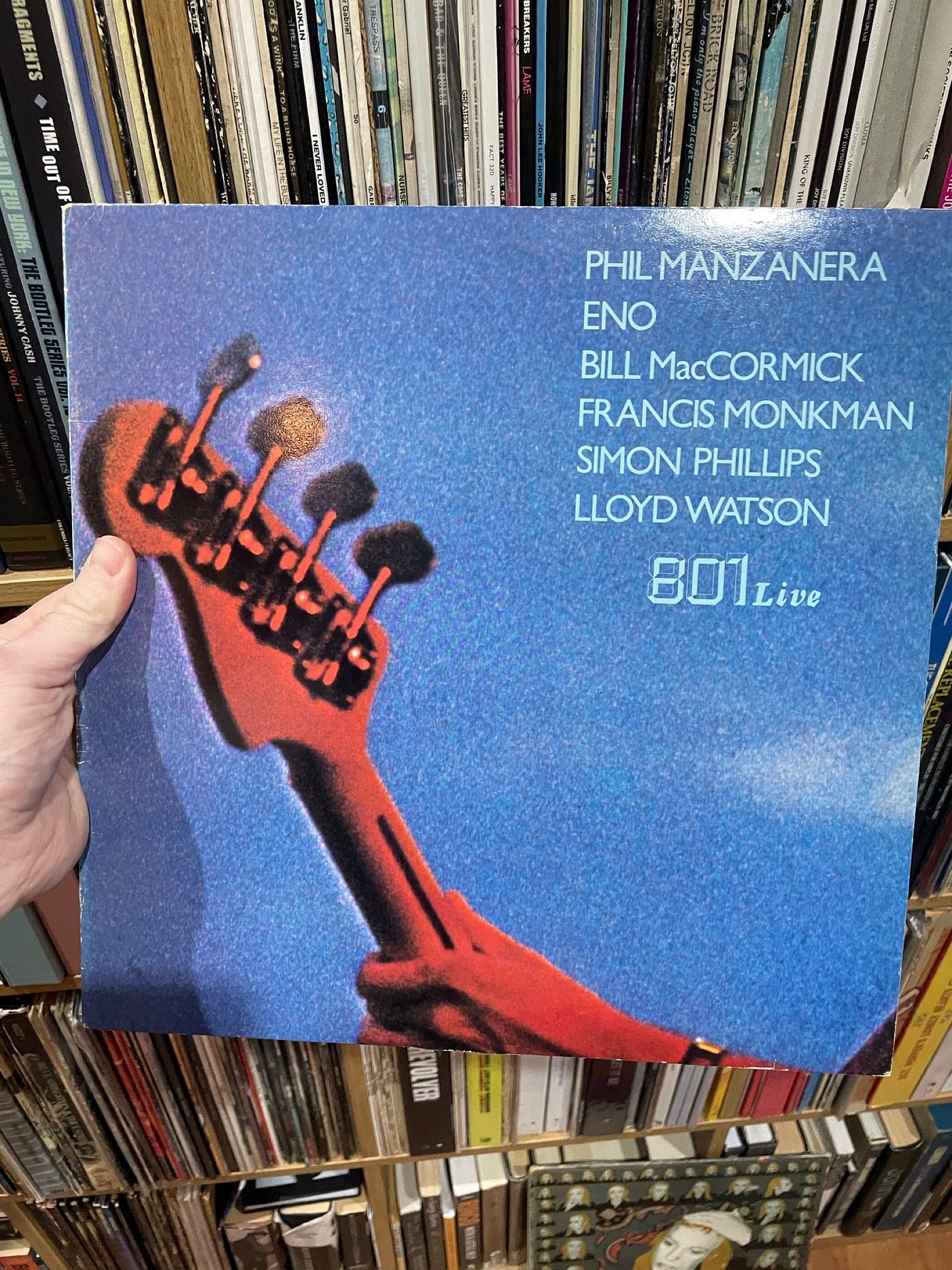
This change of plans led to a quickly arranged show that September at the Queen Elizabeth Hall in London, recorded and released as 801 Live, a special one-off document that captures Eno’s only major involvement with the band.
The album opens with Lagrima, originally from Manzanera’s debut. The studio version is all haunting Spanish guitars and echoing space, but here it becomes something darker, menacing, claustrophobic, full of manipulated sounds and distorted effects. The Enossification has begun.
It’s the perfect prelude to one of the album’s early standout moments, a bold reimagining of Tomorrow Never Knows.
Not many would attempt to cover the Beatles revolutionary record live in 1976, but if there was one artist that could pull it off, it would be Eno. With his arsenal of samplers, sequencers, and tape loops, you’d expect him to make a fair stab at recreating the sonic storm of the original. But instead, the 801 transform it into six minutes of funky, psychedelic rock. No effects, no samples, they even steer clear of Ringo’s iconic drum pattern.
Phillips’ drumming is immense, but it’s Bill MacCormick’s whirlpool bass line that drives the music, the band locking into a deep, hypnotic groove around him. Manzanera’s solo is wonderful, and Eno’s lazy, drifting vocals thread themselves through the sound. It’s a top three Beatles cover for me and one of the album’s finest moments.
Next comes East of Asteroid, a hybrid of a Manzanera solo piece and a track from Quiet Sun’s lone album. A five-minute instrumental odyssey, it’s built on frantic drumming, jagged guitar, winding bass and unexpected time changes. After letting others shine so far, now’s the moment Manzanera seizes the reins with some stunning, urgent guitar work. He really is up there with the best of them, and it’s a joy to hear him cut loose.
Things slow beautifully on Rongwrong, another cover, though Eno makes it his own with wistful vocals and music that mirrors his imagery perfectly. As he sings of turning into a cloud and drifting home, Watson and Manzanera’s guitars weave a magical spell, twining around each other with effortless grace.
Somber Reptiles follows, a gorgeous instrumental from Another Green World. Its tribal pulse merges with Monkman’s jazzy piano and Eno’s swooping synthesizer textures, creating a short but epic conclusion to side one.
Side two explodes out of the blocks with the Eno classic Baby’s On Fire, where the 801 somehow turn the heat up on the manic energy of the original. The temperature’s rising, but any idiot would see that. Eno’s sinister vocals are captivating, and Manzanera wisely avoids replicating Robert Fripp’s legendary solo, instead delivering his own magnificent blast of guitar wizardry.
Two cuts from Manzanera’s debut follow. Diamond Head evokes Pink Floyd with its soaring guitars and expansive keyboards, it’s one to sit back and absorb. Miss Shapiro, a co-write with Eno, is something else entirely: a piece of art-rock nobody else was making in 1975. It has hints of Roxy, but it’s stranger than they ever were. Eno fires his enigmatic, surreal lyrics at us in rapid bursts as the music builds and releases into a wondrous chorus. They were pioneering a new kind of pop here, and the influence runs wide.
After showing how far ahead of the game they were, the band segue into a cover of The Kinks’ You Really Got Me. Once again they reinvent it, replacing the original’s impassioned vocals with Eno in full robotic mode, cold, distant, passionless, an android only able to communicate through music, seesawing with Manzanera’s guitar on a frantic search to retain the song’s humanity.
For the encore they tear into a blistering Third Uncle. Pure musical adrenaline, its jittery, frantic rhythm sounds two musical revolutions ahead of its time, post-punk before punk has even happened. This live version might be even more wired than the studio take. A stunning end to the show and a perfect final bow for Eno as a live performer for many years.
The 801 would release one studio album, but Eno’s contributions were minimal. He had just one more “traditional” record left, 1977’s Before and After Science, before turning decisively toward ambient work and producing other artists. It would be fifteen years before he returned to the stage.
Manzanera rejoined Roxy Music and made more fantastic music, while the other musicians moved on to their own ventures, and 801 Live became what it remains today: the lone true document of this brief but brilliant band. The light that burns twice as bright burns half as long, and 801 burned so very very brightly.
메타데이터
- post_id
- 9c4264dbdda0
- slug
- looking-for-a-certain-ratio-the-brief-brilliance-of-801-9c4264dbdda0
- url
- https://medium.com/@gary19801/looking-for-a-certain-ratio-the-brief-brilliance-of-801-9c4264dbdda0
- canonical_url
- https://medium.com/@gary19801/looking-for-a-certain-ratio-the-brief-brilliance-of-801-9c4264dbdda0
- author_url
- https://medium.com/@gary19801
- status
- ok
- fetched_at
- 2026-07-25 10:40:03