Reframing Immersive Experience #01 Wolves in the Walls: How Narrative Organizes Experience in VR
An immersive experience is often approached as a technical problem. In practice, its coherence is structural: how perception stabilizes…
Reframing Immersive Experience #01 Wolves in the Walls: How Narrative Organizes Experience in VR
An immersive experience is often approached as a technical problem. In practice, its coherence is structural: how perception stabilizes, how attention is guided, how time is organized, and how participation becomes meaningful. Wolves in the Walls offers a clear case of this. As an early VR work, it shows that narrative does not simply deliver content. It can also organize the conditions through which immersive experience becomes coherent, continuous, and emotionally legible.
This essay continues a broader inquiry into how immersive experience is structured and sustained under different conditions. Although grounded in VR, its main concern is not medium specificity alone. Rather, it asks how narrative can function as a structural condition of experience. Through case-based analysis, these processes can be identified, reframed, and carried forward as transferable design principles.
In XR, narrative-driven works tend to become unstable when they rely heavily on cinematic logic. The viewer remains spectatorial, transitions depend on editing, and perspective shifts break perceptual continuity. Physical space, by contrast, provides continuity more naturally: the body remains situated, and spatial relations persist even as attention shifts. The challenge for immersive design is therefore not simply how to tell a story, but how to maintain experiential coherence as it unfolds.
From Picture Book to VR: Experiential Shift
Originally a children’s picture book, Wolves in the Walls follows Lucy, who believes wolves live inside her home, though no one believes her. When they emerge and take over the house, the family is forced to flee. Lucy later returns to find her pig puppet, prompting the family to confront the wolves and take back their home. In VR, the primary change is not narrative but experiential. The story is no longer simply imagined or observed. It is lived through embodied proximity. The viewer accompanies Lucy from within the situation, not from outside it. Meaning therefore emerges not only through interpretation alone, but through perceptual involvement and relational participation. Narrative functions not only as content but as a condition that supports entry into the experience and sustains its unfolding over time.
Condition: Establishing Perceptual Stability in Space
1. Stability of the First-Person Position
The work maintains a stable first-person position, placing the viewer alongside Lucy within a consistent perceptual frame. This reduces unnecessary reorientation and allows presence to build through continuity rather than novelty.
Experience depends on a stable relationship between the body and the environment. When this relation holds, embodied perception can unfold over time without repeated reorientation. In physical environments, continuity is largely given. In XR, it must be deliberately constructed. Wolves in the Walls succeeds because it understands immersive experience often begins not with freedom of movement but with stabilizing perceptual position.
2. Spatial and Transitional Continuity
Perceptual continuity is reinforced through the design of transitions. Lucy serves as the primary relational anchor, preserving orientation as the environment changes. When she is absent, stable objects or recurring visual forms maintain continuity.
What matters is not the use of transitions but their perceptual coherence. The work translates cinematic transition into embodied experience. Actions and sounds trigger spatial change in ways that remain intelligible within the viewer’s perceptual frame. A light turns off, darkness follows. A form disappears through occlusion, another appears through similarity or continuity. When transitions align with prior expectations, they are not experienced as breaks but as developments within the same perceptual event.
Most transitions remain gradual, allowing continuity to build. At key moments, abrupt cuts are introduced. These do not weaken the experience. On the contrary, rupture becomes effective because continuity has first been established. Disruption gains force when used sparingly and aligned with emotional escalation.
3. Spatial Scale and Psychological Tension
The narrative is structured almost entirely around interior-scale spaces, creating a sustained sense of enclosure and tension that aligns with the characters’ psychological state, producing perceptual coherence. A brief transition into a larger environment occurs mid-way, but does not alter the overall interior-based structure. Toward the end, the return to the interior scale re-establishes stability. However, introducing a more open spatial condition at the conclusion could produce a stronger sense of psychological resolution and release.
Unfolding: Organization Experience in Time
1. Guidance and Attention
Immersive environments do not inherently sustain themselves. Without guidance, a 360-degree field becomes diffuse and directionless. Wolves in the Walls addresses this by organizing attention through gaze, movement, lighting, and sound. These cues not only direct the viewer toward information but also maintain orientation within an unfolding experiential field.
The environment rarely presents itself all at once. Instead, elements appear progressively, allowing the viewer to move from part to whole. This gradual revelation reduces perceptual overload and supports continuity of attention. The principle extends beyond VR: immersive experience requires attentional structure to remain legible over time.
2. Temporal Rhythm and Emotional Structure
The work follows a rhythm of accumulation, release, transition, and closure. This is not narrative pacing but the organization of experiential intensity.
Even without a complex plot, changes in density, direction, and affect generate a felt curve of experience. Local buildups and key transformations contribute to a larger arc that regulates both emotion and attention. What holds the experience together is not story alone but rhythm: the controlled variation of intensity across time.

3. Reorientation: Reconfiguring Direction
After losing the home, the experience shifts from retreat to return. This marks a reorientation in movement and intentional direction. The subject no longer follows an established path but repositions in response to a changed situation.
Lucy continues to guide the progression, while the viewer takes a responsive rather than an initiatory role. This strengthens clarity and emotional alignment but limits agency. The trade-off is revealing. In narrative-driven immersive structures, strong relational guidance deepens coherence while narrowing the participant’s range of action. This tension remains a central design question for immersive storytelling.
Relation: Experience as Embodied Participation
1. Human Interaction
The participant gradually shifts from observer to active participant. This shift does not occur through dramatic intervention, but through relational exchange: dialogue, eye contact, and object sharing. These interactions build reciprocity rather than mere access.
Responsive characters increase the perceived significance of the surrounding environment. Once the viewer is addressed, responded to, or awaited, the space begins to matter differently. Presence becomes relational rather than merely spatial.
2. Object Interaction
Objects are not treated as isolated interactive features but as nodes within the experiential structure. The camera, jam jar, and magnifier do more than add interactivity. They articulate progression, support relational exchange, and guide the viewer through key moments without overloading the perceptual field.
This distinction is important. In immersive work, interaction becomes meaningful not when there is more of it, but when it is structurally integrated.
3. Participation as Structure
Participation is not reducible to visible action. It emerges through the relation between subject and environment: position, attention, response, and feedback. In this sense, participation is not an added layer on top of experienc, it is a condition through which experience is produced.
Meaning Formation: A Relational Structure
Although presented as a VR narrative, Wolves in the Walls reveals a broader structural principle: immersive experience often takes the form of story, not because story is required as content, but because it organizes perception, time, and relation into an intelligible whole.
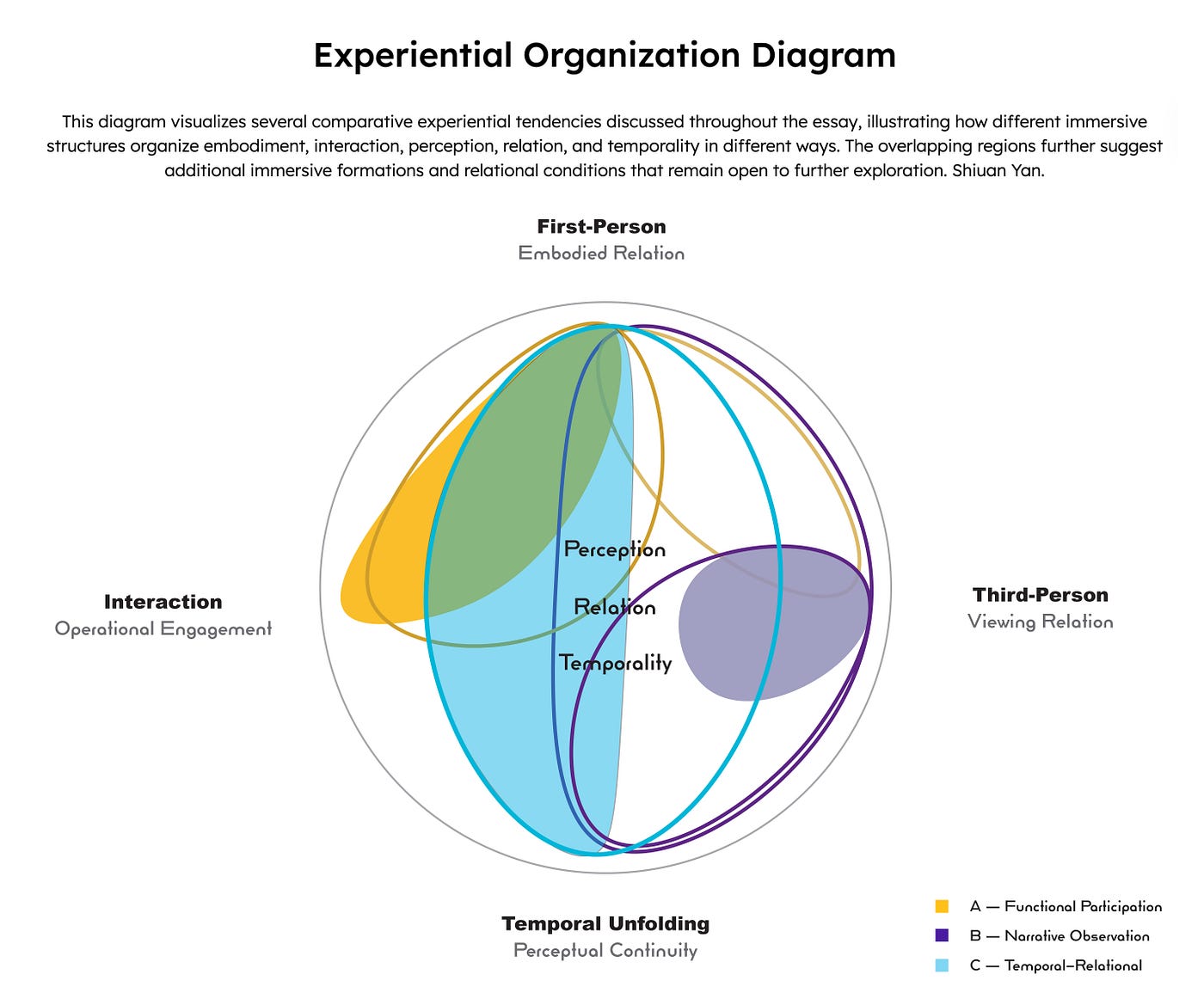
Within the Perceptual–Temporal Framework, meaning is generated through relational intensity. At the Condition level, the work establishes a stable perceptual foundation with a consistent viewpoint and coherent transition design. This keeps the viewer within a continuous field instead of repeatedly being thrown out of it.
Meaning deepens through relational engagement. Interaction with Lucy through gaze, dialogue, waiting, and response creates a reciprocal field where the viewer is no longer external to the situation. The participant moves from observation to embodied exchange. This shift forms anticipation, intensifies emotional alignment, and allows meaning emerge through involvement rather than explanation.
At the organizational level, the work follows a relatively closed temporal structure. It moves toward resolution and concludes as a bounded episode instead of remaining open-ended. Meaning is generated less through prolonged temporal indeterminacy and more through concentrated relational and emotional development within a shaped arc. This does not reduce its depth. It clarifies that immersive meaning is not singular. It depends on how perception, temporality, and relational structure are arranged. Meaning is not simply given. It is produced through relation.

The VR adaptation ends with restored stability. Unlike the original picture book, whose ending remains more open and suggests the possibility of recurrence, the VR version moves toward a definitive resolution.
What Wolves in the Walls suggests is that narrative can do more than frame events. It can establish perceptual conditions, organize temporal development, and sustain participation across an immersive experience. These principles are not limited to VR alone. They point to broader design questions across immersive media.
At the same time, embodiment, spatial constraint, and perceptual load continue to differ across formats. This leaves an important question open: when the viewer moves from observation to embodied participation, what conditions allow the experience to continue resonating after it ends?
—
Design Takeaways from Wolves in the Walls
(A narrative-driven immersive experience)
- Stable perceptual position: Avoid unstable viewpoints and spectator distance.
- Coherent transition design: Preserve continuity through characters, objects, sound, and formal correspondences.
- Guided temporal rhythm: Organize accumulation, release, and reorientation across time.
- Integrated participation: Embed human and object interaction within the narrative structure.
Author’s Note
This analysis is part of an ongoing research investigating how meaning emerges in immersive experience through perception, time, and embodied interaction. Full research framework: https://www.shiuanyanstudio.com/en/research-practice/
Shiuan Yan Studio (Research-Driven) : https://www.shiuanyanstudio.com/
I recently learned that the director of Wolves in the Walls passed away last year. I want to express my respect for him, Pete Billington, and also my appreciation for the team behind the work. His work continues to resonate, shaping how we think about immersive storytelling and quietly informing how we create within it. Even years after its release, it remains a meaningful example of how narrative and embodiment can be brought together in immersive media. To revisit it to continue a conversation it has already set in motion.
—
Work information
- Wolves in the Walls (2019). Director: Pete Billington. Fable Studio. Interactive VR Experience. Duration: 30–40 minutes.
- Official Website: https://www.fable-studio.com/wolves-in-the-walls
- Trailer: https://www.youtube.com/watch?v=2Qz6s6sR1Q8

Wolves in the Walls, Fable Studio.
메타데이터
- post_id
- 9c4cb789bfce
- slug
- reframing-immersive-experience-01-9c4cb789bfce
- url
- https://medium.com/@shiuanyanxr/reframing-immersive-experience-01-9c4cb789bfce
- canonical_url
- https://medium.com/@shiuanyanxr/reframing-immersive-experience-01-9c4cb789bfce
- author_url
- https://medium.com/@shiuanyanxr
- status
- ok
- fetched_at
- 2026-06-09 15:37:30