Chapter 16: How Could This Happen Again?
Jane Goodall invited me as her guest at the United Nations International Day of Peace. She had been named a UN Messenger of Peace, along…
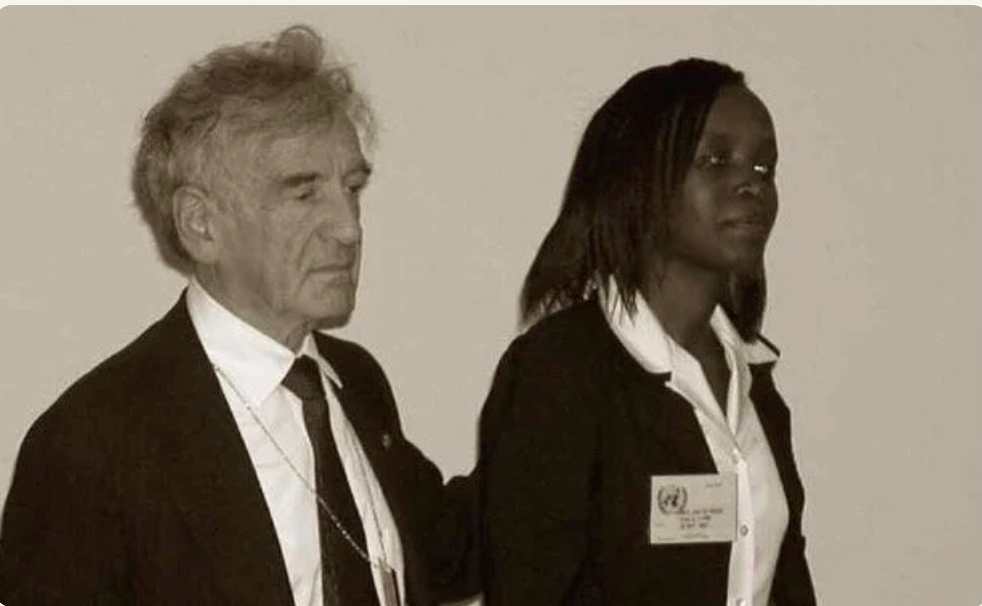
Photo by Fred Mednick at United Nations: Elie Wiesel and Jacqueline Murekatete
Chapter 16: How Could This Happen Again?
Jane Goodall invited me as her guest at the United Nations International Day of Peace. She had been named a UN Messenger of Peace, along with Muhammad Ali, Michael Douglas and Elie Wiesel. It was UN Week again. Streets were blocked so that limousines and horses could travel unimpeded. Sharpshooters paced on roofs. Secret Service agents talked into their shoulders. A steady parade of ambulances whoop-whooped.
Jane introduced me to Kofi Annan, Secretary-General of the United Nations. Though shorter and sadder-looking than I had imagined, he radiated gentleness, humility and elegance. Annan announced to the assembled, “Please follow me,” and ushered me ahead of him to a small garden outside the reception area. We stood in silence as he strode up to the Peace Bell, donated by the United Nations Association of Japan to the General Assembly in 1954. Housed in a structure modeled after a small temple symbolizing the Buddha’s birthplace, the bell rests on a stone base donated by Israel. Cast from coins and medals collected by children from around the world, the Peace Bell is bonged with a wooden mallet at each vernal equinox and again on 21 September, the International Day of Peace.
The Secretary-General faced the assembled and spoke. “A month ago, almost to this very hour, an act of unspeakable brutality struck our friends and colleagues in Baghdad. Today we ring this bell for them, for their families and loved ones. We ring it for the people of Iraq whom our colleagues were working to assist. We ring it for people of every nation who need our prayers and peace.” He raised the mallet and struck the bell gently. Its resonance throbbed and floated above and inside us, invisible and hypnotic. No one moved.
The power of that day did not lie in quick encounters with global luminaries or in a solemn moment of international communion, but in a question asked following a panel discussion with the UN Ambassadors o Peace. Seated in the front row, Jacqueline Murekatete raised her hand. She looked directly at Elie Wiesel. In 1994, she was 9 years old, living in an orphanage in Rwanda. Her entire immediate family had just been butchered, as well as most of her extended family. Granted asylum to the United States in 1995, Jacqueline moved in with her uncle. As a sophomore at New York University, she attended a lecture by David Gewirtzman, a Holocaust survivor, who spoke in graphic terms about what he had witnessed and his journey as a survivor. Stirred by the lecture, Murekatete penned Gewirtzman a note. “At one time, I, like you, had a feeling of guilt for being alive,” she wrote. “Now I’m thankful I was left.”41 Jacqueline and Gewirtzman traveled together, telling their stories.
The facilitator of the panel pointed to Jacqueline. She introduced herself and described how her six siblings and her grandmother were dragged to a river, hacked to death and dumped there, never to be recovered. She said she had read all of Elie Wiesel’s books.
And then Jacqueline’s question. “How could this happen, again?” she asked. “What happened to ‘never again’?”
Three hundred of us in the room held our collective breath. Photographers jostled for the best position to capture this, camera motor drives popping and whirring from Wiesel to Jacqueline and back again. Wiesel straightened up and shielded his eyes, scanning the audience for the source of the young woman’s voice. Seeing her, he sighed and thanked her for the question. He described how world leaders had been certain that, after the Holocaust, such horrors would be considered inconceivable, a relic of history. Never forget, never forgive, never again. And yet, he said, genocide continued. How the Americans knew what was going on in Rwanda but did nothing to stop it. How he had implored other major world leaders to intervene, but to no avail.
Wiesel mused about how he had longed to embrace the ebullience and optimism in anticipation of a new millennium. “Lots of fireworks and speeches about world peace,” he said. He continued to describe how, at last, we would close the chapter on the bloodshed of the twentieth century and open a new era of peace, inclusion and opportunity.
And yet, soon after the Rwandan genocide, he said, there was Darfur, “like a chapter in a history book in which we tear the pages out one by one until we have nothing left.” He spoke about how we were hearing testimony for the dead and the living.
He stopped and met Jacqueline’s gaze again. He told her that he had sought his entire life to answer that exact question, that even though he did not know why or how it continues to happen, one’s efforts to prevent genocide cannot flag. “I have dedicated my life to preventing it from happening again.”
He paused, took a sip of water, and continued. “I know this: we cannot hate in return. There’s even something worse than hate. The opposite of love is not hate, but indifference.” He told her that he wished he could reach across generations, across time, across race, across religion, just to hold her. Members of the audience began to weep.
The panel facilitator had the good sense to end there. Elie Wiesel was the first to rise. He crossed the stage and walked down the stairs directly toward Jacqueline. He placed his arm on her back as they walked out.
Jacqueline went on to work with Miracle Corners of the World, a nonprofit devoted to empowering “youth to become positive agents of change in their communities.” At a 2011 commencement speech at Washington University in St. Louis, Elie Wiesel peered out at the crowd and talked about his visits to Bosnia, sent by President Clinton as a Presidential Envoy, and spoke: “I would go literally from person to person, from family to family, from barrack to barrack, from tent to tent, asking them to tell me their stories. And they always began, but they stopped in the middle. Not one of the people I interviewed or interrogated ended the story.”42
I promised to meet Jane in the morning. I needed air. It was a beautiful late September afternoon. Outside, a small group posed in front of “The Knotted Gun,” a bronze statue of a large .357 Magnum revolver tied into a knot. A little boy ran around, thumb and forefinger extended, shrieking, “Bang! Bang!” His mother grabbed his arm as he tried to climb up and reach the trigger.
I crossed the street to walk through Ralph Bunche Park, named after the first African American winner of the Nobel Peace Prize for his key role in the armistice between Egypt and Israel. Prior to the Nobel, Bunche helped draft the UN charter. For years after the prize, he worked in the Sinai, the Congo, Yemen, Cyprus and Bahrain. He attended the 1963 March on Washington and the 1965 Selma to Montgomery March.
I stopped at a curved wall at the entrance to read the well-known inscription:
They shall beat their swords into plowshares. And their spears into pruning hooks. Nation shall not lift up sword against nation. Neither shall they learn war anymore.
I wondered why the documentation of voices of grief and pain does not stop humans from bringing upon themselves and the world such premeditated horror and the steady parade of swords and machetes. I wanted to block everything I had seen and heard over the past several years. Communities leveled by neglect. The abject deprivation of basic human rights. A teacher wishing that he, rather than his daughter, had perished in a school constructed by a greedy contractor who cut corners. The rage of a government official in the Niger Delta fouled by waste and purple with oil. Raphael’s funereal description of what he had witnessed. I had just seen an Auschwitz survivor console a Rwandan survivor of genocide. I tried to shake it off, but Jabriil’s voice seemed to have taken up a permanent residence in my head. “How about now?”
But then other voices drifted in. Jihad’s confident “the village will take care of it.” Deepmala’s children urging us not to let the lights go out. The voice of the teacher who, despite the violence in Gujarat, wrote that “teachers do not kill each other.” Sameena’s lack of fear in the service of girls’ education, human rights and livelihoods. That forklift driver stunned at the prospect he could apply his skills to make a difference. Solmaz’s use of science to strengthen community safety. Sister Donata’s soft and Salomon’s exclamatory voices of resilience. And, of course, there was Jane’s voice: a pant-hoot to pay attention, a warning about our stewardship of the earth, and this steady refrain: “Let’s get to work.”
Orange cones led to confusing detours. I got lost again.
I didn’t care.
메타데이터
- post_id
- 9c648568bc5f
- slug
- chapter-16-how-could-this-happen-again-9c648568bc5f
- url
- https://medium.com/in-the-small-places/chapter-16-how-could-this-happen-again-9c648568bc5f
- canonical_url
- https://medium.com/in-the-small-places/chapter-16-how-could-this-happen-again-9c648568bc5f
- author_url
- https://medium.com/@twbglobal
- status
- ok
- fetched_at
- 2026-06-14 11:28:49