Linguistic (and Semiotic) Dynamics of Social Media
Using Critical Discourse Analysis.
Linguistic (and Semiotic) Dynamics of Social Media
Using Critical Discourse Analysis.

Scrolling through social media, you might come across a seemingly simple question: “**Is transgenderism a mental illness?**” Set against a calm teal background, the question appears with no frills, just stark text and a sea of comments below. But beneath its simplicity lies a deeper narrative about how language and visual presentation can shape public discourse.
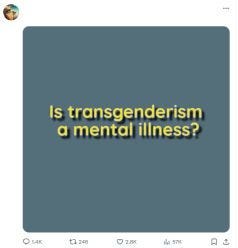
Published on X on 17/10/2024
At first glance, the question may seem straightforward, even neutral. Yet, on closer inspection, both the choice of words and the use of imagery carry significant weight in shaping the meaning and potential impact of the message. Let us explore how.
First, let’s break down the language used in the question. ”Transgenderism” is an outdated term that carries connotations of a condition or ideology, rather than describing a person’s identity or experience. Today, we typically say ‘being transgender’ or use ‘transgender identity’ — terms that centre the individual rather than framing their identity as something clinical or ideological.
When paired with the phrase “mental illness”, the tweet steps into even more dangerous territory. The implication here is subtle but potent: by framing transgender identity as a possible mental illness, it opens the door to misunderstanding and, worse, stigmatisation. Although transgender identity is not classified as a mental disorder by major health organisations, the question plants the seed of doubt, leaving room for further debate or even denial of established medical facts.
Interestingly, the phrasing of the tweet as a question also plays a key role. This isn’t a statement outright declaring an opinion; instead, it invites us to consider the possibility. Framing it this way is a common tactic in social media discourse — it’s open-ended enough to seem neutral, but at the same time, it subtly nudges the conversation in a specific direction.
While the language of the tweet is its most explicit feature, the choice of the teal-colored background also deserves attention. Teal is often associated with calmness and neutrality — a color that doesn’t shout for attention but invites reflection. In this case, the teal backdrop might be intended to soften the blow of the question, making it seem less provocative or controversial than it actually is.
Notably, the colour doesn’t directly connect with transgender symbolism, which typically uses light blue, pink, and white. This deliberate choice of a neutral color could be seen as an attempt to engage a broader audience, avoiding any immediate associations with the transgender community. But the calm aesthetic is deceptive. The minimalist design — no images, no hashtags, just the question on a blank background — directs all attention to the words themselves. It’s a visual tactic used frequently on social media: strip away everything except the message, and the message becomes inescapable.
When this kind of tweet appears on social media, it’s not just the content itself that matters, but how it interacts with the platform’s dynamics. Questions like these are tailor-made to provoke engagement. Whether people agree, disagree, or debate the ethics of the question, the tweet garners responses, and in doing so, it plays into the algorithms that determine what content gets amplified.
Social media platforms like Twitter thrive on engagement, particularly when it’s charged with emotion or controversy. Posts that generate a flurry of comments, likes, and shares are more likely to be promoted, increasing their reach. So, a question that touches on a sensitive or divisive issue — like transgender identity — will often spread more widely, fueled by the very outrage or support it sparks.
And then there’s the issue of echo chambers. In the polarised environment of social media, users often engage with content that reinforces their existing beliefs. Someone who already harbours doubts about transgender identity might interpret the question as validation of their views, while others might see it as an opportunity to challenge harmful assumptions. Either way, the conversation risks becoming more about reaffirming pre-existing biases than fostering genuine dialogue.
Beyond the abstract interplay of language and colour, we must consider the real-world impact such a tweet can have. Associating transgender identity with mental illness isn’t just an academic question — it has real consequences for how transgender people are perceived and treated in society.
For those within the transgender community, seeing their identity linked to mental illness in public discourse will undoubtedly be deeply harmful. It reinforces stigmas they have long fought against and can lead to further discrimination in areas like healthcare, employment, and social relationships. Moreover, framing their identity as a question of mental health often overlooks the real mental health challenges that transgender people face — not because of their identity, but because of the stigma and discrimination they endure.
So, what does this tweet really teach us? It’s a reminder that even seemingly simple questions can carry heavy implications. Language holds power, particularly in framing discussions about marginalised communities. And in the fast-moving world of social media, where ideas spread quickly and emotions run high, we need to be mindful of how we present sensitive issues.
It’s not about stifling debate or avoiding difficult questions, but about how we ask those questions. Are they posed in a way that promotes understanding and respect? Or do they reinforce harmful stereotypes and misinformation? In this case, the tweet, by linking transgender identity with mental illness, risks doing more harm than good.
The question “Is transgenderism a mental illness?” is far from neutral. It uses outdated language and a visual aesthetic designed to seem calm and open, but the underlying message stirs controversy. In a time when social media shapes much of our public discourse, we must think critically about how even a single line of text can influence how we understand complex issues — and how it can impact the people whose lives are at the heart of those issues.
©Antoine Decressac — 2024.
메타데이터
- post_id
- 9c652f9680f1
- slug
- linguistic-and-semiotic-dynamics-of-social-media-9c652f9680f1
- url
- https://medium.com/@adecressac/linguistic-and-semiotic-dynamics-of-social-media-9c652f9680f1
- canonical_url
- https://medium.com/@adecressac/linguistic-and-semiotic-dynamics-of-social-media-9c652f9680f1
- author_url
- https://medium.com/@adecressac
- status
- ok
- fetched_at
- 2026-07-15 18:21:02