Decoding CPO: Why Optics Has No Choice but to Come Closer
✨Recently, I spent some time studying WinWay Technology’s CPO technical forum led by Dr. Sun Chia-Pin, and one thing became clearer to me…
Decoding CPO: Why Optics Has No Choice but to Come Closer
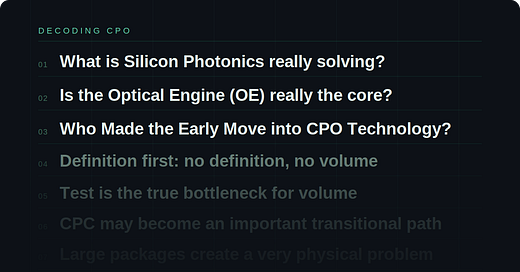
✨Recently, I spent some time studying WinWay Technology’s CPO technical forum led by Dr. Sun Chia-Pin, and one thing became clearer to me: CPO is not an easy topic to digest…
It sits across silicon photonics, advanced packaging, optical engines, lasers, connectors, and testing. But that is also why I found this topic valuable. It helped connect several scattered pieces of the AI infrastructure supply chain into one clearer map.
When people talk about AI infrastructure, the discussion usually starts with GPUs, HBM, CoWoS, power, or networking switches.
But as data rates continue to rise, another problem becomes harder to avoid: how data moves inside the system.
At high speed, copper starts to face more physical limits. Signal loss increases. Heat becomes harder to manage. Transmission reach becomes shorter. EMI also becomes a bigger concern.
This does not mean copper will disappear overnight.
A more realistic way to think about it is that copper and optics are running in parallel for now. Copper still has cost, maturity, and ecosystem advantages. But as the industry moves toward higher data rates, optics becomes increasingly difficult to avoid.
That is where silicon photonics and CPO become important.
At the simplest level, silicon photonics moves data by using photons instead of electrons. Instead of sending signals through copper with electrical current, the system sends signals through fiber using light.
It sounds simple, but the implementation is not simple at all.
CPO is not just about putting optics closer to the chip. It also creates new questions around architecture, package design, optical engine size, fiber alignment, testing, reliability, and manufacturability.
One part I found especially important is the optical engine (OE).
In the full CPO concept, the system is not only about ASICs or HBM. It is about how the ASIC, HBM, optical engine, interposer, and substrate come together.
There is also a distinction that is easy to confuse:
📍NPO (Near-packaged Optics,近封裝光學):places the optical engine on the substrate. 📍CPO (Co-packaged Optics,共同封裝光學):moves the optical engine closer, onto the interposer.
That difference matters because the optical engine’s size, position, and structure can affect how many units fit along the package edge, which then limits total system throughput.
In other words, the optical engine is not just one component in the system. It can become one of the key battlegrounds.
Another takeaway from the forum is that before CPO can scale, the industry first needs to agree on what exactly is being built.
This sounds basic, but it is critical.
Before mass production, the value chain needs clearer definitions around the optical engine, PIC, EIC, EPIC, connectors, fiber array units, lasers, and packaging structure. Without definition, there is no volume.
This may be one reason why much of the industry’s work from 2023 to 2026 has been less about immediate mass production and more about architecture definition.
CPO is not only waiting for demand.
It is waiting for architecture, standards, and manufacturable definitions to converge…
💡CPO is not a single-company problem. It is a chain problem.
The optical engine can be well designed, but if the package cannot be handled properly, tested efficiently, or aligned repeatedly, the system still cannot move into volume production.
To me, one of the most practical takeaways from the session was Design for Testing.
If testing is considered too late, the design team may end up with a product that technically works but is painful or expensive to test.
That is a dangerous situation for early-stage technologies.
📍Because in the lab, the first question is usually: Can it work?
📍But in volume production, the harder question becomes: Can it be tested repeatedly, efficiently, and economically?
This is why test planning needs to start earlier.
Decisions around FAU, connectors, cables, optical engine structure, and packaging design should not be separated from the test strategy.
If the optical engine choice reshapes the whole module, then test planning needs to start before the design is locked.
💡So my takeaway is simple:
CPO is not only about moving optics closer to the chip.
It is about whether the whole system can be defined, packaged, aligned, tested, and scaled.
Rather than only chasing the headline of “optics replacing copper,” I think the more important question is:
Who can help define the specification, and who can help break the volume-production bottleneck?
That may be where the real value of the CPO supply chain begins to show.
📩 I’ll keep tracking this topic and sharing more learning notes from the AI infrastructure supply chain in substack: https://substack.com/@suyo/note/p-198136326?r=3240fl&utm_source=notes-share-action&utm_medium=web
메타데이터
- post_id
- 9c698bf2ad97
- slug
- decoding-cpo-why-optics-has-no-choice-but-to-come-closer-9c698bf2ad97
- url
- https://medium.com/@empowered_pistachio_crow_875/decoding-cpo-why-optics-has-no-choice-but-to-come-closer-9c698bf2ad97
- canonical_url
- https://medium.com/@empowered_pistachio_crow_875/decoding-cpo-why-optics-has-no-choice-but-to-come-closer-9c698bf2ad97
- author_url
- https://medium.com/@empowered_pistachio_crow_875
- status
- ok
- fetched_at
- 2026-06-10 18:44:10





