Have You Considered Less?
The thought came to me while I was driving and contemplating human greed, not in some abstract political sense, but in the ordinary way it…
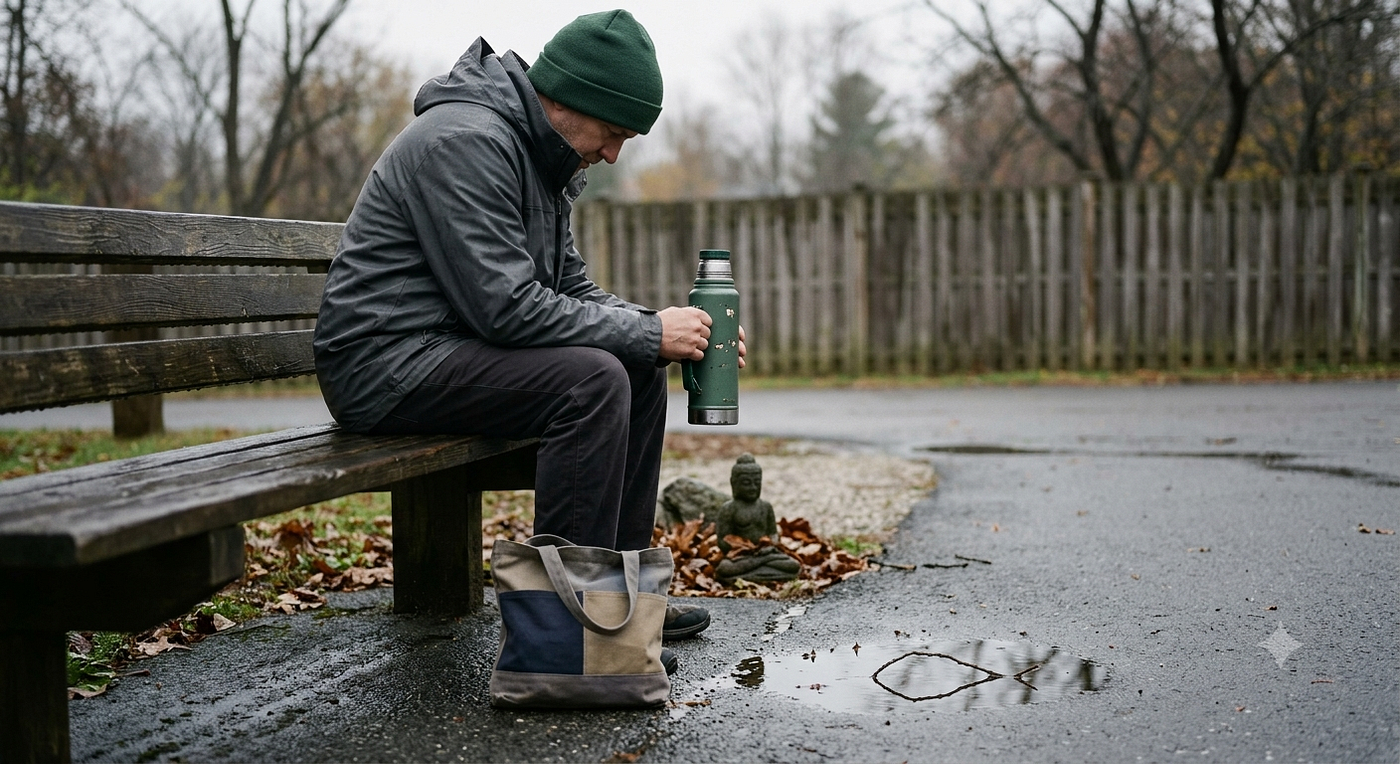
A plain morning, a small Buddha, and only what was needed.
Have You Considered Less?
The thought came to me while I was driving and contemplating human greed, not in some abstract political sense, but in the ordinary way it shows up everywhere, including in myself.
Not “less is more,” because that phrase has been worn smooth by people who say it while continuing to add more to everything. More features, more noise, more options, more explanation, more performance, more stuff. The question that came up for me was different.
Have you considered less?
I do not mean less as punishment or deprivation, and I do not mean less because someone else took something from you. I mean less as a deliberate act, as a way of viewing our options, and as a way of testing what is actually needed before we keep adding to what is already there.
That is where the Buddha comes in for me, because there is something almost offensive about plainness in a culture built on display. Plain looks boring when everything around you is trying to sell itself. Plain clothes, plain food, plain speech, plain practice, plain presence, none of it screams or begs for attention, and none of it performs importance for an audience.
But that certainly does not mean it is empty.
Most of what I wear is pretty simple. Black, white, gray, green, earth tones, forest green, earthy blues. I like color, but most of the colors I actually live in are quiet colors. Occasionally I will wear a chartreuse shirt because I like it, and that has its place too, reminding me that simplicity is not a prison or a rule against beauty and pleasure. It just means I do not need every part of my life to announce itself all the time. In fact, the less I do, oftentimes, the more I feel noticed.
There is a Buddhist quality to that. Plain is not the absence of beauty. Plain is what allows beauty to be seen without being announced, painted, or frosted onto something else.
When everything is covered in frosting, you cannot tell what the cake is. The frosting might look good, it might sell the item, and it might make the whole thing exciting for a moment, but scrape it away and you find out what was really there. Was there substance underneath? Was there nourishment? Was there structure? Was it actually good, or was it only decorated?
That applies to more than cake. Take away the branding, the status, the spectacle, the constant novelty, and the performance, and then look again at what remains. Does the thing still work? Does it still matter? Was there ever anything there beyond the decoration?
That question has followed me through my own recovery too, because alcohol came off the menu. It was not reduced, managed, optimized, negotiated with, or dressed up as moderation. It was removed.
At the time, from the outside, that probably looked like less to many people, and maybe it still does. Less freedom, less fun, less social ease, less of something people assume belongs to adult life. But that is not what happened. Taking it off the menu opened up a completely different life, and what came back was clarity, time, honesty, stability, and actual choice.
One thing disappeared, and a whole world became available.
That changed how I understand the word less, because sometimes less is not the final result. Sometimes less is the doorway to a new way of thinking, living, and feeling. Less has enabled me to love more, give more, listen more, and be less affected by the decisions of other people.
We are trained to think freedom means having the biggest possible menu. We want every option available, every desire within reach, and every path left open, but an endless menu can become its own trap. You spend your life choosing, comparing, negotiating, craving, regretting, and wondering whether something else would have been better. You carry everything because you might need it, and you chase everything because you can, until eventually the menu starts to own you.
Taking something off the menu can look restrictive from the outside while creating enormous freedom on the inside. You no longer have to negotiate with it, manage it, explain it, protect it, or keep deciding what relationship you are going to have with it today. That energy returns to you.
That is not only personal. I see the same thing in technical systems, where systems often improve when you remove what they do not actually need. Fewer dependencies mean fewer failure points. Less retained history can make recovery cleaner. Less stale authority means fewer bad actions carried forward simply because permission existed earlier. Less complexity between failure and recovery makes the whole system more honest.
You do not make something stronger by endlessly layering more onto it. You make it stronger by removing what does not belong.
That sounds simple, but almost nobody wants to do it, because more feels productive, more feels intelligent, and more looks impressive in a demo. Less looks boring until the system breaks, and then boring starts looking brilliant.
The same is true in a life. Less noise can create more attention, less consumption can create more freedom, less approval seeking can create more honesty, less control can create more adaptability, and less performance can create more presence.
This is not about rejecting comfort, and it is not about pretending poverty is noble. Forced deprivation is not wisdom, and there is nothing spiritual about people lacking what they need. This is about something else entirely. It is about noticing how much of what we call more is actually weight.
More obligations, more comparison, more debt, more maintenance, more identity to defend, more noise to sort through before we can hear ourselves think.
A population, civilization, and economy built on endless growth depends on people believing they do not have enough. It exploits dissatisfaction, so it needs comparison. It needs urgency. It needs people convinced that something is always missing, because if people begin to feel complete without consuming endlessly, a great deal of the machinery loses its grip.
That does not require a grand conspiracy. It is just how the incentives work.
If people need more and more to feel complete, they are easier to move, scare, sell to, divide, and keep chasing. But someone who needs less is harder to control. They do not respond as quickly to status. They are less vulnerable to urgency. They do not require as much from the system, which means the system has fewer handles on them.
That may be the quiet power of less.
If everyone tries to seize more, scarcity spreads. If people learn to need less, sufficiency becomes possible. Not sameness, not forced equality, and not some dead political slogan, but common sense, a world where enough is not treated like failure.
Sometimes I think the boring Buddha is boring only because he is not trying to sell anything. He is not offering a new identity, adding more frosting, or telling you to become some more impressive version of yourself. He is just sitting there, removing what is unnecessary, less craving, less noise, less performance, less attachment, less bullshit, and somehow the world gets larger.
That is the part people miss. Less does not always shrink the world. Sometimes less reveals the world. It is like covering one eye and suddenly noticing outline, contrast, movement, and light differently. You lose one kind of input, but another kind of seeing becomes possible.
Maybe that is what less really does. It changes what we are able to notice.
When you remove what is unimportant, the important things do not have to fight as hard to be seen. When you remove the frosting, you find out whether there is cake. When you take something destructive off the menu, you discover how much of your life was being spent negotiating with it. When you stop needing everything to be louder, brighter, newer, and more impressive, plain things start to show their depth.
So I do not think the question is only, how do I get more?
A better question might be much simpler.
Have you considered less?
메타데이터
- post_id
- 9c6cd5593404
- slug
- have-you-considered-less-9c6cd5593404
- url
- https://medium.com/activated-thinker/have-you-considered-less-9c6cd5593404
- canonical_url
- https://medium.com/activated-thinker/have-you-considered-less-9c6cd5593404
- author_url
- https://medium.com/@stephengettel
- status
- ok
- fetched_at
- 2026-07-08 18:29:56