Healthcare in the USSR: Free for All, Efficient on Paper, Complicated in Reality
The Soviet Union often presented its healthcare system as one of its greatest achievements. “Free healthcare for everyone” was a powerful…
Healthcare in the USSR: Free for All, Efficient on Paper, Complicated in Reality
The Soviet Union often presented its healthcare system as one of its greatest achievements. “Free healthcare for everyone” was a powerful slogan, especially compared to the inequalities of early 20th-century medicine in many countries. And in some ways, the USSR truly did build one of the largest and most accessible healthcare systems in history. But like many Soviet institutions, it looked far better on paper than it often worked in real life.
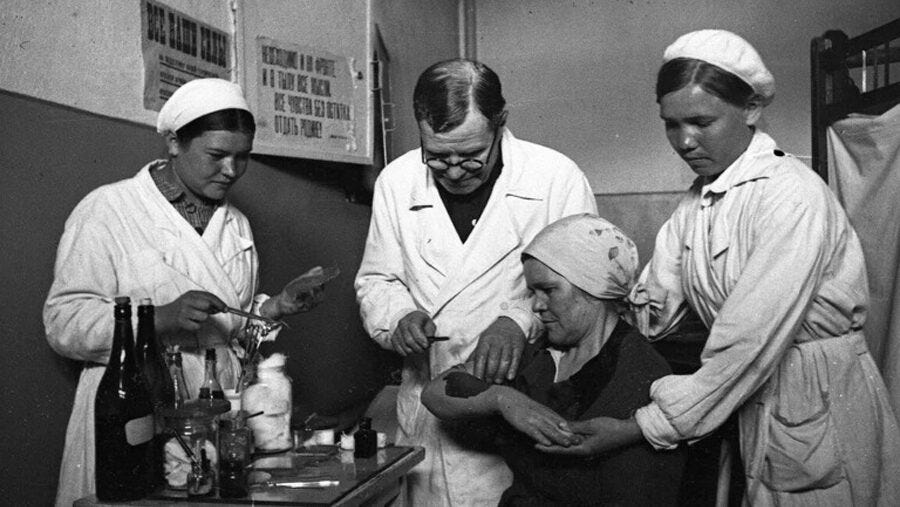
The Semashko System: Healthcare as a State Duty
Soviet healthcare was based on the Semashko model, named after Nikolai Semashko, the first People’s Commissar of Health. The core idea was simple and radical for its time:
- Healthcare was universal and free at the point of use
- All medical institutions were owned and run by the state
- Doctors were state employees
- Emphasis was placed on prevention, not just treatment
This model allowed the USSR to rapidly expand medical coverage, especially in rural and previously neglected areas.
Major Early Successes
In the first decades of Soviet rule, healthcare improved dramatically:
- Life expectancy rose sharply from pre-revolutionary levels
- Mass vaccination campaigns reduced infectious diseases
- Epidemics like typhus and cholera were largely brought under control
- Medical education expanded quickly
For a country devastated by war, revolution, and poverty, these were genuine achievements.
Healthcare for Everyone — At Least in Theory
Every citizen was entitled to care regardless of income. There were:
- Polyclinics for routine care
- Hospitals for specialized treatment
- Sanatoriums for recovery and prevention
- Workplace doctors and school medical services
In urban areas, access was usually decent. In rural regions, even basic care was often a major improvement compared to the Tsarist era.
Quantity Over Quality
The system’s biggest structural problem was its obsession with numbers. Success was measured by:
- Number of hospital beds
- Number of doctors
- Number of procedures performed
This led to strange outcomes:
- Overcrowded hospitals
- Unnecessary hospitalizations
- Short doctor visits
- Outdated treatment methods
Quality of care was hard to measure, so it was often ignored.
Chronic Shortages and Outdated Medicine
Despite being free, Soviet healthcare suffered from constant shortages:
- Modern medical equipment
- New pharmaceuticals
- Disposable supplies
Many hospitals relied on aging technology well into the 1980s. Western medical advances — especially in pharmaceuticals, imaging, and surgery — often reached the USSR late or not at all.
Doctors: Respected but Poorly Paid
Doctors were highly educated and socially respected, but poorly compensated. This created problems:
- Low morale
- Side payments and informal gifts became common
- Talented professionals had little incentive to innovate
The system discouraged specialization and research unless it aligned with state priorities.
Politics Over Science
Ideology sometimes interfered with medicine. The most infamous example was Lysenkoism, which damaged Soviet biology and genetics for decades. Although healthcare was less affected than agriculture, political pressure still shaped research, approvals, and treatment standards.
International cooperation was limited, slowing scientific exchange.
Inequality Behind the Equality
Officially, everyone was equal. In practice, there were different tiers:
- Elite clinics for party officials
- Better hospitals in major cities
- Special access to imported medicines for high-ranking individuals
Ordinary citizens often faced long waits and limited options.
The Late Soviet Decline
By the 1970s and 1980s, the system was struggling:
- Rising rates of alcoholism and chronic disease
- Falling life expectancy, especially among men
- Infrastructure decay
- Increasing gap with Western healthcare standards
The system was large, rigid, and resistant to reform.
Legacy of Soviet Healthcare
After the collapse of the USSR, many former Soviet states retained elements of the Semashko model while introducing insurance systems, private clinics, and market incentives.
The Soviet healthcare system left a mixed legacy:
- Universal access was a real achievement
- Quality, innovation, and efficiency were persistent weaknesses
Conclusion
Soviet healthcare proved that universal, free medical care on a massive scale was possible — even in a poor and war-torn country. But it also showed the limits of a system that prioritized ideology, statistics, and control over flexibility, innovation, and patient experience.
Like much of the USSR itself, it was ambitious, uneven, and ultimately unsustainable without deep reform.
메타데이터
- post_id
- 9c89f2f65d14
- slug
- healthcare-in-the-ussr-free-for-all-efficient-on-paper-complicated-in-reality-9c89f2f65d14
- url
- https://medium.com/@gwoltmann/healthcare-in-the-ussr-free-for-all-efficient-on-paper-complicated-in-reality-9c89f2f65d14
- canonical_url
- https://medium.com/@gwoltmann/healthcare-in-the-ussr-free-for-all-efficient-on-paper-complicated-in-reality-9c89f2f65d14
- author_url
- https://medium.com/@gwoltmann
- status
- ok
- fetched_at
- 2026-08-10 16:44:30