From U.S. Stocks to Hong Kong and Korean Equities: Tokenized Stocks Are Entering the Regional…
Over the past period, many market discussions have focused on bringing U.S. equities into tokenized formats.
From U.S. Stocks to Hong Kong and Korean Equities: Tokenized Stocks Are Entering the Regional Market Stage
Over the past period, many market discussions have focused on bringing U.S. equities into tokenized formats.
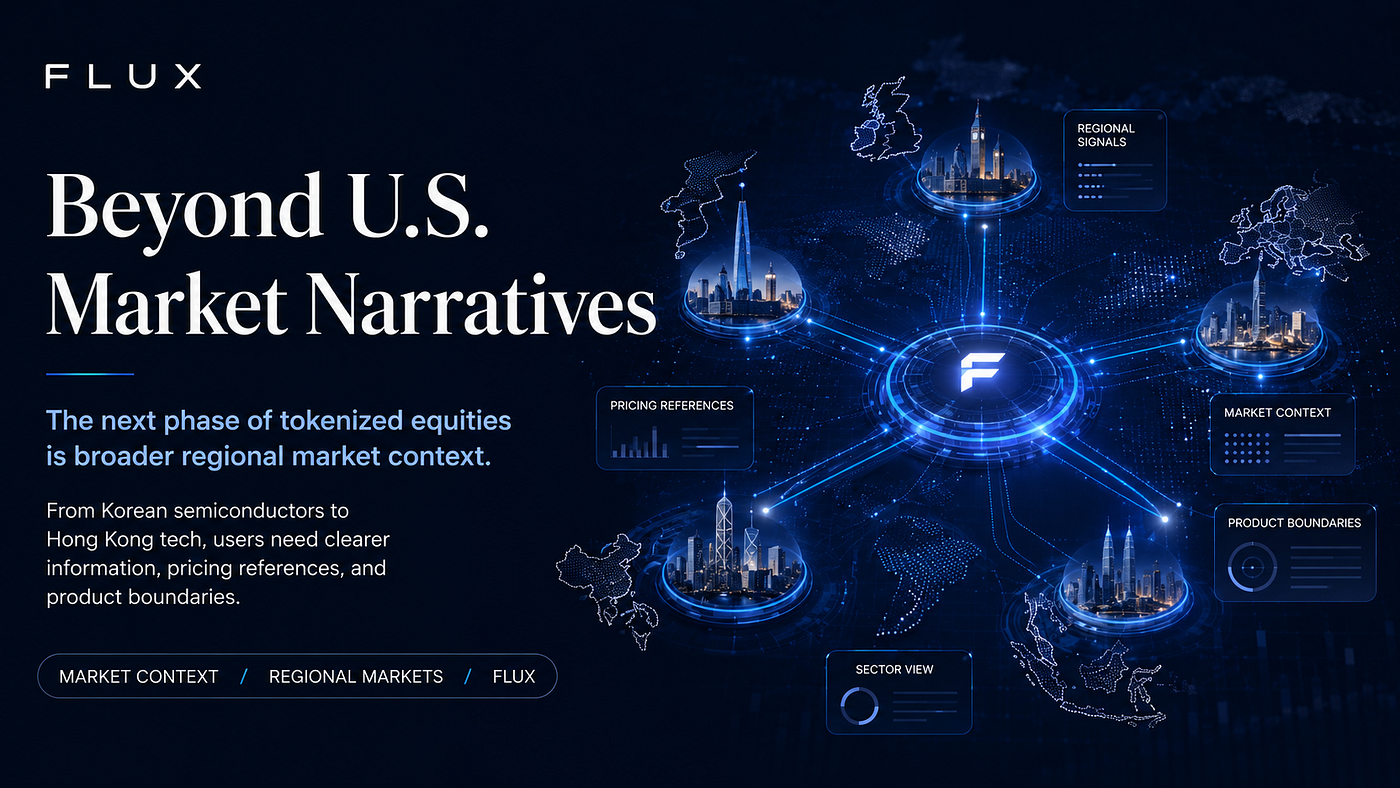
This is easy to understand. The U.S. stock market is one of the most familiar, liquid, and transparent markets for global users. Companies such as Apple, Nvidia, Tesla, and Microsoft have strong global recognition, relatively low user education costs, and deep public information coverage. For many users who are familiar with digital assets, U.S. large-cap equities have naturally become one of the first areas through which they understand the idea of tokenized market exposure.
But if tokenized equities remain limited to U.S. stocks, the discussion is still incomplete. It may represent a mature market displayed in a new format, rather than a broader understanding of the global asset landscape. Global markets do not revolve only around U.S. large-cap companies. Supply chains, industry cycles, capital flows, and regional market structures are distributed across different countries and exchanges.
Some tokenized equity initiatives are beginning to explore markets beyond U.S. assets, including regions such as Hong Kong, the United Kingdom, Europe, and South Korea. This signal is important because it shows that market interest is no longer limited to turning U.S. stocks into token-like representations. The first phase tested whether users were interested in understanding equity exposure through digital asset interfaces. The next phase may test whether users can better understand broader regional markets, pricing references, and product boundaries in a transparent way.
The meaning of regional markets lies in the fact that they represent different industrial structures and market contexts. South Korea has semiconductors, memory chips, batteries, and important parts of the AI supply chain. Companies such as SK Hynix and Samsung are not U.S. technology stocks, but they occupy important positions in AI infrastructure. AI needs GPUs, but it also depends on HBM, memory, wafer manufacturing, advanced packaging, materials, and equipment. If users only look at U.S. companies, it is difficult to fully understand how the AI supply chain is distributed globally.
Hong Kong markets have a different meaning. Hong Kong connects Chinese technology, internet, consumer, healthcare, new energy, and financial companies, while also standing at the intersection between international capital and Chinese enterprises. Many Chinese companies may not be primarily represented through U.S. markets, but they still reflect real industrial trends and regional market dynamics. For global users, Hong Kong is not simply a peripheral market. It is an important window for understanding Chinese technology, consumption, and capital market structure.
The U.K. market brings another structure, including financials, energy, mining, consumer brands, and multinational companies. London has long connected European capital markets, dollar liquidity, resource assets, and global companies. Its market structure is different from U.S. technology stocks and provides another perspective for understanding global industries. In the future, if tokenized market products continue to cover the U.K., Europe, South Korea, Hong Kong, and other regions where available and compliant, users may see not only a few popular tickers, but a more complete global market map.
This means the discussion around tokenized equities is gradually evolving from U.S.-focused narratives toward broader regional market context. Early platforms can attract attention by referencing U.S. large-cap stocks because these assets are easier to understand and communicate. But in the next stage, what truly matters is not simply who can list more tickers. It is who can present core assets, market structures, pricing references, access models, and risk information across different regions in a clearer and more responsible way.
Regional market expansion also brings higher requirements. Korean assets involve local currency, local trading systems, and specific industry cycles. Hong Kong stocks involve Hong Kong dollar pricing, liquidity structures, and policy expectations. U.K. and European assets involve different regulations, currencies, and market conventions. Users do not need only the name of a tokenized stock product. They need to understand where the price comes from, what the product represents, how market information is referenced, what risks may exist, and what limitations apply in different jurisdictions.
Otherwise, globalization becomes only a longer asset list, not a better user experience.
Therefore, the next stage of tokenized equities should not be understood only as adding more U.S. tickers. It should be understood as helping users build a clearer view of regional markets and global industry structures. U.S. technology, Korean semiconductors, Hong Kong technology, Chinese consumption, U.K. financials, European healthcare, Japanese manufacturing, and Taiwanese chips are all part of the broader global market picture.
Flux’s long-term value should also be understood within this trend. Flux should not be viewed as simply connecting users to one market or turning digital capital into a set of trading buttons. Its focus is to help stablecoin users better understand market data, pricing logic, regional asset context, and access paths where supported by applicable rules and product availability. U.S. equities may be one starting point because they are mature, familiar, and widely followed. But a more valuable user experience in the future should gradually help users understand more regional markets, clearer product boundaries, and more transparent market information.
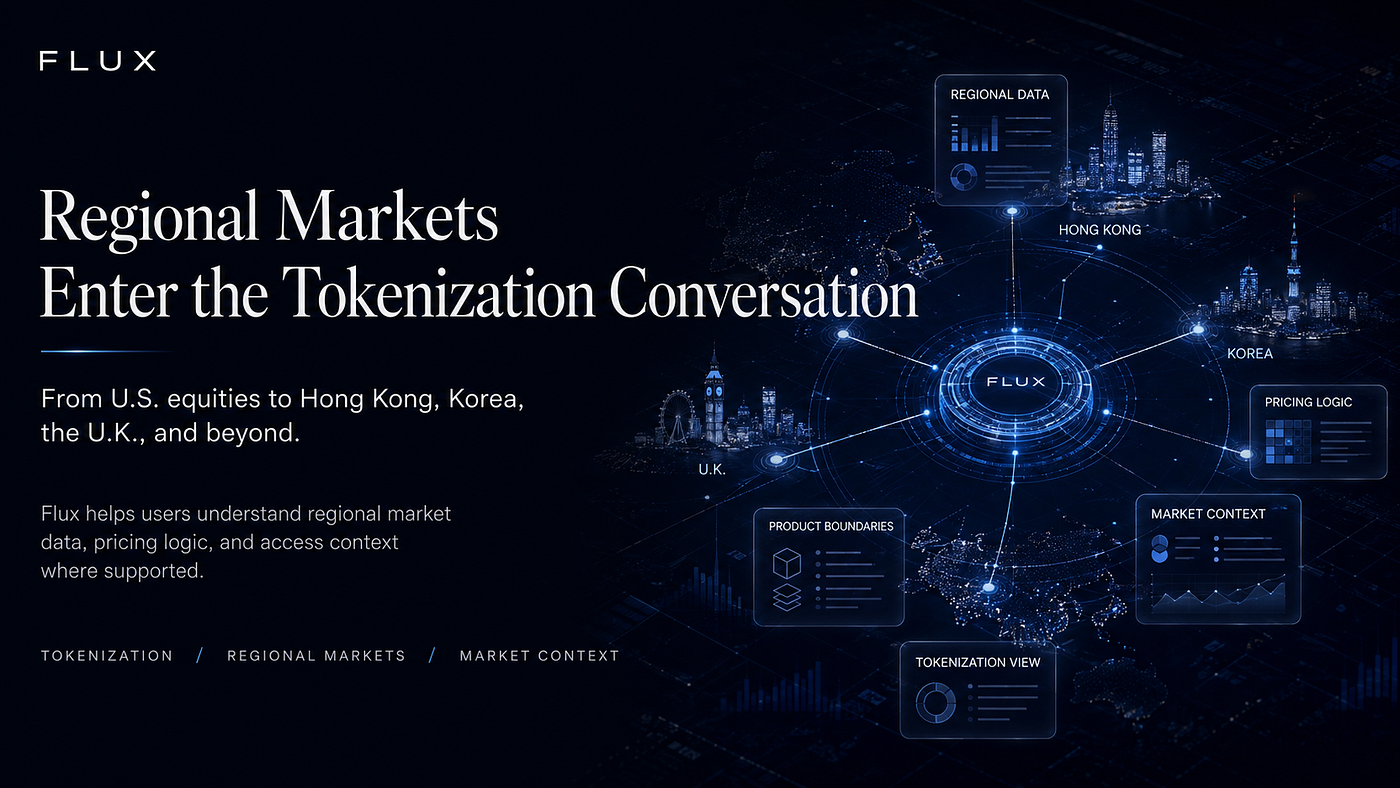
The future of tokenized market access should not be only about creating more asset labels. It should be about improving how users understand global markets, how prices are referenced, how risks are explained, and how access paths are presented responsibly. As digital-dollar users become more familiar with real-world market information, the next step is not simply more products. It is clearer context, stronger transparency, and a more responsible bridge between digital capital and global market understanding.
Disclaimer: This article is for informational purposes only and does not constitute investment advice, financial advice, legal advice, or a recommendation to buy, sell, or hold any asset. Product availability, market access, and related services may vary by jurisdiction and applicable regulations.
메타데이터
- post_id
- 9c8a4b23c461
- slug
- from-u-s-stocks-to-hong-kong-and-korean-equities-tokenized-stocks-are-entering-the-regional-9c8a4b23c461
- url
- https://medium.com/@c7gv17epaw/from-u-s-stocks-to-hong-kong-and-korean-equities-tokenized-stocks-are-entering-the-regional-9c8a4b23c461
- canonical_url
- https://medium.com/@c7gv17epaw/from-u-s-stocks-to-hong-kong-and-korean-equities-tokenized-stocks-are-entering-the-regional-9c8a4b23c461
- author_url
- https://medium.com/@c7gv17epaw
- status
- ok
- fetched_at
- 2026-08-06 22:33:55



