The Biggest Endpoint Security Challenge Isn’t Malware — It’s Visibility
https://appdirs.com/
The Biggest Endpoint Security Challenge Isn’t Malware — It’s Visibility
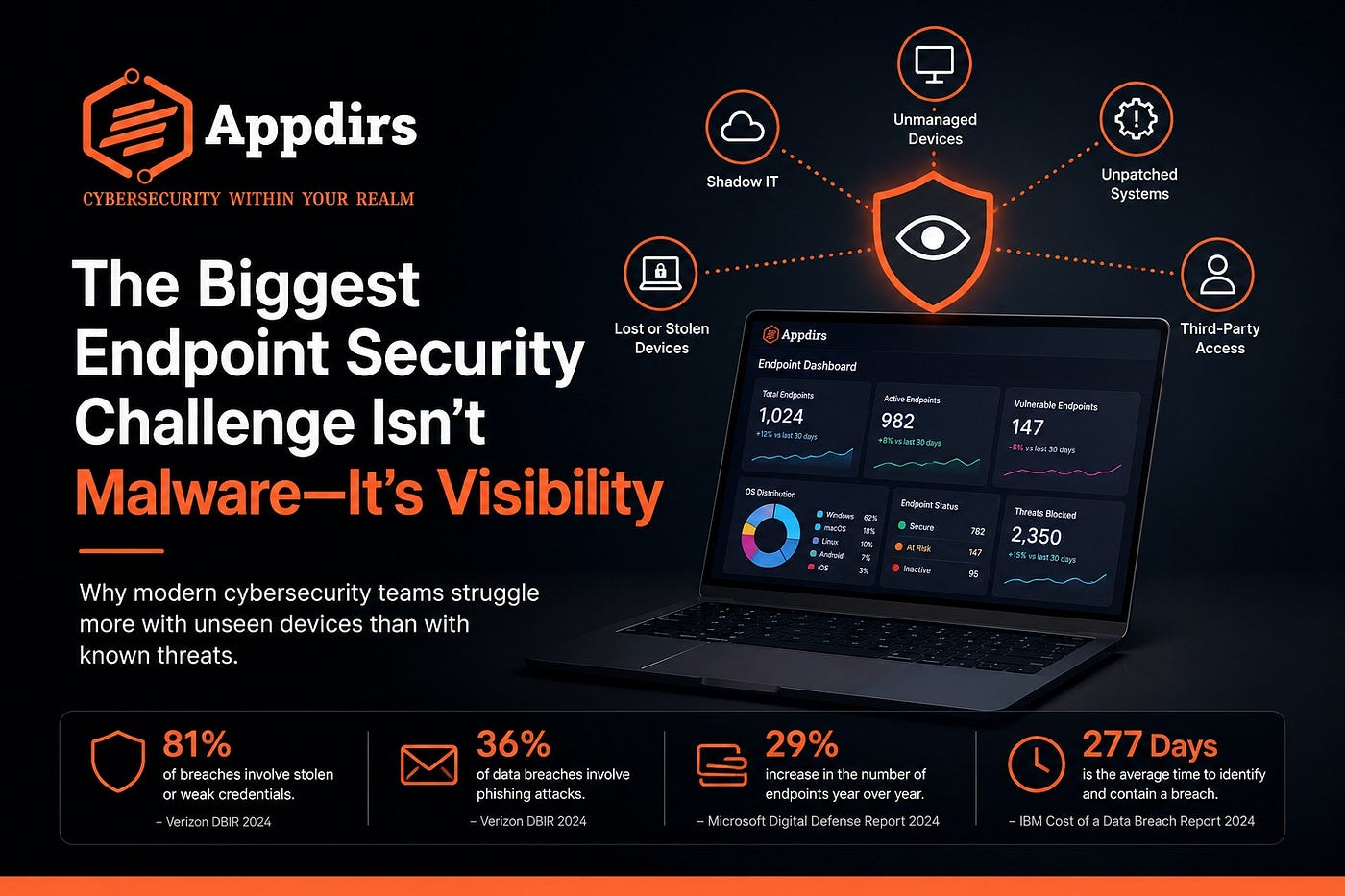
Why modern cybersecurity teams struggle more with unseen devices than with known threats
Most organizations believe their biggest endpoint security risk is malware.They’re wrong.
The larger problem is visibility.
Security teams can’t defend devices they don’t know exist.
A laptop used by a contractor. A former employee’s device that still has access credentials. A personal smartphone connecting to business applications. An unpatched workstation operating outside standard security policies.
These visibility gaps create opportunities for attackers long before malware ever enters the picture.
As organizations embrace remote work, cloud applications, mobile devices, and hybrid IT environments, endpoints have become one of the most attractive targets for cybercriminals. But the challenge facing security teams today isn’t simply stopping threats — it’s maintaining visibility and control across an increasingly distributed environment.
In this guide, we’ll explore what endpoint security is, why visibility has become its most important component, how modern endpoint protection works, and what organizations should consider when evaluating endpoint security solutions.
What Is Endpoint Security?
Endpoint security is the practice of protecting devices that connect to an organization’s network from cyber threats.
These devices, known as endpoints, include:
- Desktop computers
- Laptops
- Smartphones
- Tablets
- Servers
- Point-of-sale systems
- Internet of Things (IoT) devices
Every endpoint represents a potential entry point for attackers. Because employees use these devices daily to access applications, data, and company resources, endpoints are often the first target in phishing campaigns, malware attacks, and ransomware incidents.
Endpoint security combines technologies, policies, and monitoring capabilities to detect, prevent, and respond to threats affecting these devices.
Why Endpoint Security Matters More Than Ever
The growth of remote work, cloud adoption, and mobile computing has dramatically expanded the number of endpoints organizations must protect.
Industry research consistently shows that compromised credentials, phishing attacks, and endpoint-based attacks remain among the most common entry points for cybercriminals. Security teams must now secure hundreds — or even thousands — of endpoints across laptops, smartphones, tablets, remote workstations, and cloud-connected devices.
The challenge is no longer simply preventing malware.
It’s maintaining visibility and control across an environment that changes daily.
The Numbers Behind the Endpoint Security Problem
The endpoint landscape is growing faster than many organizations can manage.
According to IBM’s Cost of a Data Breach Report, stolen or compromised credentials continue to rank among the most common causes of security breaches, often providing attackers with direct access to endpoint devices and business applications.
Microsoft’s security research has also highlighted how phishing and identity-based attacks remain among the most successful techniques used by threat actors to gain access to corporate environments.
For organizations embracing remote work, contractors, third-party vendors, and bring-your-own-device (BYOD) policies, every new device and application introduces another potential blind spot.
The result is a simple reality:
Most organizations aren’t struggling because they have too much malware. They’re struggling because they don’t have complete visibility into what they’re supposed to protect.
Common Endpoint Security Threats
Modern endpoints face a wide range of cybersecurity threats.
Malware
Malware is malicious software designed to damage systems, steal information, or provide attackers with unauthorized access.
Examples include:
- Trojans
- Spyware
- Worms
- Rootkits
Ransomware
Ransomware encrypts files and systems, preventing access until a ransom is paid.
Many of the most disruptive cyberattacks in recent years have involved ransomware spreading through compromised endpoints.
Phishing Attacks
Phishing remains one of the most successful attack methods.
Attackers use fraudulent emails, messages, or websites to trick users into:
- Revealing passwords
- Downloading malware
- Approving unauthorized transactions
Zero-Day Exploits
A zero-day exploit targets a software vulnerability before a patch is available.
Because there is no immediate fix, organizations rely heavily on endpoint security tools to detect suspicious behavior and reduce risk.
Insider Threats
Not all threats come from external attackers.
Employees, contractors, or partners can accidentally — or intentionally — compromise sensitive information.
How Endpoint Security Works
Modern endpoint security solutions use multiple layers of protection rather than relying solely on traditional antivirus technology.
Threat Prevention
Known malicious files, websites, and applications are identified and blocked before they can execute.
Behavioral Analysis
Advanced security solutions monitor application and user behavior to detect suspicious activities.
For example, if a legitimate application suddenly begins encrypting hundreds of files, the system may identify this as ransomware behavior and stop it automatically.
Real-Time Monitoring
Endpoint activity is continuously monitored for signs of compromise.
This enables security teams to identify threats as they emerge rather than after damage has already occurred.
Automated Response
Modern solutions can automatically:
- Isolate infected devices
- Terminate malicious processes
- Block suspicious network connections
- Trigger remediation workflows
Centralized Management
Security administrators can monitor and manage all endpoints from a single dashboard, improving visibility and reducing operational complexity.
A Real-World Visibility Problem
Consider a mid-sized company with 500 employees.
The IT department believes it manages approximately 700 devices across laptops, mobile phones, and workstations.
After conducting a comprehensive asset discovery assessment, the security team uncovers:
- Former employee laptops that still have active access credentials
- Contractor devices connecting through unmanaged networks
- Personal smartphones accessing cloud applications
- Test systems that haven’t received security updates in months
- Remote workstations operating outside standard security policies
Suddenly, the organization realizes it isn’t managing 700 endpoints.
It’s managing closer to 1,000.
The issue wasn’t that malware bypassed security controls.
The issue was that security teams couldn’t fully see what existed within the environment.
Attackers frequently exploit these visibility gaps because unmanaged devices often lack monitoring, patching, and security controls.In many cases, the most vulnerable endpoint is the one nobody realizes is there.

Why Visibility Is the Real Endpoint Security Challenge
When people think about endpoint security, they typically focus on stopping malware, ransomware, and phishing attacks.
Those threats matter.
But they’re not the root problem.
The real challenge is visibility.
Security teams can only protect what they know exists.
If an organization cannot confidently answer questions such as:
- How many devices are connected to company resources?
- Which endpoints are missing critical patches?
- Which devices are unmanaged?
- Which users are accessing sensitive applications?
- Which endpoints are exhibiting suspicious behavior?
then even the most advanced security tools become less effective.
Organizations often invest heavily in threat detection technologies while overlooking a fundamental reality: unmanaged or unknown endpoints frequently sit outside those protections altogether.
This is why many cybersecurity leaders increasingly view endpoint security as an asset visibility problem first and a malware problem second.
Malware, ransomware, and phishing attacks are often symptoms.
A lack of visibility is the underlying condition that allows those threats to succeed.
The future of endpoint security isn’t simply about detecting threats faster.
It’s about building complete visibility across every device, user, application, and access point within the environment.
Because the endpoint you can’t see is often the endpoint that creates the greatest risk.
Endpoint Security vs. Traditional Antivirus
Many organizations still assume antivirus software is enough.
While antivirus remains useful, modern endpoint security provides significantly broader protection.
Traditional Antivirus
Modern Endpoint Security
Detects known malware signatures
Detects known and unknown threats
Limited visibility
Centralized endpoint visibility
Reactive protection
Proactive threat detection
Minimal response capabilities
Automated response and remediation
Focused on malware
Protects against multiple attack types
The cybersecurity landscape has evolved, and security solutions must evolve with it.
Best Practices for Endpoint Security
Technology alone cannot eliminate risk.
Organizations should combine security tools with strong security practices.
Keep Systems Updated
Apply operating system and application patches promptly.
Unpatched vulnerabilities remain one of the most common attack vectors.
Enable Multi-Factor Authentication (MFA)
MFA significantly reduces the likelihood of account compromise.
Train Employees Regularly
Security awareness training helps users recognize phishing attempts and social engineering attacks.
Monitor Endpoint Activity
Continuous monitoring improves visibility and helps identify threats before they escalate.
Adopt a Zero Trust Strategy
Never automatically trust users or devices.
Verify access requests continuously based on risk and context.
Endpoint Security Is Becoming a Visibility Problem
For years, endpoint security was primarily a prevention problem.
Organizations focused on blocking malware before it reached users.
Today, the challenge is different.
Security teams are overwhelmed by device sprawl, remote work, cloud applications, third-party access, and increasingly complex IT environments.
The organizations that reduce risk most effectively are often not the ones with the most security tools.
They are the ones with the clearest visibility into their environment.
Without visibility, detection becomes harder.
Response becomes slower.
Risk becomes harder to measure.
And attackers gain more opportunities to operate unnoticed.
How Appdirs Supports Modern Endpoint Security
Organizations evaluating endpoint security solutions should look beyond malware detection and consider visibility, device management, vulnerability management, compliance monitoring, and operational simplicity.
Platforms such as Appdirs are designed around this broader approach, helping organizations improve visibility while reducing the complexity of managing multiple disconnected security tools.
As endpoint environments continue to expand, a unified approach can help security teams better understand, monitor, and secure their entire device ecosystem.
Frequently Asked Questions
Is endpoint security the same as antivirus?
No.
Antivirus software primarily focuses on detecting known malware, while endpoint security includes monitoring, threat detection, response, visibility, vulnerability management, and broader protection capabilities.
Do small businesses need endpoint security?
Absolutely.
Small businesses are frequently targeted because attackers often assume they have fewer security resources and weaker defenses.
What devices require endpoint protection?
Any device connected to a network should be protected, including laptops, desktops, smartphones, tablets, servers, and IoT devices.
Can endpoint security prevent ransomware?
While no solution can guarantee complete protection, modern endpoint security platforms can significantly reduce ransomware risk through detection, prevention, monitoring, and automated response capabilities.
Final Thoughts
Endpoint security is no longer just about preventing malware infections.
As organizations expand across remote work environments, cloud platforms, mobile devices, and third-party access points, visibility has become the foundation of effective security.
Before security teams can detect, respond, or remediate threats, they must first understand exactly what devices exist, who is using them, and how those devices are accessing organizational resources.
The most effective endpoint security strategies combine technology, visibility, user awareness, and proactive risk management.
Whether you’re evaluating your first endpoint security solution or modernizing an existing security stack, understanding how endpoint protection fits into your broader cybersecurity strategy is a critical step toward building a more resilient organization.
Because in modern cybersecurity, you can’t secure what you can’t see.
메타데이터
- post_id
- 9c99f8a87b68
- slug
- the-biggest-endpoint-security-challenge-isnt-malware-it-s-visibility-9c99f8a87b68
- url
- https://medium.com/@contact_38858/the-biggest-endpoint-security-challenge-isnt-malware-it-s-visibility-9c99f8a87b68
- canonical_url
- https://medium.com/@contact_38858/the-biggest-endpoint-security-challenge-isnt-malware-it-s-visibility-9c99f8a87b68
- author_url
- https://medium.com/@contact_38858
- status
- ok
- fetched_at
- 2026-06-24 23:31:39

