Deterministic Guardrails: The Least Sexy Idea in Agentic AI Is the One Keeping Agents Employed
Everyone sells agent autonomy. The agents actually surviving production are the ones wrapped in rigid, boring, un-clever code that refuses…
Deterministic Guardrails: The Least Sexy Idea in Agentic AI Is the One Keeping Agents Employed
Everyone sells agent autonomy. The agents actually surviving production are the ones wrapped in rigid, boring, un-clever code that refuses to let the model improvise. Here’s why constraint — not intelligence — is what ships.
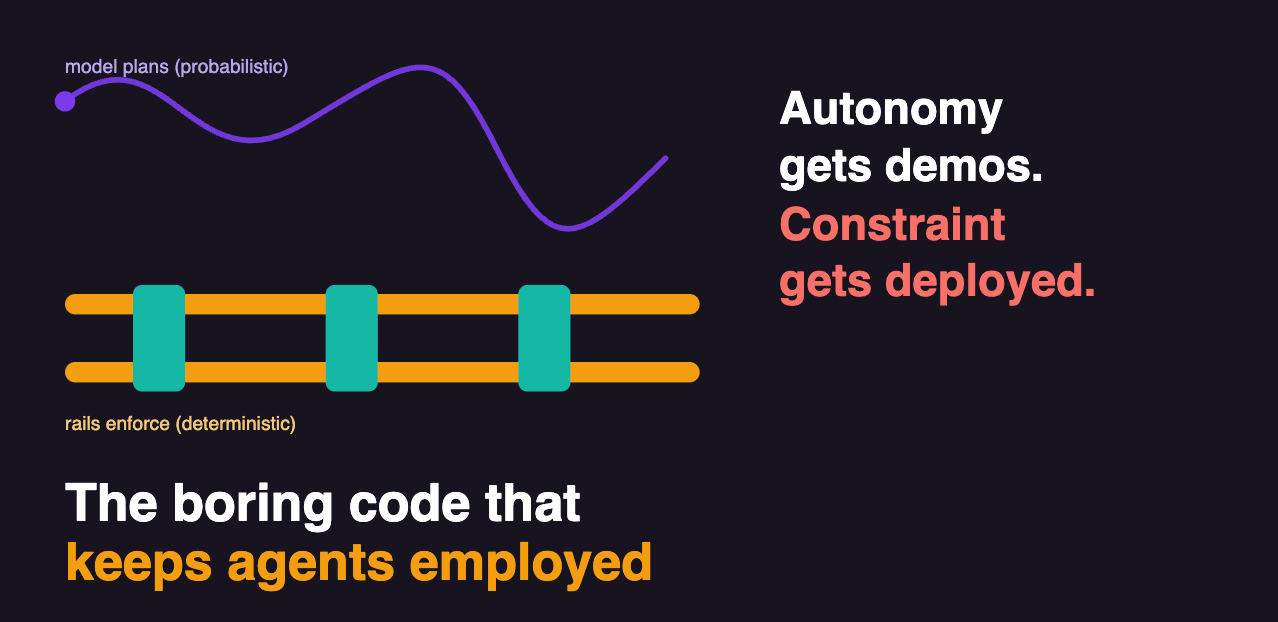
Picture the two agents that live in every company experimenting with this technology. The first is the demo agent: fully autonomous, reasons out loud, dazzles the room, decides everything for itself. The second is the production agent: quietly doing real work six months later, and — if you look under the hood — wrapped in so much rigid, un-clever, hard-coded plumbing that it barely looks “agentic” at all.
Here’s the part nobody puts on a conference slide: they are often the same underlying model. The difference between the agent that wowed the room and the agent that’s still employed isn’t intelligence. It’s the boring code wrapped around it — the code that refuses to let the model improvise on the things that matter.
That boring code has a name. It’s called deterministic guardrails, and I’ve come to believe it’s the most underrated idea in the entire field.
First, the two words — in plain language
Deterministic is just a fancy word for predictable: same input, same output, every single time. Traditional software is deterministic — 2 + 2 returns 4 today, tomorrow, and on your worst day in production. A pocket calculator is deterministic.
Large language models are the opposite — they’re probabilistic. They generate outputs from likelihoods, not fixed rules, which is exactly why the same prompt can give you a brilliant answer on Monday and a baffling one on Tuesday. That flexibility is the whole magic of agents. It’s also the whole danger.
A guardrail is a piece of ordinary, deterministic code that sits around the probabilistic model and enforces rules the model is not allowed to break — no matter how confidently it wants to. The model gets to be creative about how to solve your problem. The guardrail makes sure it can’t be “creative” about refunding ₹90,000 to someone who never asked, or emailing your customer list to a stranger.
The model is the improviser. The guardrail is the part of the band that refuses to change key mid-song.
Why a smart model isn’t enough
The instinct — I had it too — is that a smarter model needs fewer guardrails. If the model is capable enough, won’t it just do the right thing?
No, and the reason is structural, not a matter of model quality. A probabilistic system will, by definition, occasionally produce an unlikely output. Ninety-nine times it refunds the correct amount; the hundredth time it misreads the context and refunds ten times too much. You cannot prompt your way out of this — “please always double-check the amount” reduces the odds, but reducing odds is not the same as making something impossible. And in production, “unlikely” runs headfirst into scale.
This is the mental shift that separates people who’ve shipped agents from people who’ve only demoed them. A demo runs the happy path five times. Production runs the agent ten thousand times a day across every weird input real users invent — and an unlikely failure, run ten thousand times a day, stops being unlikely; it becomes Tuesday. At that volume, a one-in-a-thousand catastrophe isn’t a tail risk. It’s a daily occurrence. Deterministic guardrails exist to make the catastrophic outputs not merely unlikely, but structurally impossible.
The move: separate what the model decides from what the code enforces
Here’s the whole philosophy in one sentence: let the model plan, but never let the model be the thing that enforces a rule that actually matters.
Think of an air traffic controller and a pilot. The pilot (the model) has enormous freedom in how to fly the plane. But the controller (the guardrail) enforces a few non-negotiables — you do not land on a runway that’s occupied, full stop — and no amount of pilot brilliance or confidence overrides them. The rules that protect lives aren’t left to in-the-moment judgment. They’re enforced by a system that sits outside the judgment.
Concretely, that means certain steps happen in a fixed order, certain limits are hard caps, and certain actions are simply unavailable to the model. Here’s what it looks like in real, runnable code — a refund guardrail with three rails the model cannot talk its way past:
class GuardrailError(Exception):
    pass

REFUND_LIMIT = 5000  # rupees
def execute_refund(state, amount):
    # Rail 1: identity MUST be verified before any refund, always.
    if not state.get("identity_verified"):
        raise GuardrailError("blocked: refund before identity check")
    # Rail 2: a hard cap the model cannot argue past.
    if amount > REFUND_LIMIT:
        raise GuardrailError(f"blocked: {amount} over limit -> human required")
    # Rail 3: idempotency -- never double-refund the same order.
    if state.get("refunded"):
        raise GuardrailError("blocked: order already refunded")
    state["refunded"] = True
    return f"refunded {amount}"
Notice what this code is not. There’s no model in it. No prompt, no “please be careful,” no cleverness. It’s the kind of dull, defensive code any backend engineer has written a thousand times — and that’s precisely the point. When I ran an agent against these rails, every dangerous move got stopped cold: the attempt to refund before verifying identity — blocked. The attempt to refund above the limit — blocked, routed to a human. The attempt to refund the same order twice — blocked. The model can propose all of these. It cannot execute any of them. That gap is the entire product.
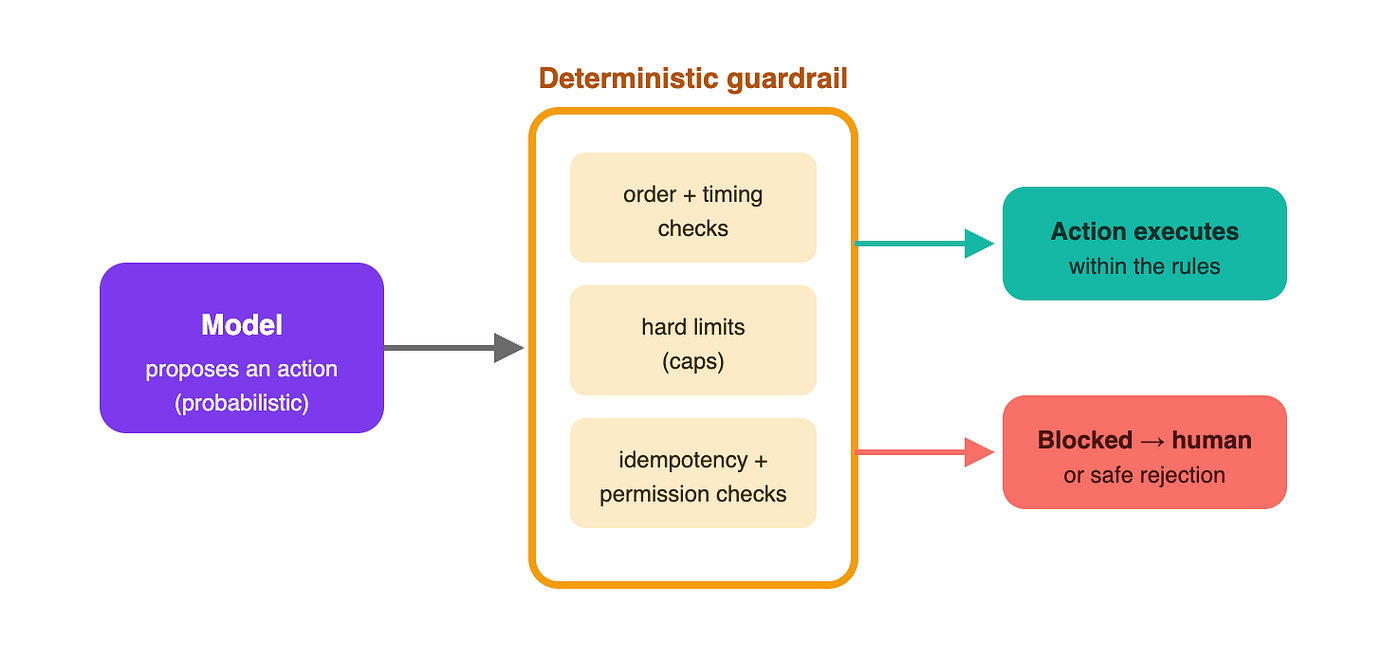
The guardrail sits between proposal and execution. The model (purple) is free to propose any action. Nothing reaches the outside world until it passes deterministic checks (amber) — correct order and timing, hard limits, permissions, and idempotency (no accidental repeats). Safe actions execute (teal); rule-breaking ones are blocked and routed to a human (coral). The model’s creativity is preserved; its blast radius is not.
The four rails worth knowing by name
You don’t need a framework to start — most guardrails are plain code. Four types cover the vast majority of production needs:
- Sequence rails — enforce that steps happen in a required order. Verify identity before refunding; check inventory before promising delivery. The model can’t reorder safety-critical steps.
- Limit rails — hard caps on amounts, counts, and spend. Refunds over ₹5,000 need a human; the agent can never exceed a set cost per task. A ceiling the model cannot negotiate past.
- Permission rails — the model simply doesn’t have access to certain tools or data. The safest dangerous action is the one that isn’t reachable at all.
- Idempotency rails — a piece of jargon worth learning: idempotent means doing something twice has the same effect as doing it once. It stops the classic agent disaster where a retry loop sends the same email — or the same refund — five times.
The theme running through all four: the interesting thinking stays with the model; the dangerous doing gets constrained by code.
“Isn’t this just… a normal program? Why call it an agent?”
This is the strongest objection, and it deserves a real answer rather than a dodge. If you’re hard-coding the order of steps, the limits, and the permissions — haven’t you strangled the very autonomy that made it an agent? Isn’t this just a workflow with a language model bolted on?
Sometimes, honestly, yes — and that’s a feature. For a huge share of real tasks, a mostly-deterministic workflow with the model handling a few genuinely fuzzy steps is not a compromised agent; it’s the correct design, and pretending otherwise is how projects die. For a surprising number of workflows, a plain state machine with a model in a few slots beats a “real” agent — and calling that a lesser design is vanity, not engineering.
But the framing is a false binary. Guardrails don’t eliminate autonomy — they bound it, and bounded autonomy is exactly what makes autonomy shippable. The model still decides which tools to call, in what combination, how to interpret a messy request, how to phrase a reply, when to ask a clarifying question. That’s enormous freedom.
The rails only remove freedom on the handful of actions where a wrong move is expensive or irreversible. You’re not caging the agent — you’re giving it a space large enough to be useful and small enough to be safe.
Guardrails don’t kill autonomy. They’re the reason anyone lets your agent have any.
Where the honest limits are
Two caveats, because guardrails aren’t magic. First, they cost latency. Every check runs before an action fires, and a heavy chain of them adds up — production teams in 2026 generally keep the whole guardrail budget within a few hundred milliseconds, or users start to feel the drag. Cheap deterministic checks first, expensive model-based checks only where needed.
Second, deterministic rails only catch what you can define in advance. They’re perfect for “never refund above ₹5,000” and useless for “is this response subtly off-brand?” — a fuzzy, judgment-based question. That’s the boundary where deterministic guardrails hand off to their probabilistic cousins: evals and LLM-as-judge checks, which I dug into in my last piece. The two aren’t rivals. The rule of thumb: if a rule can be written as plain code, it should be — and only the genuinely fuzzy stuff earns a model-based check.
Steal this starter checklist
- List your irreversible actions — anything involving money, external messages, or data deletion. These need rails first.
- For each, ask “what’s the worst valid-looking output?” — the plausible catastrophe, not the obvious error. That’s what a rail must make impossible.
- Write the rail as plain code, outside the model — no prompt is a guardrail; a prompt is a suggestion.
- Add hard caps and a human-handoff path — over the limit shouldn’t fail; it should escalate.
- Make every external action idempotent — so a retry can never double-charge, double-send, or double-delete.
- Keep the deterministic checks cheap and first — spend your latency budget wisely.
The unglamorous truth
The agent demos that go viral are selling autonomy — look how little we constrained it, look how much it figured out alone. The agents quietly generating value in production are selling the opposite, if they were honest about it: look how carefully we decided what this thing is not allowed to do.
That’s the trade the whole field is slowly, grudgingly learning. The winners aren’t the teams with the most autonomous agents. They’re the teams that turned a probabilistic model into a dependable business outcome — and you don’t get dependable from probability alone. You get it from the boring rails wrapped around the magic.
Autonomy gets the demo. Constraint gets the deployment.
Follow Think in AI Agents to catch it. And tell me in the comments: what’s the scariest action your agent can take with no human in the loop? The best answers become case studies in the new series.
Level up your skills with my Amazon eBooks
Get the The AI Agent Builder’s Playbook : Why AI Agent Projects Die in Production on Amazon.
Get the Copilot Studio for Architects: When to Use It, What It Really Costs, and How to Combine It with Pro-Code AI Agents on Amazon.
메타데이터
- post_id
- 9cbea9d04de8
- slug
- deterministic-guardrails-the-least-sexy-idea-in-agentic-ai-is-the-one-keeping-agents-employed-9cbea9d04de8
- url
- https://medium.com/system-design-mastery-series/deterministic-guardrails-the-least-sexy-idea-in-agentic-ai-is-the-one-keeping-agents-employed-9cbea9d04de8
- canonical_url
- https://medium.com/system-design-mastery-series/deterministic-guardrails-the-least-sexy-idea-in-agentic-ai-is-the-one-keeping-agents-employed-9cbea9d04de8
- author_url
- https://medium.com/@sureshdotariya
- status
- ok
- fetched_at
- 2026-07-14 22:43:35