Paradise Lost? Glamping in the Shadow of a Volcano
Experience tranquility and reflection at Glamping Teras Merapi, beneath the looming volcano’s shadow.
Paradise Lost? Glamping in the Shadow of a Volcano
A blanket of fog shrouded Teras Merapi, accompanied by a symphony of howling winds and a torrential downpour. Tents stood at attention outside, bracing themselves against the storm. Inside our pendopo, the wind howled like a wounded beast, seeping through the walls.
Water trickled through the ill-fitted aluminum window, forming puddles on the tattered plastic mat below. Raindrops, like tiny tears from the sky, added to the growing pool.
The biting cold, a stark contrast to the warmth I was used to, seeped into my bones, bringing an eerie silence. It was Saturday, November 30, 2024, just a few days after Auni’s wedding.
The storm outside mirrored the tempest within me. The wound in my heart, fresh and raw, felt like an unhealed scar. Seeking solace, I wandered through the mist-shrouded surroundings, hoping the mountain air might offer some clarity.
“Look at Mahéng, the akamsi (resident)!” Mas Jay chuckled. “Everyone else is bundled up, but he’s just in a T-shirt.”
A wry smile tugged at my lips. I was dressed simply, wearing a navy blue T-shirt with Gus Dur’s words emblazoned across the front: “Peace without justice is an illusion.” The words, heavy with meaning, weighed on my heart like a storm cloud.
The quote lingered in my mind and prompted me to contemplate justice in a broader context, not just for humanity but for the entire natural world.
The wind, like a restless narrator, carried questions I couldn’t ignore. We often profess social justice, but, how often do we think about ecological justice?
Nature, our generous provider, is often exploited for humanity’s endless wants. We claim to love nature, yet our actions betray us, pristine wildernesses littered with trash, forests felled in the name of “modern.”
Our anthropocentric worldview blinds us to the interconnectedness of all living things. Just as a smartphone becomes useless with one broken component, so too does nature falter when its balance is disrupted. A single tree cut down may seem inconsequential, but it can cripple an entire ecosystem.
When I speak of plants communicating or trees having conversations, many dismiss me as eccentric. Yet science continues to prove nature’s intelligence. A 2023 study published in Nature Communications Journal revealed subtle forms of plant communication. Titled “Green Leaf Volatile Sensory Calcium Transduction in Arabidopsis,” the research demonstrated how plants send signals to one another, reminding us that nature is far more complex than we often see and think.
So, what are the consequences of our anthropocentric worldview?
Our anthropocentric mindset reduces nature to something inanimate, free to take. Deforestation for food estates, housing developments, and other “necessities” disregards the delicate balance of ecosystems. The irony is that when nature fights back, with floods, landslides, or storms, we label it a disaster, ignoring that we caused the imbalance in the first place.
As darkness fell over the mountain, Merapi’s rugged volcanic peaks remained hidden behind a shroud of mist. The heavy silence that descended mirrored the unspoken wrath of a wounded earth. The fog seemed to carry nature’s grief, a silent protest against humanity’s injustices.
I stood there, surrounded by the chill and the whispers of the wind, wondering if 2024 would end on a hopeful note, or if we would remain lost in the fog, blind to the lessons nature has long been trying to teach us.
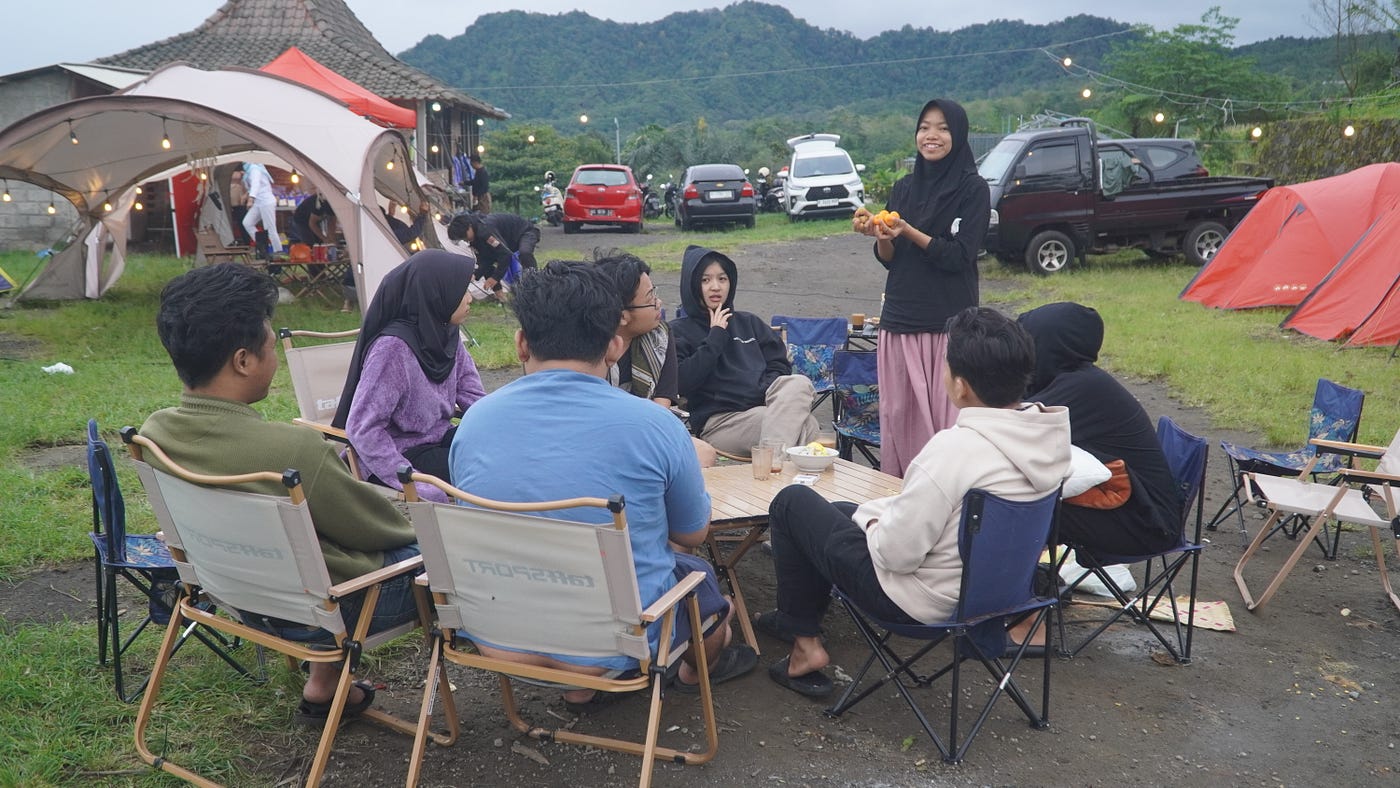
Embracing the tranquility amidst the fog and chill of Teras Merapi, where nature speaks louder than just a backdrop. Photo: Doc. Seknas Jaringan GUSDURian.
AFTER warming ourselves with a bowl of Soto on a chilly Sunday morning, December 1st, we kicked off the new month and year-end with a volcano tour. Eighteen sturdy jeeps, though a bit aged, were ready to take us on an adventure.
Just like city dwellers, constantly glued to our phones, we weren’t any different. Our cameras were at the ready, capturing every nook and cranny.
Our first stop was the Museum Mini Sisa Hartaku, or The House of Memory, located on Jalan Petung Merapi. Here, memories of the 2010 eruption were vividly preserved, offering a glimpse into the devastation it caused.
One of the jeep drivers led us to a burnt-out clock that had stopped working. This clock, frozen at 12:05 AM, marked the exact moment of the eruption on Friday, November 5, 2010. The eruption was accompanied by thunderous roars, volcanic earthquakes, and a rain of pebbles and ash, making the situation even more terrifying.

The melting and stopped clock marks the moment when Mount Merapi erupted. Photo: Personal Documentation.
From the museum’s front porch, we could see the remnants of Kimin and Wati’s former home, a place now steeped in sorrow. The inscriptions etched into the ruins spoke of a vibrant life once lived there, now lost to time.
Inside the museum, items like melted televisions, twisted bicycle frames, buckets, radios, and gamelan instruments were arranged to tell the story of destruction. The skeletal remains of livestock, too, added to the somber atmosphere.
Photographs taken during the eruption hung on the walls, transporting us back in time to witness the raw terror of a disaster that claimed 242 lives. Some of the quotes inscribed on the museum walls echoed the residents’ pain, some resigned, like “Everything is gone,” while others were philosophical, like “Merapi never breaks its promise.” These words served as a stark reminder of nature’s sheer power.
But the most thought-provoking statement came from the mountain itself: “Mount Merapi apologizes if its lava has hit, dragged, destroyed, or anything else, as it was simply following its natural flow.”

The inscription reads in Javanese, roughly meaning that Merapi apologizes for destroying the village with its hot lava. Photo: Personal Documentation.
This message stopped me in my tracks. Indeed, Merapi is merely a volcano doing what volcanoes do. The hot lava follows its natural path. It is we, humans, who often forget our place and build settlements where we shouldn’t. When we disrupt nature’s balance, we must not complain when nature retaliates.
FOLLOWING our selfie spree at the museum, our jeep drivers took us to Triangulation Hill, located within The Lost World Park. This hill marks the final boundary where humans are permitted to live on the slopes of Merapi. Beyond this point, settlements are strictly prohibited due to safety concerns.
At the summit, a 70-centimeter stone marker with a cross (x) symbol stands as a clear warning for this disaster-prone area. Dating back to the colonial era, this marker reinforces the long-standing prohibition on living in such a hazardous zone.
Triangulation Hill itself stands at around 70 meters and is surrounded by various photo spots, including a hobbit house, a miniature Mount Merapi, and the iconic Triangulation Hill sign. At the peak, a large joglo shelters the stone marker, providing a resting place for tourists after the steep steps.
However, I couldn’t shake the feeling that Triangulation Hill had become overly commercialized. It felt like any other photo spot, set against a backdrop of lush tropical vegetation with attractions like a flying fox.
Our final stop on the volcano tour was the Kaliadem Bunker in Kepuharjo, Cangkringan District, Sleman. Built-in the early 2000s by the Sleman Regency Government, this bunker was originally designed as a refuge from Merapi’s pyroclastic flows.
Yet, the bunker holds a tragic story. On June 14, 2006, Merapi erupted violently, unleashing a pyroclastic flow that engulfed the shelter. Two volunteers who had taken refuge inside were found dead, victims of the extreme heat that filled the confined space, measuring just 7 meters long, 2.5 meters wide, and 2.5 meters high, despite having ventilation and an iron door.
As we made our way back, one of my friends suddenly asked, “Why do humans find solace in the remnants of disaster?” This simple yet profound question lingered with me, serving as a poignant end to our trip, leaving us deep in thought as the jeep rumbled downhill [Mahéng].
메타데이터
- post_id
- 9d15f0d29f63
- slug
- paradise-lost-glamping-in-the-shadow-of-a-volcano-9d15f0d29f63
- url
- https://medium.com/@iamaheng/paradise-lost-glamping-in-the-shadow-of-a-volcano-9d15f0d29f63
- canonical_url
- https://medium.com/@iamaheng/paradise-lost-glamping-in-the-shadow-of-a-volcano-9d15f0d29f63
- author_url
- https://medium.com/@iamaheng
- status
- ok
- fetched_at
- 2026-07-21 17:23:18