Payment Posting Services: What Your Practice Needs to Know Before Choosing One
There is a step in the medical billing process that most practices do not think about until something goes wrong.
Payment Posting Services: What Your Practice Needs to Know Before Choosing One
There is a step in the medical billing process that most practices do not think about until something goes wrong.
Claims go out. Payments come back. And somewhere in the middle between the payer sending a remittance and your accounts receivable reflecting an accurate balance payment posting happens.
When it is done well, nobody notices. Cash flow is steady. AR is clean. Reports make sense. Everything lines up the way it should.
When it is done poorly, the problems are subtle at first. Small discrepancies in AR. Balances that do not quite add up. Secondary claims that never go out because the primary payment was never properly posted. Patient statements going out with wrong balances. And eventually a revenue leak that has been quietly running for months before anyone identifies the source.
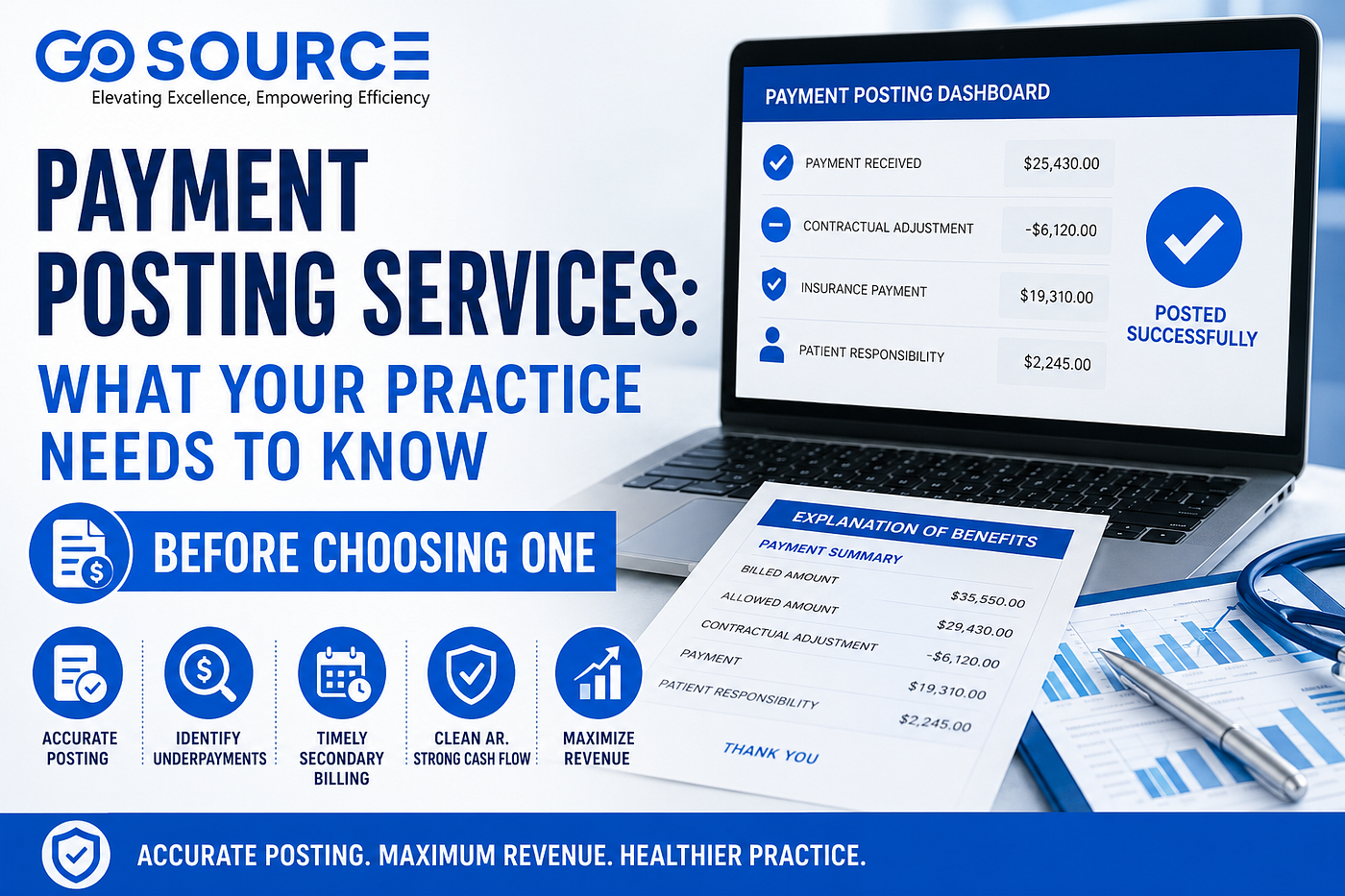
Payment posting is not the most glamorous part of medical billing. But it is one of the most consequential. And choosing the right payment posting service or evaluating whether your current one is performing is worth far more attention than most practices give it.
This blog breaks down exactly what payment posting services cover, what separates excellent from average, and the specific questions to ask before you trust this part of your revenue cycle to anyone.
Curious how billing errors affect speciality practices? — Read More here.
What Payment Posting Actually Is And Why It Is More Complex Than It Sounds
Payment posting is the process of recording payments received from insurance payers and patients into your practice management system and reconciling those payments against what was billed and what was contractually owed.
That definition sounds simple. In practice it involves several distinct workflows that all need to happen accurately and in the right sequence.
ERA and EOB processing. When a payer processes a claim, they send back either an Electronic Remittance Advice (ERA) or a paper Explanation of Benefits (EOB). Both documents explain what was paid, what was adjusted, what was denied, and why. Payment posting services receive these documents from dozens of payers simultaneously and record every line item accurately into your system.
ERA auto-posting has become the standard for high-volume practices. When configured correctly, ERA files from payers are automatically matched to outstanding claims and posted without manual entry. But auto-posting is not a set-it-and-forget-it function. ERA files need to be mapped correctly to your practice management system, exceptions need to be caught and handled manually, and the auto-posting logic needs to be reviewed regularly as payer formats change.
Contractual adjustment posting. Every payer has a contracted rate for every service. When a payer pays less than the billed amount, which is almost always, the difference between the billed charge and the allowed amount is posted as a contractual adjustment. Getting these adjustments right matters for two reasons. Incorrect adjustments create false AR balances that make your practice appear to be owed money it is not, inflating AR and distorting your financial reports. And incorrect adjustments can mask underpayment situations where the payer paid less than even the contracted rate that should be pursued.
Secondary billing. When a primary payer processes a claim and there is still a patient balance that may be covered by a secondary insurance plan, that secondary claim needs to be filed promptly. Payment posting is the trigger point. The moment the primary EOB or ERA is posted, the secondary billing workflow should begin automatically or through a defined manual process. When payment posting is slow or inaccurate, secondary billing gets delayed, secondary claims miss filing deadlines, and revenue that should have been collected from insurance ends up incorrectly billed to the patient or written off entirely.
Patient balance posting. After insurance payments and adjustments are applied, whatever remains is the patient’s responsibility. That balance needs to be clearly posted so patient statements reflect the correct amount. Errors in patient balance posting are one of the most common causes of patient billing disputes, and patient billing disputes damage the patient relationship while consuming staff time to resolve.
Underpayment identification. Every remittance that comes in needs to be checked against the contractual rate. Payers make payment errors; they apply the wrong fee schedule, they bundle services that should be paid separately, and they apply incorrect member cost-sharing. When payment posting is done by someone who is only recording what the payer sent without checking whether it is correct, underpayments accumulate silently.
The Difference Between Basic Payment Posting and Excellent Payment Posting
Most payment posting services do the basics. They receive remittances. They post payments. They apply adjustments. They send patient balances to the billing queue.
What separates excellent payment posting from adequate posting is what happens beyond the basics.
Underpayment review built into every remittance. Every payment received should be cross-referenced against the contracted rate for that payer before it is posted as final. If the payment is short even by a small amount, it should be flagged for follow-up rather than posted and forgotten. Over the course of a month the aggregate value of small underpayments across hundreds of claims can be significant. Over the course of a year it can represent tens of thousands of dollars in lost revenue that was contractually owed but never pursued.
Same-day or next-day posting turnaround. Delayed payment posting creates cascading problems. When payments sit unposted, your AR does not reflect your actual financial position. Secondary claims do not go out on time. Patient statements are delayed. And your billing team cannot accurately assess which claims are still outstanding because the system does not reflect what has actually been paid. Excellent payment posting services operate on a same-day or next-day turnaround regardless of volume.
Exception handling with clear escalation. Not every ERA posts cleanly. Some lines reject during auto-posting because of system mapping issues. Some payers send non-standard ERA formats. Some remittances include adjustments that require manual review. An excellent payment posting service has a defined exception handling process; every exception is identified, categorised, and resolved within a specific timeframe rather than left in a queue that nobody owns.
Reconciliation reporting. At the end of every posting cycle your billing team should be able to reconcile total payments received against total deposits in your bank account. This three-way reconciliation of remittances posted, deposits received, and system balances updated is how you catch payer deposit errors, system sync issues, and internal posting mistakes before they become significant problems. If your payment posting service does not provide regular reconciliation reports, that is a gap worth addressing.
The Questions to Ask Before Choosing a Payment Posting Service
Whether you are evaluating a new billing partner or assessing your current one, these are the specific questions that reveal whether payment posting is being handled at a standard that protects your revenue.
What is your ERA auto-posting rate, and how do you handle exceptions? A high auto-posting rate typically above 85% indicates that ERA mapping is well configured and payer connections are maintained. Ask specifically what happens to the exceptions. Who reviews them, how quickly, and how are they resolved?
How do you identify and flag underpayments? This question reveals whether the service is simply recording what payers send or actively checking what payers owe. If the answer is vague or if underpayment identification is described as a separate service, that is a signal that routine underpayments are being posted as final without review.
What is your turnaround time from receipt of remittance to posting completion? Same-day is best. Next day is acceptable. Anything beyond 48 hours starts affecting secondary billing timelines, patient statement accuracy, and AR reporting integrity.
How do you handle secondary claim filing after primary payment posting? Ask for the specific workflow. How is the secondary claim triggered after primary posting? Who is responsible for ensuring it goes out? What is the target timeframe? And how are secondary filing deadline risks flagged when primary posting is delayed?
What reconciliation reporting do you provide? Ask to see a sample. If the reporting does not show a clear three-way reconciliation between remittances posted, deposits received, and system balances, ask why. The absence of reconciliation reporting is one of the most consistent red flags in payment posting operations.
Can you demonstrate your contracted rate verification process? Ask the service to walk you through how they verify that each payment received matches the contracted rate before posting it as final. If there is no clear answer, the underpayment check is not happening.
Signs Your Current Payment Posting Is Underperforming
Sometimes the problem is not choosing a new payment posting service. It is recognising that your current one has gaps that are costing you money.
Watch for these signals:
Your days in AR keep climbing even though claim volume has not increased. This often reflects delayed posting that makes your AR appear to contain outstanding claims that have actually been paid but not yet recorded.
Your patient statements regularly generate disputes about incorrect balances. Errors in patient balance posting after insurance adjustments are one of the most common causes of patient billing complaints, and they are entirely preventable.
Secondary claims are being filed late or not at all. If secondary billing depends on someone remembering to check for primary posting completion rather than on an automated trigger, filing delays are almost inevitable.
Your bank deposits and your posted payment totals do not reconcile cleanly each month. Even small discrepancies signal a reconciliation process that is not functioning properly, and small discrepancies tend to grow.
Underpayment complaints are rare or non-existent. Not because payers are always paying correctly but because nobody is looking. A practice that never identifies underpayments almost certainly has a payment posting process that is not checking for them.
The Takeaway
Payment posting is not where the medical billing story starts. But it is where a lot of revenue is quietly lost through delayed posting, unidentified underpayments, missed secondary claims, and reconciliation gaps that nobody catches until the damage has already accumulated.
The practices with the cleanest AR, the most accurate patient statements, and the strongest secondary claim recovery rates are not the ones whose payment posting is the most automated. They are the ones whose payment posting is the most accurate where every remittance is reviewed, every underpayment is flagged, every secondary opportunity is captured, and every posting cycle reconciles cleanly.
That standard is not complicated to build. But it does require a payment posting service that treats accuracy as the non-negotiable baseline, not just speed.
GoSourceMD provides dedicated payment posting services that combine ERA auto-posting with human review for every remittance, so underpayments are caught, secondary claims go out on time, and your AR always reflects your true financial position.
FAQs
Q. What is the difference between ERA posting and EOB posting? ERA stands for ‘Electronic Remittance’. Advice a digital file sent by payers that can be auto-posted directly into most practice management systems. EOB stands for Explanation of Benefits, traditionally a paper document that requires manual posting. Most major commercial payers and Medicare now support ERA. Smaller payers and some Medicaid programs may still send paper EOBs. A full payment posting service handles both formats accurately and reconciles them within the same workflow.
Q. How often should payment posting be done? Ideally daily. Posting remittances the same day they are received keeps AR current, ensures secondary claims are filed promptly, and provides accurate daily financial reporting. Practices that batch post weekly or bi-weekly consistently have higher days in AR and more frequent secondary claim filing issues than those posting daily.
Q. What happens if a payer sends an incorrect ERA file? ERA files occasionally contain formatting errors, incorrect adjustment codes, or payment amounts that do not match the paper remittance. A quality payment posting service has an exception handling process that flags these discrepancies, holds the posting until the issue is resolved, and contacts the payer for a corrected remittance where necessary rather than posting an inaccurate file.
Q. Can payment posting services identify when payers are consistently underpaying? Yes, and this is one of the most valuable functions a payment posting service can provide. When payment posting includes systematic contracted rate verification, the data across hundreds of remittances reveals which payers are consistently underpaying and by how much. This data is the foundation for a formal underpayment recovery process and for payer contract renegotiation.
Q. What is the cost of outsourcing payment posting services? Payment posting is typically included as part of a full revenue cycle management or medical billing outsourcing arrangement priced as a percentage of collections, usually 4 to 9%. Some billing companies offer payment posting as a standalone service charged on a per-remittance or per-line-item basis. For practices with high claim volumes the per-item model may be more cost-effective. Always confirm what is included specifically, whether underpayment review and secondary claim triggering are part of the standard service or add-ons.
메타데이터
- post_id
- 9d170488e57d
- slug
- payment-posting-services-what-your-practice-needs-to-know-before-choosing-one-9d170488e57d
- url
- https://medium.com/@rex.gosource/payment-posting-services-what-your-practice-needs-to-know-before-choosing-one-9d170488e57d
- canonical_url
- https://medium.com/@rex.gosource/payment-posting-services-what-your-practice-needs-to-know-before-choosing-one-9d170488e57d
- author_url
- https://medium.com/@rex.gosource
- status
- ok
- fetched_at
- 2026-06-13 07:35:29