The DCIM Civil War: Why Data Center Pros Are Ditching Legacy Giants for Lean, Open Tools
There’s something almost poetic about asking a room full of data center professionals to name their favorite DCIM vendor. You expect…
The DCIM Civil War: Why Data Center Pros Are Ditching Legacy Giants for Lean, Open Tools
There’s something almost poetic about asking a room full of data center professionals to name their favorite DCIM vendor. You expect nuance. You expect polite hedging. Maybe a few “it depends” answers.
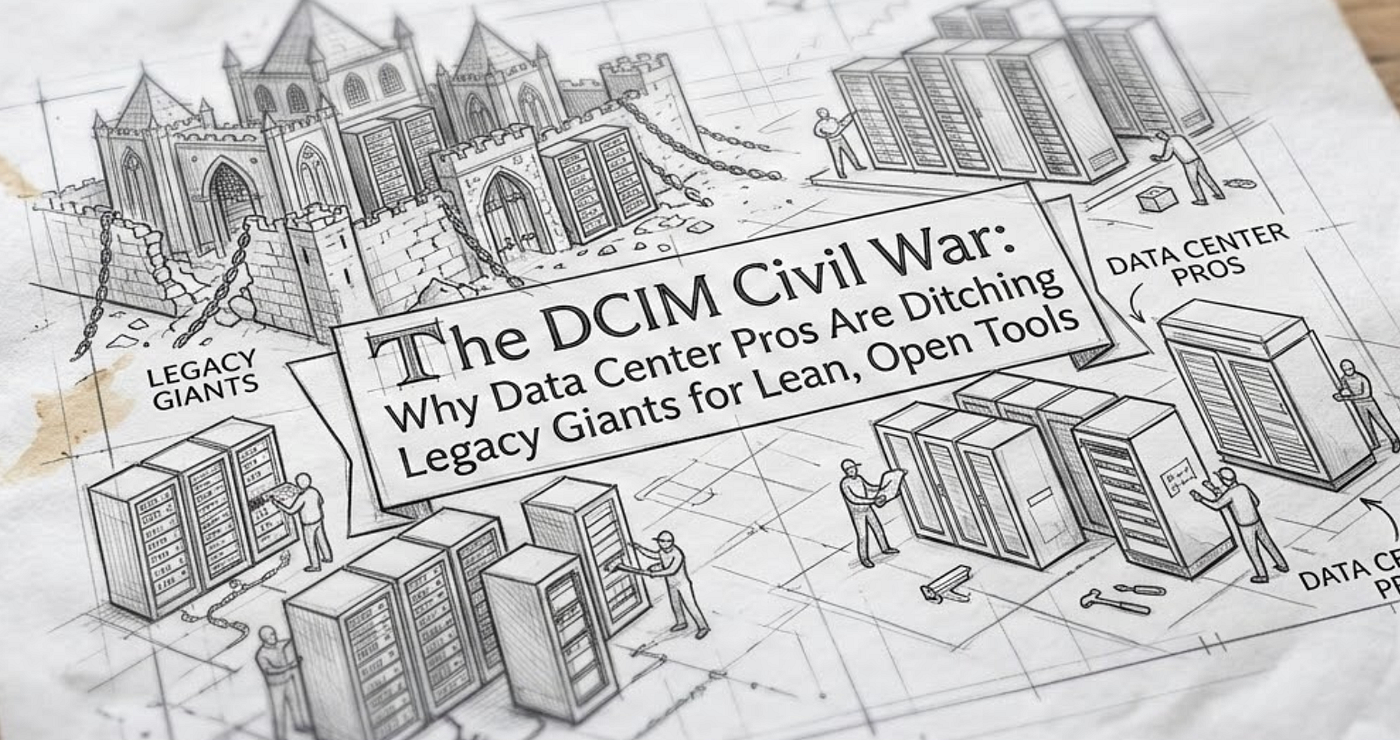
Instead, what you get feels more like a civil war.
Some swear by lean, open-source tools. Others defend enterprise-grade platforms with six-figure price tags. And then there’s a third camp — the battle-worn operators who’ve spent a decade inside legacy systems and sound like they’re still recovering.
The question was simple: What’s your favorite DCIM vendor, and why?
The answers were anything but simple.
NetBox: The Quiet Favorite That’s Not So Quiet Anymore
If there was a clear crowd favorite, it was NetBox.
Not a long speech. Not a polished pitch. Just one-word endorsements. “NetBox.” “Definitely NetBox.” “NetBox 100%.” When engineers talk like that, it’s rarely hype. It’s fatigue with everything else.
One operator summed it up plainly: they’ve “used loads of things over the years and nothing comes close.” That kind of statement doesn’t come from someone dazzled by a UI demo. It comes from someone who’s wrestled with clunky installs, licensing audits, and month-long implementations — and found something that just works.
What stands out isn’t just that NetBox is open source. It’s that it feels aligned with how modern infrastructure teams think. It links to routers and switches. It integrates cleanly. It doesn’t feel bolted together from legacy tech.
There’s an undercurrent here: control. With NetBox, teams feel like they own the system instead of negotiating with it.
Of course, not everyone says it outright, but the subtext is obvious. When people choose NetBox, they’re often choosing autonomy over enterprise hand-holding.
And that says a lot.
Sunbird: Powerful, Polished — and Painfully Expensive
Then there’s Sunbird.
If NetBox is the scrappy favorite, Sunbird is the polished enterprise athlete. Several operators describe impressive demos. Quick proof-of-concept setups. Linux appliance deployment on a VM in an afternoon. VMware integration working almost immediately.
One user watched a large client implement it and described it as “very impressive.” Detailed asset management. Global power usage views down to a single outlet. The kind of granular visibility that makes colo conversations a lot less awkward.
Sunbird seems to win on capability. It’s what “the big boys use,” according to one commenter. And in infrastructure circles, that endorsement carries weight.
But then comes the quote.
Over $100,000 per year in licensing, according to one experience. Suddenly that polished demo feels heavier. Another team liked it but pivoted away after seeing the numbers. They only needed power monitoring in the end, and even that alternative came with its own headaches.
Sunbird isn’t getting trashed. That’s the interesting part. It’s respected. But it’s also seen as something you grow into — or something you justify to finance with a deep breath.
One voice described it simply: “Not cheap but capabilities are unmatched.”
That’s high praise. It’s also a warning label.
Nlyte: The Frustration Runs Deep
If NetBox is enthusiasm and Sunbird is cautious admiration, Nlyte is something else entirely.
Frustration. Burnout. Sarcasm sharp enough to cut cable ties.
“Everything about Nlyte sucks,” one long-time user wrote. Not subtle. Not diplomatic.
The complaints aren’t vague either. Clunky interface. Inflexible workflows. A product that hasn’t meaningfully evolved in a decade except for moving from Flash to HTML5. Add-on modules that cost extra. Support that doesn’t “follow the sun.” Database issues with massive tables lacking indexes.
That’s not nitpicking. That’s systemic pain.
One engineer described the installation process as a time machine back to 2005 — registry tweaks, fragile dependencies, dozens of support calls. Another said NEO, its power management module, felt like a completely different platform bolted on awkwardly.
And yet, buried in the frustration is something important: some teams still use it. Some have used it for over ten years. Not because they love it, but because enterprise decisions are messy. Another business unit chose it. A migration is expensive. Momentum is real.
One user admitted that once it’s running, it’s “fine.” Not glowing praise, but not catastrophic either. The core seems functional. It’s everything around it — the install, the workflows, the cost structure — that drains goodwill.
There’s also a telling question from someone considering Nlyte: are the workflow features useful for enforcing consistency? That perspective matters. Some teams crave rigidity. They want guardrails that force updates and prevent skipped documentation.
In theory, that’s where Nlyte shines.
In practice? The responses suggest it often feels like wrestling a rigid system instead of being supported by it.
OpenDCIM and the “Good Enough” Philosophy
OpenDCIM pops up as well. It doesn’t spark the same passionate endorsements as NetBox, but the tone is calm and confident.
“Has everything we need and the price is right.”
That sentence captures a whole philosophy. Not every data center needs deep simulation tools or outlet-level power visualization across global facilities. Some teams want asset tracking, cabinet layouts, and reasonable power data. Done.
Open-source tools carry a different kind of risk. You’re trading vendor accountability for flexibility. But for some operators, that trade feels sane.
It also exposes a divide in DCIM expectations. Are you running hyperscale facilities with executive dashboards and compliance layers stacked ten deep? Or are you managing racks, circuits, and capacity planning without wanting to negotiate a contract every time you add a module?
The “good enough” camp isn’t anti-enterprise. It’s anti-bloat.
Facilities vs IT: A Subtle Fault Line
One comment cuts through the noise: the right DCIM depends on whether you’re more facilities-focused, IT-focused, or both.
That’s not a throwaway line. It explains half the tension in these debates.
Facilities teams care deeply about power distribution, cooling efficiency, and infrastructure redundancy. IT teams obsess over device relationships, VLAN mapping, and virtualization integration.
Some platforms lean heavily into facilities. Others grew out of network documentation roots. The friction happens when a product claims to do both and ends up pleasing neither fully.
Sunbird’s detailed power visibility appeals to facilities-heavy environments. NetBox’s integration and API-driven flexibility resonate with IT-driven shops. Nlyte attempts to straddle the line — sometimes at the cost of elegance.
And when internal business groups pull in different directions, the technology choice becomes political.
One team loved Sunbird’s demo and quick VMware tie-in but lost the decision to another business unit pushing Nlyte. The result? Nearly a year to fully implement.
That’s not a product flaw alone. That’s enterprise reality.
The Cost Question No One Escapes
Licensing hovers over this entire conversation.
Six-figure annual costs. Add-on modules priced separately. Power management features that cost extra. Even proof-of-concepts that aren’t easy to run with your own data.
When someone says, “Everything costs extra,” that’s not just complaining. It reflects how DCIM vendors historically structured pricing — base platform plus modules plus support tiers plus scaling fees.
Compare that to open-source options where the cost shifts from licensing to labor and internal expertise.
There’s no free lunch. But the appetite for big recurring checks seems thinner than it used to be.
One subtle pattern stands out: teams that only wanted a slice of DCIM functionality often walked away from enterprise suites. If all you need is power monitoring, paying for an asset management empire feels excessive.
And when budgets tighten, “good enough” starts sounding brilliant.
So What’s the Real Favorite?
If you tally endorsements, NetBox wins on enthusiasm. Sunbird wins on capability. Nlyte wins on… debate. OpenDCIM wins on affordability.
But that’s too simple.
The real favorite seems to be control. Teams want tools that adapt to them. They want installations that don’t feel like archaeological digs through Windows Server settings. They want pricing that doesn’t balloon with every added feature.
They also want credibility. One commenter praised a specific software creator personally. “Good dude. 10/10 would use his software again.” That human connection matters. DCIM isn’t just software; it’s an operational backbone. Trust counts.
There’s also a generational shift happening. Legacy DCIM platforms grew up in a world where heavyweight, all-in-one enterprise systems were the norm. Modern infrastructure teams are used to APIs, modularity, automation, and Git workflows.
When a DCIM feels like a static monolith, it clashes with that culture.
The debate isn’t just about vendors. It’s about philosophy.
The Uncomfortable Truth About DCIM
Here’s the part no one loves to say out loud: many teams don’t fully use their DCIM.
They buy for future-proofing. They implement core modules. And then they leave half the advanced features untouched because the operational overhead is too high.
Those glossy simulation tools in demos? According to one frustrated voice, making them actually work can be “insane” in terms of effort.
This isn’t unique to any one vendor. It’s endemic to enterprise software. Complexity scales faster than attention.
That’s why the quieter endorsements of simpler tools feel powerful. They reflect lived experience. People choosing something they’ll actually maintain.
And yet, large enterprises still gravitate toward feature-rich platforms because regulatory, reporting, and cross-team visibility demands don’t disappear.
There isn’t a universal winner. There’s alignment — or misalignment.
Where This Leaves the Industry
The DCIM space feels like it’s at an inflection point.
Open-source tools are no longer side projects. They’re credible, widely adopted, and integrated into serious environments. Enterprise vendors still deliver unmatched depth in certain areas, especially facilities-grade power analytics and executive reporting.
Legacy platforms face the toughest scrutiny. Not because they don’t work, but because expectations have changed.
Operators today are fluent in automation. They expect APIs to be first-class citizens. They expect installs to be painless. They expect workflows to feel intuitive, not punishing.
And when a system feels stuck in 2005, they say so.
In the end, the question “What’s your favorite DCIM?” reveals something deeper: people don’t want to fight their tools anymore.
They want clarity. They want flexibility. They want transparency on cost. And they want software that respects their time.
That’s not a radical demand. It’s basic operational sanity.
The real civil war in DCIM isn’t vendor versus vendor.
It’s legacy thinking versus modern expectations.
And if the tone of these conversations is any indicator, the tide is shifting fast.
메타데이터
- post_id
- 9d32f60fb7d7
- slug
- the-dcim-civil-war-why-data-center-pros-are-ditching-legacy-giants-for-lean-open-tools-9d32f60fb7d7
- url
- https://medium.com/@PlanB./the-dcim-civil-war-why-data-center-pros-are-ditching-legacy-giants-for-lean-open-tools-9d32f60fb7d7
- canonical_url
- https://medium.com/@PlanB./the-dcim-civil-war-why-data-center-pros-are-ditching-legacy-giants-for-lean-open-tools-9d32f60fb7d7
- author_url
- https://medium.com/@PlanB.
- status
- ok
- fetched_at
- 2026-06-27 07:40:21