5 Surprising Truths About How We Really Speak: The Language Machine
While going through The Language Instinct by Steven Pinker, I came across these insights.
5 Surprising Truths About How We Really Speak: The Language Machine
While going through The Language Instinct by Steven Pinker, I came across these insights.
The Biology Behind How We Speak
As you read these words, you are participating in one of the true wonders of the natural world. We belong to a species with a remarkable, almost magical ability: we can shape events in each other’s brains with exquisite precision. This isn’t the fringe science of “mind control,” but a miracle so common we often forget it exists. It is called language.
Simply by making specific noises with our mouths, we can cause precise new combinations of ideas to arise in someone else’s mind. Consider the power of this “telepathy.” I can describe the mating habits of an octopus — how a male caresses a female with seven arms before slipping his eighth into her breathing tube — and you see it. I can tell you to apply club soda to a cherry stain on a white suit, and I have potentially altered your behavior months into the future.
Most remarkably, I can use language to bridge gaps of time, space, and acquaintanceship. I can share the secrets of protagonists in a world that is the product of a stranger’s imagination — the daytime drama All My Children. I can tell you that Dixie is stunned to see Tad because she thought he was dead, or that she must eventually inform Brian that things are not finished between her and Tad because Jamie is actually Tad’s son. In an instant, your brain is populated by the “passions” and “shocks” of people who do not exist, simply because of the way I modulated my breath. This is the engine of human cooperation, a biological trait that has allowed Homo sapiens to reshape the planet.
Takeaway 1: Language Is an Internal Instinct, Not an Invention
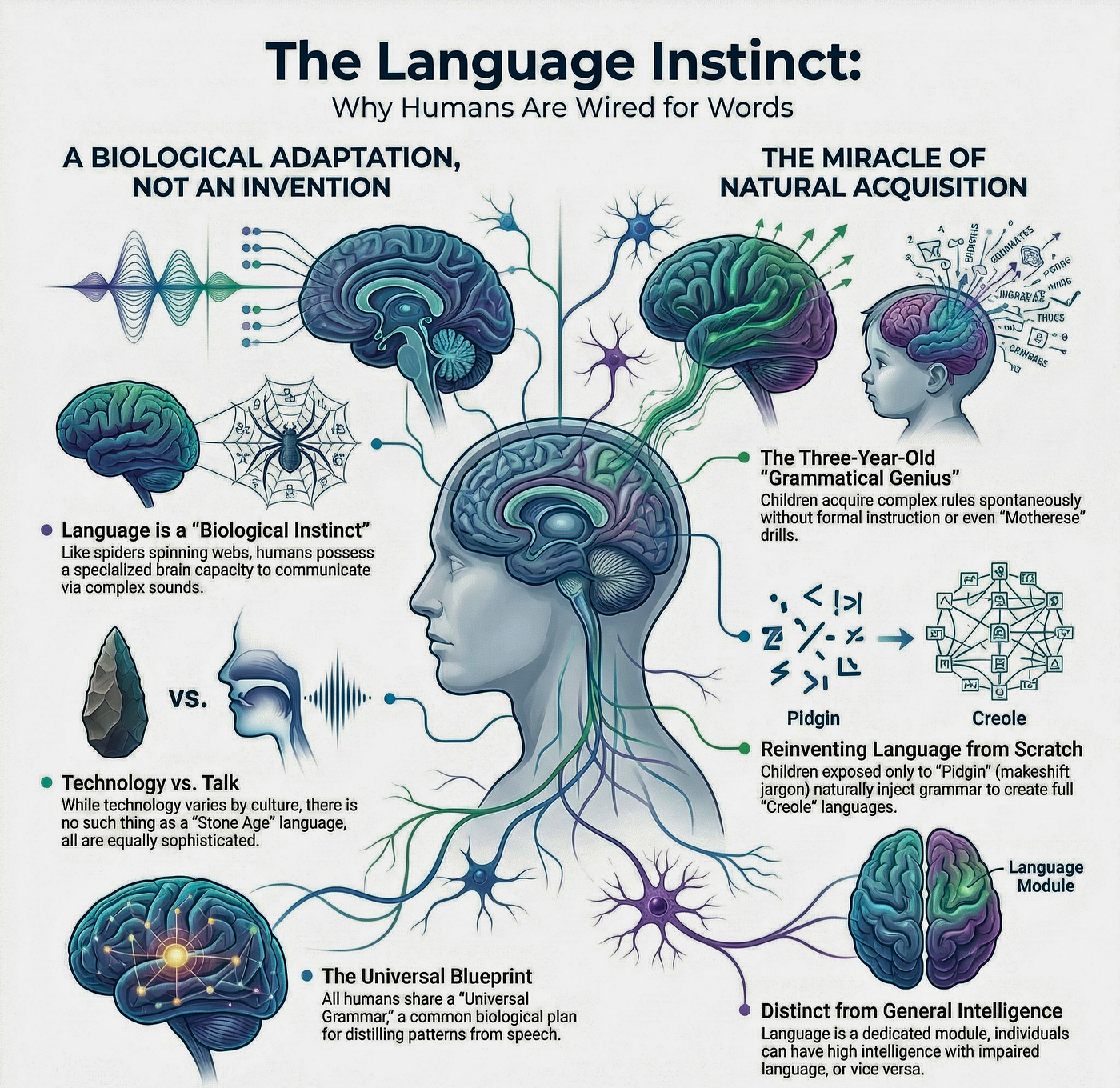
Most people assume language is a cultural invention, like learning to tell time or understanding how the federal government works. However, the evidence suggests otherwise. Language is a biological adaptation — a specialized skill that develops in children spontaneously, without conscious effort or formal instruction.
To understand this, consider the spider. A spider spins a web not because it went to architectural school, but because it has a “spider brain” that gives it the urge and the competence to spin. Humans speak because we have “human brains.” We are born with a “language instinct” that allows us to acquire the complex art of speech as naturally as we learn to stand or walk. This inverts the popular wisdom that children must be “taught” to speak; in reality, they are “grammatical geniuses” long before they enter a classroom.
“Language is an art, like brewing or baking; but writing would have been a better simile. It certainly is not a true instinct, for every language has to be learned. It differs, however, widely from all ordinary arts, for man has an instinctive tendency to speak, as we see in the babble of our young children; while no child has an instinctive tendency to brew, bake, or write.”
— Charles Darwin
Takeaway 2: You Don’t Actually Think in English (Welcome to “Mentalese”)
A common misconception is that our thoughts are identical to the words we speak. But if thought were dependent on words, how could we ever find ourselves struggling to find the “right word” for a pre-existing idea? How could a child learn their first word, or how could we translate ideas between languages?
Cognitive science shows that we think in a silent medium called “Mentalese.” This is an internal language of thought that is richer and more conceptually complex than any spoken tongue. Evidence for Mentalese is found in:
- Languageless Adults: Individuals like Ildefonso, who lacked formal language until adulthood, still demonstrated the ability to do math, handle money, and navigate complex social narratives.
- Baby Math: Five-month-old infants, who cannot yet speak, have been shown to perform basic mental arithmetic, tracking the number of Mickey Mouse dolls behind a screen and showing surprise if the count is incorrect.
- Mental Rotation: Experiments show that we can “rotate” images in our minds at a specific speed (about 56 RPM), a process that uses a mental graphics system rather than a verbal description.
Ambiguity provides the ultimate proof that thoughts and words are distinct. A single sentence can correspond to two completely different thoughts in Mentalese, proving the words themselves are just a “cloak” for the underlying idea.
Takeaway 3: There Is No Such Thing as a “Primitive” Language
There is a persistent myth that “Stone Age” tribes or less-educated social groups speak “simpler” languages. In reality, every human group ever discovered possesses a language of immense grammatical complexity.
Consider Kivunjo, a Bantu language spoken on the slopes of Mount Kilimanjaro. While English speakers might consider it “exotic,” its complexity makes English look like checkers compared to chess. A Kivunjo verb can have fourteen tenses and must agree with nouns across sixteen different “genders” (categories including humans, body parts, and extended objects). Similarly, the Cherokee pronoun system distinguishes between “you and I,” “another person and I,” and “several other people and I,” all of which English collapses into “we.”
Education and social status have nothing to do with biological “engineering excellence.” Even the most maligned dialects follow strict, logical rules. As the linguist Max Weinreich famously noted: “A language is just a dialect with an army and a navy.”
“When it comes to linguistic form, Plato walks with the Macedonian swineherd, Confucius with the head-hunting savage of Assam.”
— Edward Sapir
Takeaway 4: Children Are the True Creators of Language
Children do not just imitate their parents; they are the “language machines” that actually build the system. We see this most clearly in the transition from “Pidgins” to “Creoles.”
When speakers of different languages are forced together, they develop a Pidgin — a makeshift jargon with no consistent grammar. However, when children are exposed to this “noisy” input, they don’t just repeat the broken strings. They instinctively inject grammatical complexity, creating a Creole — a full language with standardized rules — in a single generation.
Case Studies in Creation:
- Simon: A deaf boy raised by parents who learned American Sign Language (ASL) late in life. Though his parents’ signing was ungrammatical “sign salad,” Simon filtered out their errors and reinvented the logical rules of ASL, surpassing his teachers.
- Nicaraguan Sign Language (ISN): In the 1970s, deaf children in Nicaragua were brought together for the first time. Older students used a rudimentary Pidgin (LSN), but the younger children took a “standardization leap.” They did not “learn” the language; they created it, transforming simple gestures into a complex, fluid grammar (ISN) that was completely absent in the input they received.
Takeaway 5: Grammar Is a Tree, Not a Chain
If we think in a multidimensional web of Mentalese, how do we communicate it? We face a “bottleneck” problem: the mouth can only produce one sound at a time. Grammar is the engineering solution to this problem, allowing us to squeeze a web of thoughts into a linear stream of speech.
Many assume we speak in a “word-chain,” where one word simply triggers the next based on probability. But word-chains are “amnesiacs.” They cannot explain “long-distance dependencies” like If… then. To say, “If the girl eats ice cream, then the boy eats hot dogs,” the brain must remember the “If” to ensure the “then” appears later. Because we can nest these indefinitely, a chain would require an infinite, impossible memory.
Instead, our brains use Phrase Structure — an invisible “tree” architecture. Think of a “Noun Phrase” (NP) as a modular plug-and-socket fitting. Once your brain identifies an NP, it can “snap” it into any position — subject, object, or indirect object — without re-learning the rules for that phrase. This invisible superstructure is what allows us to recognize that “Colorless green ideas sleep furiously” is grammatical, even though it is nonsense.
A sentence like “The happy boy eats ice cream” is mentally organized into:
- Noun Phrase (NP): [The] [happy] [boy] — The “Subject” fitting
- Verb Phrase (VP): [eats] [ice cream] — The “Action” fitting
- The VP itself contains another NP [ice cream] acting as the “Object.”
Conclusion: The Future of the Human Instinct
In George Orwell’s 1984, the state attempted to control thought through “Newspeak,” a language designed to make “heretical” thoughts impossible by deleting the words for them. But the science of the language instinct tells us this is a biological impossibility. Because Mentalese exists independently of words, humans will always be able to conceive of freedom, even if the word is stripped away. The next generation of children would simply creolize the language, reinventing complexity where it was missing.
Today, we face a new question. We have built Artificial Intelligence (Large Language Models) that can mimic the surface of our speech with startling fluency. Yet, these machines are essentially the “word-chain” models that cognitive science has debunked; they operate on transition probabilities rather than an internal instinct for meaning.
In an age of AI that mimics the surface of our speech, can a machine ever truly “think” if it lacks the biological instinct for Mentalese? We are not just users of a cultural tool; we are biological language users, equipped with a mental organ that remains one of the most sophisticated pieces of engineering in the known universe. Our “telepathy” is not just a trick of probability; it is our birthright.
메타데이터
- post_id
- 9d350d04b4da
- slug
- 5-surprising-truths-about-how-we-really-speak-the-language-machine-9d350d04b4da
- url
- https://medium.com/@krashikapaal/5-surprising-truths-about-how-we-really-speak-the-language-machine-9d350d04b4da
- canonical_url
- https://medium.com/@krashikapaal/5-surprising-truths-about-how-we-really-speak-the-language-machine-9d350d04b4da
- author_url
- https://medium.com/@krashikapaal
- status
- ok
- fetched_at
- 2026-06-09 15:37:30