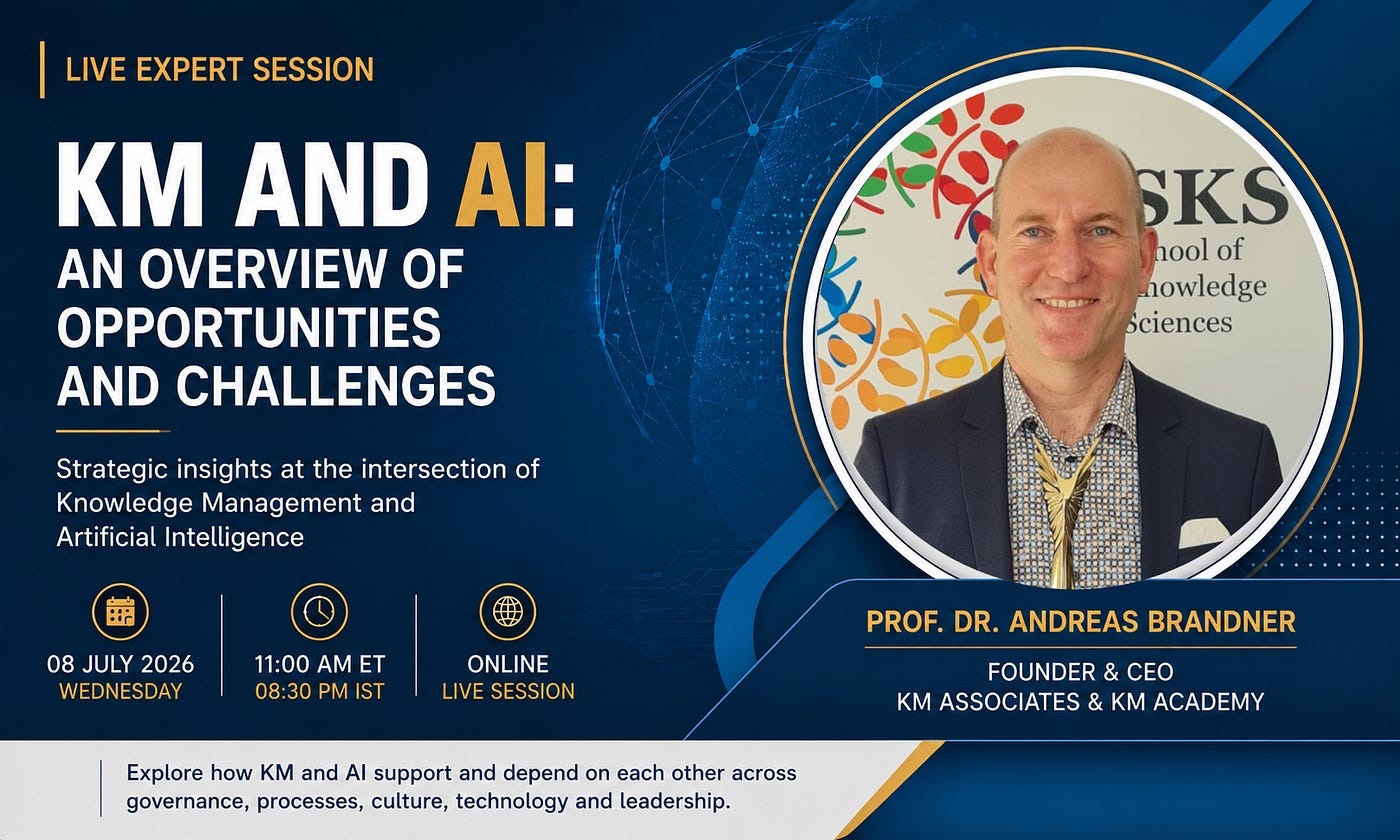
How AI and Knowledge Management Create Real Business Advantage
Artificial intelligence is moving fast. Many organizations are investing in copilots, chatbots, search assistants, analytics engines, and…
How AI and Knowledge Management Create Real Business Advantage

Artificial intelligence is moving fast. Many organizations are investing in copilots, chatbots, search assistants, analytics engines, and automation platforms. Yet a growing number of leaders are discovering an uncomfortable truth: AI alone does not create business advantage.
Without trusted knowledge, clear context, and governed information, even advanced AI systems produce weak answers, inconsistent outputs, and limited value.
This is where Knowledge Management becomes essential.
The organizations creating real advantage today are not simply buying AI tools. They are combining AI with strong Knowledge Management practices to improve decisions, scale expertise, reduce waste, and accelerate execution.
AI needs knowledge to perform. Knowledge Management gives it the foundation.
The Problem Most Organizations Miss
Many AI programs begin with technology selection. Leaders compare vendors, run pilots, and launch tools across teams. But they often overlook the condition of their internal knowledge environment.
Common issues include:
- Critical knowledge trapped in inboxes and personal files
- Duplicate documents across multiple systems
- Outdated procedures still in circulation
- Poor search experiences
- No ownership for content quality
- Missing lessons learned from past projects
- Inconsistent terminology across departments
When AI is layered onto this environment, it does not remove the chaos. It often amplifies it.
If the source knowledge is fragmented, AI outputs become fragmented. If internal content is outdated, AI recommendations may be outdated. If expertise is invisible, AI cannot easily connect people to the right knowledge.
This is why some expensive AI programs struggle to show return.
Why Knowledge Management Matters More in the AI Era
Knowledge Management is the discipline of capturing, organizing, sharing, governing, and improving organizational knowledge so people can perform better.
In the past, KM was sometimes seen as a support function. In the AI era, it becomes a strategic enabler.
AI systems depend on:
- Accurate content
- Structured information
- Reliable taxonomies
- Clear metadata
- Updated policies
- Reusable institutional knowledge
- Context about how work gets done
These are classic Knowledge Management strengths.
Organizations that invested in KM before AI often move faster now because their knowledge assets are easier for AI systems to access and interpret.
Those that ignored KM are now paying the price through remediation, cleanup, and stalled AI deployments.
How AI and Knowledge Management Together Create Business Advantage
The real opportunity comes from combining machine intelligence with organizational intelligence.
1. Faster, Better Decision-Making
Executives and frontline teams make hundreds of decisions every week. Many are delayed because information is scattered or unclear.
When AI is connected to a trusted knowledge base, teams can retrieve relevant policies, past case examples, market insights, and internal expertise quickly.
This shortens decision cycles and improves confidence.
A global manufacturing company, for example, can use AI to surface maintenance knowledge, historical incidents, and engineering guidance in seconds, reducing downtime and operational risk.
2. Scaled Expertise Across the Enterprise
Every company has experts whose knowledge drives performance. The problem is scale.
One expert cannot personally support thousands of employees.
Knowledge Management captures expert methods, playbooks, decision logic, and lessons learned. AI then makes that knowledge conversational, searchable, and available at scale.
Instead of asking one specialist repeatedly, employees can access AI-enabled guidance instantly.
This is especially powerful in consulting, healthcare, engineering, banking, and customer support environments.
3. Higher Productivity Without Reinventing Work
Many teams waste time recreating presentations, proposals, analyses, templates, and answers that already exist somewhere in the business.
Knowledge Management reduces duplication through reuse. AI accelerates that reuse by helping employees find and adapt what already exists.
Examples include:
- Sales teams generating proposals from proven templates
- HR teams retrieving policy answers quickly
- Project teams accessing prior lessons learned
- Legal teams locating precedent language faster
The result is less repetition and more productive work.
4. Stronger Customer Experience
Customers expect speed, accuracy, and consistency.
When service agents rely only on memory or fragmented systems, quality varies. When AI is connected to curated knowledge, service becomes faster and more reliable.
AI can guide agents, summarize cases, recommend next steps, and retrieve approved answers in real time.
This improves first-contact resolution, reduces handling time, and strengthens trust.
5. Reduced Risk and Better Governance
Uncontrolled AI creates risk. So does uncontrolled knowledge.
Knowledge Management introduces governance disciplines such as ownership, lifecycle control, version management, content review, and access controls.
These controls become even more valuable when AI uses internal content.
With strong KM governance, organizations reduce risks such as:
- Hallucinated answers based on weak sources
- Use of outdated procedures
- Inconsistent regulatory responses
- Exposure of sensitive information
- Conflicting internal guidance
Responsible AI requires responsible knowledge practices.
What Leading Organizations Are Doing Differently
The most successful organizations are not treating AI and KM as separate programs.
They are integrating them through practical operating models.
They Build Trusted Knowledge Sources First
Instead of feeding everything into AI, they identify priority content such as policies, product information, operating procedures, and expert guidance.
They improve quality before scaling access.
They Create Taxonomies and Metadata
Well-structured knowledge improves discoverability and AI relevance.
Common language across the enterprise matters more than many realize.
They Focus on High-Value Use Cases
Rather than launching AI everywhere, leaders target areas where knowledge friction is costly:
- Customer support
- Employee onboarding
- Field operations
- Sales enablement
- IT service management
- Compliance support
They Measure Outcomes, Not Activity
Strong programs track:
- Time saved
- Search success rate
- Reuse of knowledge assets
- Faster onboarding
- Reduced support costs
- Better decision speed
- Customer satisfaction improvements
A Practical Framework for Leaders
If you want real business advantage, use this sequence.
Step 1: Audit Your Knowledge Environment
Assess where knowledge lives, what is outdated, what is duplicated, and where expertise is concentrated.
Step 2: Prioritize Strategic Knowledge Domains
Focus on the knowledge most tied to revenue, risk, service, and productivity.
Step 3: Improve Governance
Assign owners, review cycles, quality standards, and access controls.
Step 4: Deploy AI on Trusted Content
Connect AI tools to curated, relevant, high-quality knowledge.
Step 5: Continuously Learn and Improve
Use analytics, feedback loops, and user behavior data to improve both AI outputs and knowledge assets.
The Competitive Shift Already Underway
Many organizations still believe AI advantage comes mainly from model selection.
That view is incomplete.
Over time, competitive advantage will come less from the AI model itself and more from the quality of proprietary knowledge, operational context, and the ability to continuously learn faster than competitors.
Models can be purchased.
Organizational knowledge cannot.
That makes Knowledge Management one of the most underappreciated strategic assets in the AI economy.
Final Thought
AI can generate answers, summarize documents, and automate tasks. But without strong Knowledge Management, it often lacks the depth, trust, and relevance organizations need.
When AI and Knowledge Management work together, businesses move faster, learn faster, and execute better.
The companies that understand this early will not just use AI. They will outperform with it.
Discussion Prompt
Is your organization investing in AI tools, Knowledge Management foundations, or both? The answer may determine the value you actually capture.
For more insights visit: Smritex
메타데이터
- post_id
- 9d4b41fe7faa
- slug
- how-ai-and-knowledge-management-create-real-business-advantage-9d4b41fe7faa
- url
- https://medium.com/@smritex/how-ai-and-knowledge-management-create-real-business-advantage-9d4b41fe7faa
- canonical_url
- https://medium.com/@smritex/how-ai-and-knowledge-management-create-real-business-advantage-9d4b41fe7faa
- author_url
- https://medium.com/@smritex
- status
- ok
- fetched_at
- 2026-06-15 22:55:51