Who Controls Capital Allocation in an Agentic Enterprise?
Is Financial Governance Too Slow to Utilize Artificial Intelligence?
Who Controls Capital Allocation in an Agentic Enterprise?
Is Financial Governance Too Slow to Utilize Artificial Intelligence?
Corporate finance leaders are accustomed to controlling capital allocation through a structured cadence. Historical mechanisms such as monthly financials, quarterly forecasts, annual budgeting cycles, and executive approvals were designed for stability and oversight.
But the enterprise operating environment has changed. AI is now embedded deeply within operational systems, generating continuous signals that influence revenue, expenses, investments and overall risk exposure. Platforms and emerging “agentic” systems can do more than analyze data. They can act upon it autonomously. This emergence is raising fundamental questions about who will control capital cash flows in the future business environment.
This creates a structural tension between operational AI systems that adapt in real time and financial governance systems that remain periodic and driven by human interaction. Anaplan, an agentic AI platform, is beginning to act as an independent financial analyst while planning workflows and make execute actions that an individual contributor would. This represents a shift beyond traditional forecasting toward active participation by AI in the planning processes.
The central question facing CFOs and FP&A leaders is: Who controls capital allocation when AI systems can observe, reason, and act in real time to make spending decisions?
This horizon assessment evaluates how agentic AI could reshape financial decision-making authority and outlines governance frameworks that will be required to guide these autonomous decisions.
Agentic AI Insights & Understanding
What Is Agentic AI?
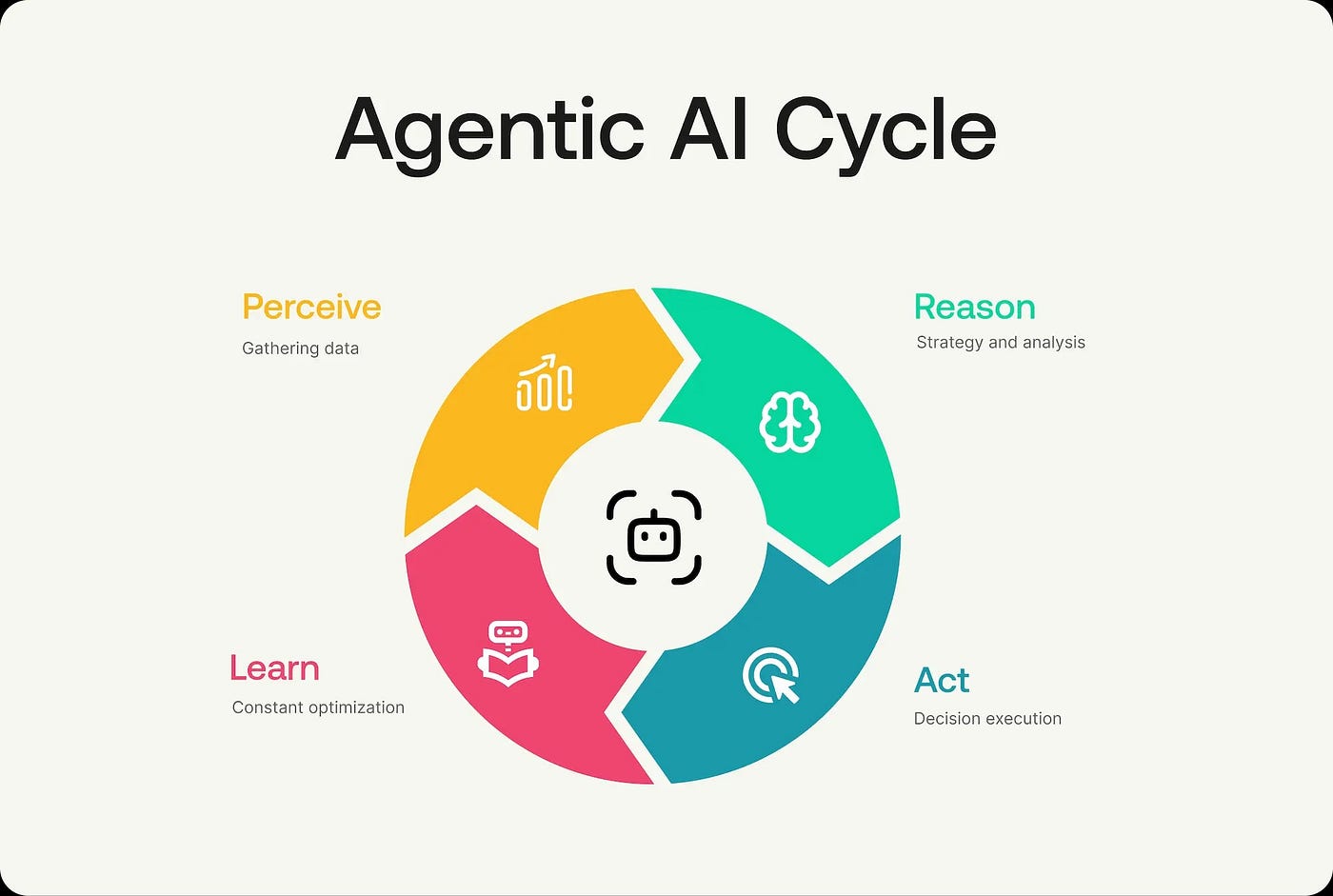
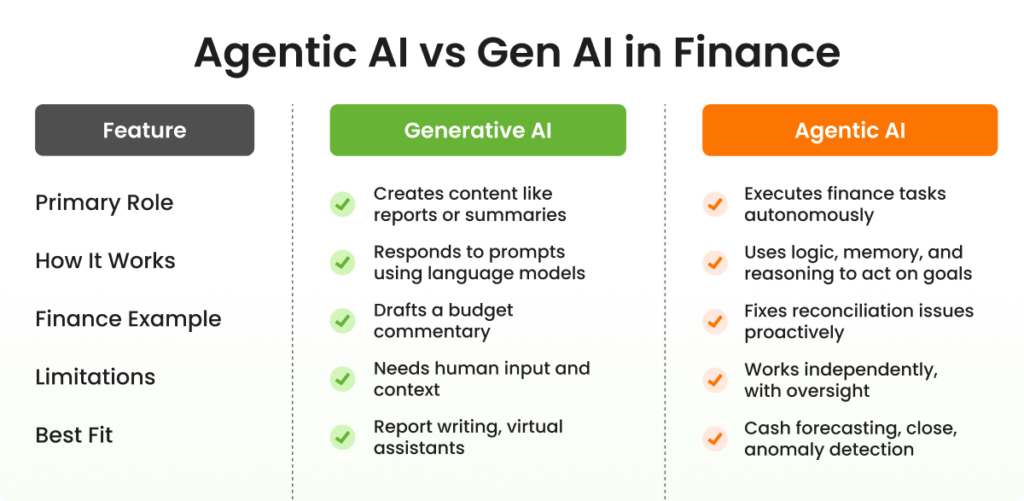
Agentic AI refers to AI systems capable of autonomously interpreting objectives, reasoning about context, and initiating actions within defined parameters. Unlike generative AI that responds to prompts, agentic AI operates continuously, senses system changes, and builds a knowledge base to guide future autonomous decisions. According to Gartner, “57% of finance teams are currently implementing or planning agentic AI approaches.” This signals that there is growing momentum behind the integration of systems that can make autonomous decisions guiding operational finance functions.
The key attributes of agentic AI systems include:
- Continuous data monitoring
- Real-time scenario modeling
- Continuous learning and reframing
- Removal of manual workloads
- Actionable decision making
These attributes make agentic AI qualitatively different from traditional predictive analytics, BI tools, or analytical AI. In simpler terms, agentic AI observes an enterprise in real time, reasons with data, and takes action.
Source: Digidop
How Agentic AI Operates in Finance
In a financial planning context, agentic AI systems can automate complex multi-step workflows:
- Monitoring performance indicators and flagging potential risks.
- Dynamically simulating scenarios and optimizing future outcomes.
- Initiating financial updates regarding journal entries, forecasts, budgets, etc.
- Alerting human stakeholders when capital purchase thresholds are crossed.
Unlike typical predictive models, agentic systems interact with numerous budget and forecast versions and can initiate updates without human prompting. These agentic systems operate instantaneously, without the need for humans to publish forecasts on a periodic basis. Anaplan’s *AI Agents* illustrate this capability by reviewing forecast models, flagging anomalies, and automate monthly close processes, that at the same time maintain accuracy and trust.
The Current & Future Role of Agentic AI in Finance
Current State of Adoption
Most organizations today leverage AI for analytics, predictive modeling, and variance analysis in FP&A. While augmented AI improves forecasting accuracy and responsiveness, execution remains with the individual. This limits potential operational efficiencies created by agentic systems due to the periodic governance built into modern corporate finance structure.
AI Agents are now creating workflows and execution loops, not just generating warning signals. While many finance leaders have implemented AI into their operations, there is still more to be desired.
Emerging Practices and Tools
Many ERP platforms and vendors are beginning to embed agentic features into enterprise finance environments:
- Anaplan’s AI Agents automate aspects of planning workflows throughout multiple departments, simplifying the complexities of cross-functional planning processes.
- Prophix One FP&A Plus is promoting agentic AI in FP&A by providing transforming data into real-time insights, advanced modeling, and the automation of manual tasks.
- Additionally, ERP and planning suites from SAP, Oracle, or Microsoft increasingly include intelligent autonomous modeling, insight creation, and decision-making.
In practice, agentic AI augments execution and monitoring, in addition to planning and variance analysis. This will allow FP&A teams to be more proactive and enable near-continuous updates of forecast and planning models.
Potential Impact
Leading consulting research from PwC’s AI Agent Survey indicates the deployment of agentic AI could:
- Reduce process cycle times by up to 90%.
- Redirect 60% of finance teams’ time toward strategic insights.
- Improve forecast speed and accuracy by up to 40%.
This survey included responses from 308 U.S. business executives in April 2025.
These efficiency and capacity gains suggest that finance functions could transition from batched to continuous planning. Activities such as variance analysis, forecast refreshes, and capital allocations that typically occur monthly or quarterly could instead be completed weekly, daily, or continuously with the use of agentic systems. This would enable dynamic capital adjustments at a rapid pace.
Source: Highradius
These efficiencies rely on high data integrity, leadership direction, and the correct governance systems to come to fruition. The inputs and system reviews are vital to create trust within an agentic enterprise if they are to make capital allocations.
Additionally, the improved rate of financial output will stress the need for human review, which is vital for modern compliance requirements to be met. Finance teams will be limited in their ability to focus on strategic insights, as more time will be spent reviewing the agentic system for audit purposes, which validates the need for an update to modern governance practices.
Risks & The Current Governance Landscape
Agentic AI includes operational risks and raises governance, ethical, and compliance concerns that require anticipatory frameworks within FP&A teams.
Operational Risks
Autonomous decision systems carry risks such as:
- Model drift: AI decisions deteriorate over time if underlying patterns change without receiving feedback from end users.
- Opaque logic: Decisions may lack explainability, limiting the ability of FP&A to explain the reasoning behind capital allocation to executives.
- Data quality risk: Incorrect inputs spread false information throughout the enterprise, leading to rapid errors in downstream decisions.
Without proper controls, autonomous actions could propagate unintended capital adjustments with material downstream effects, damaging the credibility of finance within an enterprise.
Governance, Audit, and Compliance Concerns
The execution of implementing autonomous decision making within FP&A raises immediate regulatory and control concerns. As stated earlier, autonomous decisions may lack explainability. SOX compliance requires documented controls highlighting authorization and reasoning behind financial decisions. Audit trails must clearly explain why and how a decision was made, whether it was made autonomously or not.
Companies will need to create ethical governance frameworks, such as AGENTSAFE, that attach guardrails to agentic AI within enterprise systems. New governance frameworks must provide continuous monitoring and accountability, assess and flag risks, and generate auditable decisions that support SOX compliance reporting.
These types of governance frameworks will become the new standard practice, as enterprises will not be allowed to use the excuse of compliance or auditability as reasons to not fully utilize the power of agentic AI.
Designing Capital Governance for an Agentic Enterprise
Finance leaders should proactively design governance frameworks that can account for autonomous decisions within financial planning before it becomes the default within operations.
Tiered Decision Architecture
By establishing clear layers of autonomy, agentic AI systems can differentiate when to act, make suggestions, or provide analysis.
- Tier 1: Low-materiality autonomous actions Allow agentic systems to make minor capital allocations within predefined budgets.
- Tier 2: Human-approved autonomous recommendations AI suggests adjustments for moderate operational impacts; human finance leaders approve allocations.
- Tier 3: CFO strategic decisions utilizing agentic analysis Major capital allocations, long-term investments and structural finance decisions remain with CFO level authority.
This allows for agility while maintaining oversight on material capital decisions. Future CFO responsibilities may partially shift from approver of capital allocations to architect of autonomous decision controls. AI will become a partner in planning and allocations, rather than a substitute for the informed oversight finance leaders provide enterprises.
Auditability & Explainability Standards
Agentic systems should produce:
- Decision logs, data risk assessments, and data lineage reports.
- Summaries of model reasoning and updates to underlying pattern reframing.
- Reviewable reports for human oversight and feedback.
These reports and summaries should be integrated into monthly close processes, financial statement reviews, forecasting updates, budgeting cycles, and compliance reviews to strengthen internal controls.
Conclusion: Implementing Governance Today
AI-driven operational systems already operate in real time. Today’s financial governance frameworks have yet to match the pace. Without deliberate decision frameworks, control gaps will emerge. The role of finance leadership is more than just adopting AI, but to design its responsible implementation and use.
The future of FP&A is not merely utilizing AI for faster and more accurate forecasting. It will include the deliberate design of how capital is allocated using agentic AI’s machine level speed.
It is vital that we restructure modern governance practices to capitalize on the advantages that agentic AI offers our enterprises. We must lay the foundation for new processes of decision-making today that fulfill the ethical requirements within the corporate finance space if we are to remain competitive in this future business environment.
Writer’s Note
This assessment draws on industry sources including enterprise software vendors, relevant consulting research, and AI governance frameworks. Generative AI (ChatGPT 5.2 & Microsoft Copilot) assisted in structuring and synthesizing content. All sources included in the article were independently verified and cited directly. All analysis and writing outside of linked material are original.
메타데이터
- post_id
- 9d4eccd478dc
- slug
- who-controls-capital-allocation-in-an-agentic-enterprise-9d4eccd478dc
- url
- https://medium.com/@masonengnes5/who-controls-capital-allocation-in-an-agentic-enterprise-9d4eccd478dc
- canonical_url
- https://medium.com/@masonengnes5/who-controls-capital-allocation-in-an-agentic-enterprise-9d4eccd478dc
- author_url
- https://medium.com/@masonengnes5
- status
- ok
- fetched_at
- 2026-06-22 05:41:33



