China Sails Ahead With 40,000 Ton Drone Carrier
Beijing’s Type 076 Sichuan pioneers fixed-wing UAV operations at sea, blending advanced catapult technology with amphibious assault…
Naval Warfare
China Sails Ahead With 40,000 Ton Drone Carrier
Beijing’s Type 076 Sichuan pioneers fixed-wing UAV operations at sea, blending advanced catapult technology with amphibious assault capabilities in a vessel that signals a decisive shift in unmanned naval power

China’s first drone-carrying Type 076 amphibious assault ship, the Sichuan, on its maiden sea trial last November. Picture: Xinhua News Agency
The commissioning of the Type 076 amphibious assault ship, specifically the lead vessel Sichuan, marks a significant transformation in the naval strategy of the People’s Liberation Army Navy.
This vessel is a technical departure from traditional amphibious warfare ships, integrating technologies typically reserved for fleet aircraft carriers.
By combining a large displacement with electromagnetic launch systems, the Type 076 creates a new category of maritime platform often referred to as a drone carrier.
This development indicates a clear intent to dominate the UAV domain at sea, providing a flexible alternative to traditional carrier strike groups.
Technical specifications and design architecture
The Sichuan is a substantial vessel with a full load displacement estimated to be between 40,000 and 50,000 tonnes.
With an overall length of approximately 252 to 263 metres and a beam of 45 to 50 metres, it is comparable in scale to the America class amphibious assault ships of the US Navy.
However, its design features several unique elements that distinguish it from its US counterparts.
The most prominent feature is the inclusion of an electromagnetic catapult, similar to the electromagnetic aircraft launch system found on the Fujian aircraft carrier.
This technology allows for the launch of heavier fixed-wing unmanned combat aerial vehicles that cannot operate from traditional flat-deck amphibious ships relying on vertical take-off or short runways. To aid the return of these aircraft, the ship is equipped with arresting gear consisting of three arrestor wires, enabling a full catapult-assisted take-off but arrested recovery configuration (CATOBAR).

The superstructure employs a twin-island layout. This configuration separates the primary navigation bridge from the aviation control centre, an arrangement seen on the UK’s Queen Elizabeth class carriers.
This layout optimises the flow of personnel and improves the management of complex flight operations involving both rotary-wing and fixed-wing assets. The propulsion system is probably an integrated electric propulsion arrangement, powered by two 21 megawatt gas turbines and six 6 megawatt diesel engines, providing a total power output of approximately 78 megawatts.
What we don’t know is whether the electrical system, critical for the EMALS launcher, is AC or DC.
I’ve written previously about the Chinese engineers’ move towards DC electrical systems for technical reasons, and reportedly employed on the Fujian aircraft carrier.
UAV integration
The primary mission of the Type 076 is the operation of sophisticated unmanned aerial vehicles.
The flight deck and hangar are specifically designed to accommodate the GJ-21, a stealthy, jet-powered flying wing drone. Reports suggest the Sichuan could carry up to 19 of these aircraft. The GJ-21 is a derivative of the GJ-11 Sharp Sword and is estimated to have a maximum take-off mass exceeding 15 tonnes.
By utilising electromagnetic catapults, the Type 076 can launch these drones with high frequency and heavy payloads, including internal weapon bays for precision-guided munitions.
This capability allows the ship to conduct long-range reconnaissance and strike missions without risking piloted aircraft. The air wing is also expected to include the WZ-7 Soaring Dragon for high-altitude surveillance and the GJ-2 Medium-Altitude Long-Endurance drone.

WZ-7 UAV at Airshow China Zhuhai 2022. By Infinty 0 — Own work, CC BY-SA 4.0
In addition to fixed-wing assets, the Sichuan will operate a variety of rotary-wing aircraft.
These include the Z-20 utility helicopter and the Z-10 attack helicopter. The ship also supports rotary-wing drones for search and rescue or local maritime security.
This diverse air wing provides the commander with a comprehensive toolkit for modern naval warfare, ranging from stealthy deep-strike capabilities to traditional troop transport and fire support.
It’s a powerful vessel and does not need the ‘domestics’ for a large crew of airmen. Pilots are required for the drones, but the management issues are much simpler.
Amphibious assault and troop projection
Despite its focus on aviation, the Type 076 promises to be a highly capable amphibious assault platform. It retains a large stern well dock capable of launching and recovering air-cushioned landing craft, such as the Type 726 Yuyi class.
These hovercraft can transport main battle tanks and armoured vehicles directly to beachheads from over-the-horizon distances.
The internal capacity of the vessel allows for the transport of over 1,000 marine corps personnel. The ship is designed to facilitate rapid horizontal and vertical landings, bypassing geographical constraints and coastal defences.
This “over-the-horizon” landing capability is essential for operations in complex topographical environments where traditional beach assaults are too risky.
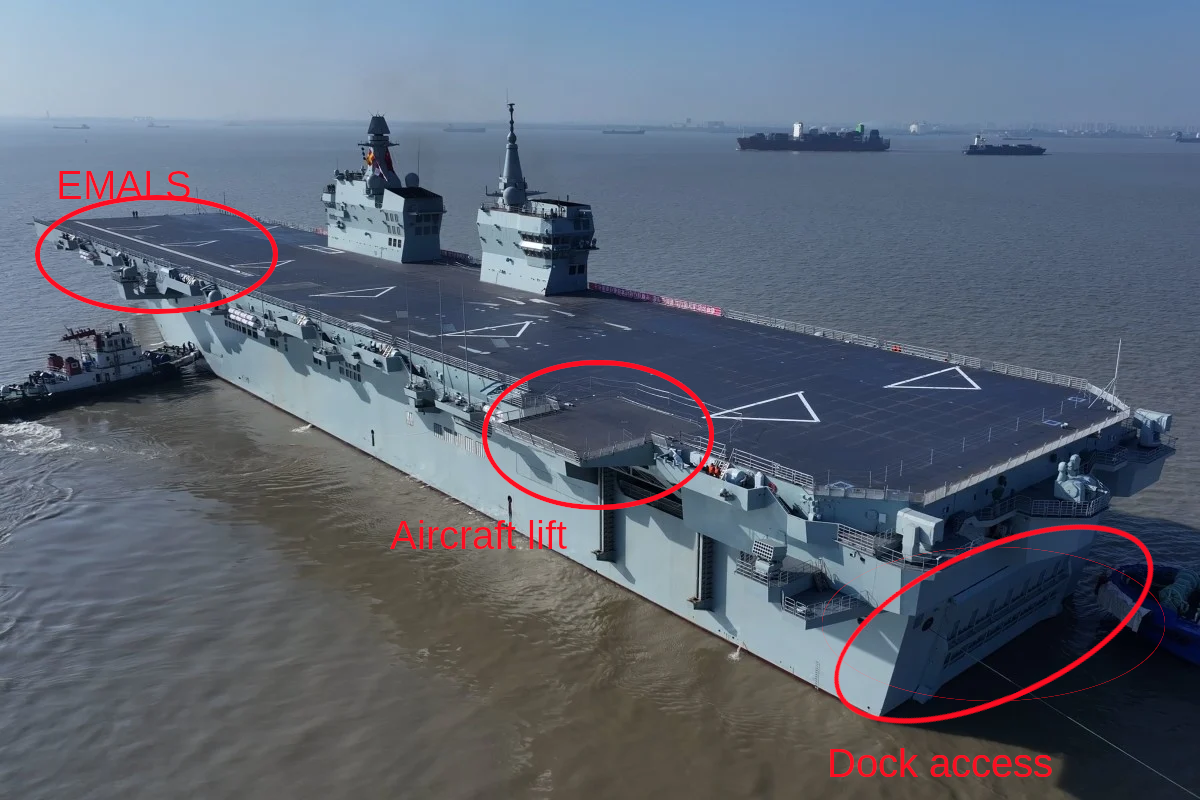
076 Sichuan amphibious assault and drone carrier.
The ship is equipped with robust self-defence systems to protect itself and the embarked troops. The armament includes three Type 1130 close-in weapon systems, which are 11-barrel 30 mm Gatling guns capable of intercepting incoming anti-ship missiles.
Additionally, it carries three 24-round HHQ-10 surface-to-air missile batteries and four countermeasure launchers for deploying flares and chaff. This layered defence ensures the vessel can operate in contested environments.
[embed]
Strategic impact and regional security
The introduction of the Type 076 signals a qualitative leap in the ability of the People’s Liberation Army Navy to project power. By operating as a “drone mother ship,” the Sichuan can provide persistent surveillance and strike capabilities over vast maritime areas.
This reduces the burden on larger, more expensive aircraft carriers, allowing them to focus on high-intensity blue-water missions while the Type 076 manages regional operations.
In the context of the South China Sea and the Taiwan Strait, the Type 076 offers a versatile tool for island encirclement and rapid force projection. Its ability to maintain effective operational control using stealthy drones allows for high-frequency sorties that traditional amphibious ships cannot match.
This capability is particularly relevant for countering asymmetric threats, such as “swarm boat” strategies, where numerous small, fast targets require constant monitoring and rapid response.
Furthermore, the rapid construction of the Sichuan, which moved from modular assembly to sea trials in approximately two years, demonstrates the industrial capacity and urgency of the naval expansion.
This speed of development suggests that the Type 076 is not merely a prototype but the beginning of a class that will become a central pillar of the future fleet.
Comparison with global counterparts
The Type 076 maps out a unique evolutionary path in naval architecture. While the US Navy America class and the Japanese Izumo class have moved toward operating the F-35B short take-off and vertical landing fighter, China has chosen to invest in catapult-launched unmanned systems. This approach avoids the high cost and complexity of vertical-landing manned jets while still achieving significant aerial strike range and stealth.
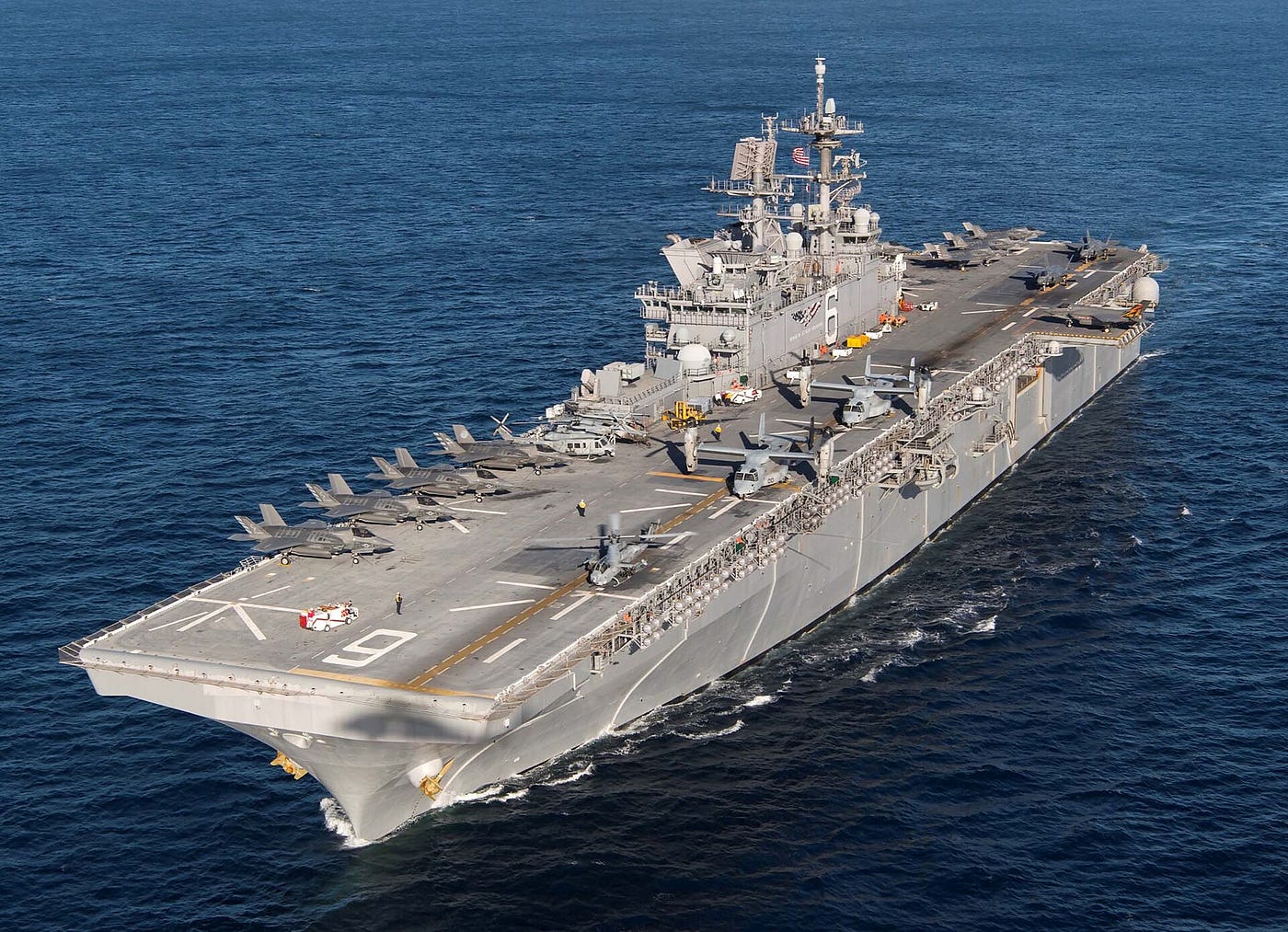
USS America (LHA-6) in 2018.
Unlike the French Charles de Gaulle, which is a dedicated nuclear-powered aircraft carrier of similar tonnage, the Type 076 maintains its amphibious well dock.
This makes it a multi-role vessel that can perform air superiority tasks via drones while simultaneously landing a battalion of marines. This hybrid nature makes the Type 076 one of the most flexible naval assets afloat.
As sea trials continue throughout 2026, the integration of the GJ-21 and other advanced drones will be the primary focus of the testing phase.

China’s GJ-21 drone in flight with the arrester hook, typically for carrier landing, lowered. Image: Weibo
The success of these operations will determine how quickly subsequent ships of the class enter service. If the Sichuan achieves its design goals, it will likely redefine the role of the amphibious assault ship in modern naval doctrine, shifting the focus from simple transport and support to a platform capable of independent, high-technology power projection.
https://digital-commons.usnwc.edu/cgi/viewcontent.cgi?article=1033&context=cmsi-translations
메타데이터
- post_id
- 9d5b156086b8
- slug
- china-sails-ahead-with-40-000-ton-drone-carrier-9d5b156086b8
- url
- https://medium.com/the-dock-on-the-bay/china-sails-ahead-with-40-000-ton-drone-carrier-9d5b156086b8
- canonical_url
- https://medium.com/the-dock-on-the-bay/china-sails-ahead-with-40-000-ton-drone-carrier-9d5b156086b8
- author_url
- https://medium.com/@james-marinero
- status
- ok
- fetched_at
- 2026-06-15 20:49:13