Scarcity Isn’t Just “Not Enough” — It’s a Bandwidth Tax on Your Brain
Scarcity can be described as having less than you feel you need. While money is the classic case, scarcity also applies to:

Scarcity Isn’t Just “Not Enough” — It’s a Bandwidth Tax on Your Brain
Scarcity can be described as having less than you feel you need. While money is the classic case, scarcity also applies to:
· time scarcity (overcommitment)
· energy scarcity (chronic fatigue)
· food/calorie scarcity (restrictive dieting)
· connection scarcity (loneliness)
· resource scarcity at work (tools, staff, support)
Key point: scarcity changes what your mind prioritizes, often involuntarily.
2) Two mechanisms: focus dividend vs bandwidth tax
Scarcity has a dual effect:
· Focus dividend (tunneling): urgent needs narrow attention. In the short term, this can increase task focus.
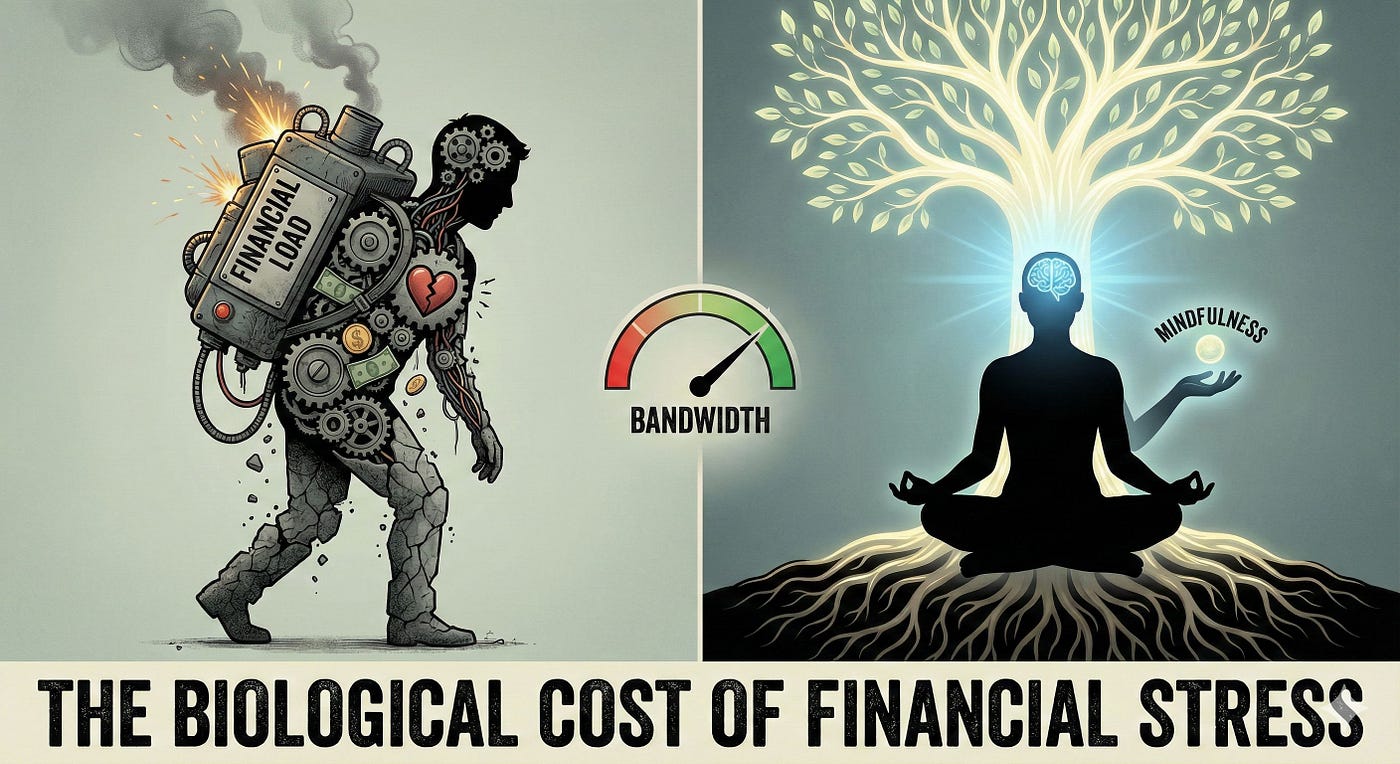
· Bandwidth tax: the same tunnel consumes working memory and executive control, reducing capacity for planning, flexible thinking, and self-regulation.
A useful analogy: bandwidth is your brain’s available “RAM.” Scarcity runs in the background and uses it.

3) What gets impaired under scarcity (common patterns)
When bandwidth is taxed, executive functions are more likely to degrade. Typical outcomes include:
· Short-term decision bias: quick fixes that create future costs
· Lower self-control: reduced capacity to resist impulses or maintain long-term plans
· Reduced cognitive flexibility: task-switching becomes harder; strategy updates slow down
· Inattention to non-urgent signals: preventive actions get neglected
· Increased self-focus: perspective-taking may decrease under intense threat/pressure
Scientific honesty note: If you want to include neural/EEG details (e.g., P3/N1/LPP), cite the exact studies and keep claims cautious.
4) Why it becomes a trap (a feedback loop)
The trap is a self-reinforcing loop:
Scarcity → tunneling → borrowing (time/money/energy) → future scarcity → higher bandwidth tax.
This helps explain why people can look “irrational” under pressure while behaving in a predictable scarcity pattern.

5) Why “slack” is the most practical antidote
Slack is a buffer: spare capacity that makes future-thinking possible.
Reframing slack (no table — just bullets):
· Traditional view: slack = waste, inefficiency
· Behavioral view: slack = resilience, adaptability, strategic capacity
· Without slack: systems become brittle, reactive, and innovation-hostile
6) Practical interventions (evidence-informed, low-risk)
Below are strategies that reduce cognitive load and rebuild slack. They are “evidence-informed,” but you should cite any specific quantitative claims you keep.
· Reduce trivial decisions: standardize routines to limit decision fatigue
· Remove low-value work: delete/automate/delegate tasks that don’t move core outcomes
· Schedule meeting buffers: prevent back-to-back cognitive strain
· Protect deep work blocks: notifications off, single objective, time-boxed
· Segment large projects: make obstacles visible early; reduce planning fallacies
· Set a daily priority statement: one sentence that anchors your day
· Take real breaks: movement and attention resets, not more screen input
[embed]
Checklist (copy/paste)
If you feel trapped in scarcity, check these boxes:
A) Identify the scarce resource
· What is scarce right now? (time / money / energy / attention / support)
· What am I “borrowing” to cope? (sleep / relationships / future time / health)
B) Reduce the bandwidth tax
· I eliminated at least one low-value task this week
· I standardized one routine to reduce trivial decisions
· I protected one deep work block (no notifications)

C) Build slack deliberately
· I added buffer between meetings (5–10 minutes)
· I created a small financial/time/emotional buffer (even if tiny)
· I scheduled a real break that restores attention (walk/breathing/movement)
D) Prevent relapse into the trap
· I wrote a one-sentence daily mission
· I broke a large project into near-term chunks with visible friction points
· I reviewed what surprised me and adjusted the system (not just effort)
Sources
· Mullainathan & Shafir — Scarcity: Why Having Too Little Means So Much
· Mani et al. (Science, 2013) — evidence linking poverty/financial strain to reduced cognitive performance
· Shah et al. (Science, 2012) — experimental work on consequences of “having too little”
· Keys et al. — Minnesota Starvation Experiment / The Biology of Human Starvation
· Sweller (and follow-ups) — Cognitive Load Theory (working memory limits; extraneous load)

메타데이터
- post_id
- 9d62652b0d7b
- slug
- scarcity-isnt-just-not-enough-it-s-a-bandwidth-tax-on-your-brain-9d62652b0d7b
- url
- https://medium.com/@locusnova/scarcity-isnt-just-not-enough-it-s-a-bandwidth-tax-on-your-brain-9d62652b0d7b
- canonical_url
- https://medium.com/@locusnova/scarcity-isnt-just-not-enough-it-s-a-bandwidth-tax-on-your-brain-9d62652b0d7b
- author_url
- https://medium.com/@locusnova
- status
- ok
- fetched_at
- 2026-08-16 03:52:42