Things That Bothered Me When I Was Dysphoric
Now that I’m at peace with my identity and body, so many worries are gone from my mind.
Things That Bothered Me When I Was Dysphoric
Now that I’m at peace with my identity and body, so many worries are gone from my mind.
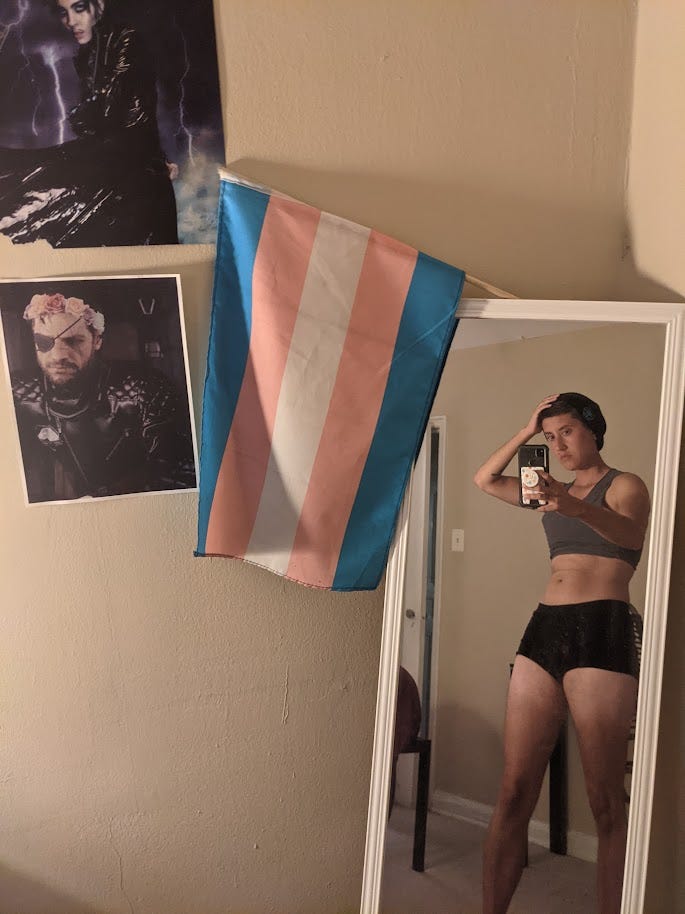
An old selfie of me in my bedroom from September 2021. I’m wearing a grey binder and black boyshort underwear. A trans flag is draped over my mirror; on the wall beside it are a small Dorian Electra poster and a Tumblr edit of Punished Venom Snake wearing a flower crown.
People getting my name wrong.
When I was dysphoric and had a name that didn’t suit me well, a person misspelling or mispronouncing it absolutely enraged me. My old name, Erika, had a clear masculine origin, with a drape of femininity that hung over it like an afterthought. It had enough of an edge with its velar plosive K that I could disappear comfortably inside it. But when anybody spelled it with a C, Erica, or dared to pronounce my middle name Dawn any differently from the masculine Don, my name hung heavy, a dysphoria hoodie that had gotten all wet. I was adamant about people getting my name right from the time I was a young child.
When I stopped being dysphoric, I had a name that people routinely misspelled and mispronounced. Here in Chicago, people most often pronounce “Devon” like the street, /də-VAHN/ (also the Blacker pronunciation of the name). If they heard the way I said it, with a schwa at the end, DEV-/ə/n, they would spell it with an i or an e. Never once did the sound clang against my ears.
If a stranger asked which way of saying the name I preferred, I said that I didn’t care, and I truly didn’t. I never corrected the spelling unless somebody was taking down my email. The name was more mine, yet it felt less personal, less in need of defending. It fit me comfortably in all weather and under any circumstances, and I didn’t cling to one perfect formulation of it to protect me from being seen in the wrong way. Devon was a loose, breezy cotton shirt I could always breathe in, and it could take on any particular shape.
Other people having the same name as me.
When I was dysphoric, I hated the name Erika on anybody else. If there was another girl with my name in the room, then she usually spelled it in the incorrect way, with a rounded C that softened her and made us both look bland. When I was on my own, I felt that I could make Erika into whatever I wanted it to be. But if there were many of us, we were only girls, nondescript ones out of a million with no features. Even when I started trying on new transgender names for myself, running into somebody who shared the name made me feel itchy and somehow both hypervisible and ignored.
Now that I am not dysphoric, I have a name that I share with many people, and it feels like a celebration, not an affront. I know so many Devons, men and women alike, and it’s always a fun bonding moment to run into another one. I have a Devin that runs the comic book club that I frequent, Devin Whitlock, and an energetic, drummer Devon who sometimes sits beside me in chorus practice and borrows my music binder.
I share my name completely with another person, Dr. Devon M Price; she has the same credentials as me in the same field and receives emails intended for me all the time. It has never makes me feel dysphoric to share so much of my identity with someone who is broadly read as a woman, or to have my professional footprint disappear into her far superior website and SEO. Our name is something I’m happy to share, and the beautiful, accomplished, loving person that she is helps me feel even more proud of it. I don’t need my name to tell everybody who I am, it’s just the address where I live, and you can find a lot of lovely flowers if you take the wrong turn.
Anybody resembling me.
When I was dysphoric, I hated seeing another person like me in the room. I had a boyfriend who rotated through a vast stable of eating-disordered, wide-hipped blondes and I loathed every single one, including myself. People at the cafe I frequented would sometimes tell me I resembled a Venezuelan Miss Universe winner and I would scroll through her photographs, mystified and confused, a little flattered because it always paid to be attractive, but nauseated by the thought of wearing so much makeup.
When I became a binder-wearing theyfab with a complicatedly shaved haircut, I sneered at every similarly shaped person in the room and avoided neighborhoods where folks like that gathered. Nobody ever saw individuals like us as anything but annoying women. And then, when I became a man and people well-intentionedly started telling me about the various man celebrities they thought I resembled, I would pitch a shitfit, instructing them to never tell a trans person that they looked like a cis person of their target gender, not ever, because that’s not what they were aspiring to be, goddammit, they were only trying to be themselves.
When I stopped being dysphoric, this all went away. I no longer felt like an eyesore if I was wearing the same obviously on-trend baggy pants as nine other queer people in the room. I could look like a woman that somebody knew, I could be the skater boy they went to middle school with, I could be indistinguishable from a lesbian or a gay man and it didn’t hurt. It all felt so fleeting, and in that there was freedom. My chinchilla is a standard grey, and most people couldn’t pick him out of a herd of a dozen other standard grey chinchillas. That does not make him any less of my sweet boy, and the resemblance is not an insult to him, because a standard grey chinchilla is a perfectly fine thing to be.

A chinchilla like any other. A perfect thing.
The sexual orientations of my partners.
When I was dysphoric, I deluded myself into thinking that my straight boyfriend wasn’t straight. He had gay friends who would drag him to the bars and ply him with free shots, and when he slunk into the alleyways of Andersonville to take a piss late at night, sometimes a guy would slink up behind him trying to cruise. It didn’t bother him much because he was an actor. He once wrote a play about having fruity little wrist motions that his mom and stepfather had tried to shame him out of. Though he made little comments about preferring me in long hair and with actual femininity, I liked to tell myself he was secretly a little bit gay, and that was why we could be together.
I clung to the small bi-curious fumblings of my past dating partners to validate myself. One boyfriend in college would always make out with guys when he was hammered. Another would get on Craigslist about once a month to get fucked in the ass. My straight female friends found that kind of thing disgusting and told me they would never date a man like that, but it made me salivate and lifted my heart. I’d only blow a gasket when these men showed interest in women; when my graduate school boyfriend pursued an OKCupid girl with a profile picture of herself in a sleek bodysuit and a long ponytail captioned divine femininity, I wanted to cut myself apart.
When I was dating queer but still dysphoric, I tried policing the identities and attraction patterns of anyone who was interested in me, as if that would help me define myself. If a partner of mine dated only other trans mascs, I obsessed over the thought they were reducing me to my pussy, and I wanted to lob off parts of their other sexual partners with knives. If anyone so much as made eyes at me at a sapphic or lesbian-oriented event I felt sick with myself for being a woman, even though plenty of lesbians aren’t. If a person who was interested in me dated broadly among the trans and woman spectrum, that wasn’t any better, because I was still something other than the man I kept insisting that I was.
Now that I am not dysphoric, I can see the people I have been with as individuals, not symbols of my own gender redemption, and I can regard their other partners as individuals too. A lesbian-aligned person being attracted to me is just a compliment; it pays to be attractive, after all. A gay man being interested in me is fine, a straight or ‘heteroflexible’ guy being into me is fine (though he won’t be worth my time), but my true solidarity lives with the nonbinaries, bisexuals, and asexuals, who know that these labels make less sense the more closely you look at them.
I understand now that everybody has their own relationship to sexuality and gender, as nonsensical as it is deeply felt. It is not really any of my business. All that matters is what I want to do with them, what they want to do with me, and if there is any other kind of sexy story we want to overlay on top of that.
Being misgendered.
When I was dysphoric I cared about pronouns and others’ perceptions a great deal. Every she stayed in my body for a whole day after it was uttered, and anytime I was thoughtlessly grouped with the gals I fixated on what I must have done to get myself erased in that way. I really thought that the right button-up shirt or parting of my hair could rescue me from discomfort by seducing others into using the magic words. I adorned myself with pronoun pins, hats, bios, emails signatures and wrote long essays about the importance of being seen. It didn’t change how people acted as much as it gave me an open, raw hangnail to always chew.
As my gender evolved, so did my most hated pronouns: at first it was she, the heavy weight of my assigned gender, and then it was they, with its thoughtless neutrality. Eventually everything felt wrong, because when people called me a man, they meant the kind of person who did MMA fighting or wanted to be handsome, and when they said I was generically trans or nonbinary, they meant the kind of person who wore bolo ties and led workplace discussions with a slide of the genderbread person projected onto the wall.
When I stopped being dysphoric, I stopped reading deeply into any of it. My partner’s dad calls me she, and it makes me feel kinda fishy, if I’m being honest, even while their cousins are simultaneously calling me bro and dude. I get into a cab and sometimes I am a lady, and sometimes I am a gay man. I can still put on my ‘passing’ straight man voice and be treated like one sometimes, and it tickles me.
I use whichever bathroom is least likely to be full of people; being transmisogyny-exempt I don’t do so out of worries about safety, I just enjoy the silence. I wish everybody could move with that freedom. Everybody should be able to.
Any flaw in my appearance.
When I was dysphoric I was perfectionistic about my looks. I covered every pimple in concealer, powder, and BB cream (makeup was significantly simpler back then). I fretted over every cowlick with shears and clippers until it eroded into the smooth plane of my head. A stain on a shirt would send me running home.
I had all kinds of expectations for how I had to look: every silhouette sleek and flawless, not a mark on me, always a little more polished than everybody else. And sometimes my mood would change and the outfit I was wearing would suddenly become loathsome to me, the wrong color washing out my face or the shape of a garment suddenly making me seem too wide at the hip or too muscular or not wide-shouldered enough. The standards that I set for myself were confusing, ever-shifting, impossible.
Now that I am not dysphoric I am a lot more sloppy with it. I have cracked nail polish hanging out of peeling old slide sandals that I wear inside and to the store. My wolfy twink Carly Rae Jepsen-hillbilly-pretty-boy-hybrid mullet looks glorious right now, but I could live even if it didn’t; getting fully comfortable with my gender and body is the only thing that made it possible for me to get over the awkward tennis-ball phase and grow out my short hair.
I attend speaking engagements in overlarge women’s blazers with the rolled-up sleeves held in place by just a bobby pin with my self-cut bangs looking a little wonky and uneven and I feel sexy. I miss a few hairs under my chin while I’m shaving and when I catch sight of them in the mirror I think, ah, that’s fine.
It’s something to do with not having to earn my right to be in public with my attractiveness, but if it were entirely that, then I would have stopped scrutinizing my looks when I was a man. I didn’t. I hated any time that my pants sat wrong on my waist or the blend on my buzz cut looked bumpy back then. Now I can even withstand being told I have a bowl cut because I’ve combed my layers wrong. I can bear zits and spinach in my teeth without wanting to run home or die.
My body is really sexy in its androgynous, expansive form that’s growing all shaggy and saggy in different places. But mostly I just do not have to think about it like I used to. It is not an unruly thing I am managing to carry around with me, it is the stuff of life itself.

Looking fine and feeling good.
Change.
I used to want to be one thing that was solidly defined, and I wanted for everyone to be able to see it. This was a core experience of my dysphoria: being ill at ease in the identity that was thrust upon me, and especially with the expectations that came with it, I wanted to broadcast with my body and how I moved through the world that I could not be forced to conform. But trying to get everybody on board with the way that you want to live is just an extension of the prison. You have to chart your own way out yourself.
When I was dysphoric, I wanted to be able to sculpt my body into some definition of perfection and then freeze it into place. For a long time the only gender affirming body modification that I knew was starvation (I see a younger version of myself in the musician Medusa writing about eating disorders as a nonbinary transition tool); later came strength training, which rewarded my eating with a Dorito-chip masculine torso shape. When I got injured last year, that all slipped from my grasp, and in the year since I stopped testosterone I have gotten softer in the ass and belly.
[embed]
I am changing, deteriorating, growing, as all living things do. One of my other great sources of dysphoria, beyond my loathing of change, has to do with being a human, and I still do not believe that I will really die. But I cannot deny that I am aging: the cat’s claws are at the sides of my eyes, and when I leaned back this morning to do ab exercises my back spasmed and I had to lie on the floor.
And so I have finally surrendered to boring, adult practicality: I am starting physical therapy for my hypermobility in a week. My partner and the other Dr. Devon are slowly winnowing away at my resistance to getting disability insurance and a life insurance policy.
For longer than most people I was able to dig into consistency and hold fast to it: the same word counts every day, the same workout, the same stubborn self-denial of food, rest, and play. It cannot hold. And I am picturing myself now as a creature with flinty streaks in my long hair who takes high-energy (but low impact!) walks and swims in the morning and has enough calmness afterward to sit still. I am getting fatter now and mostly really liking it, I am doing gentle Pilates and focusing on form, and I’m hearing my vocal range expanding on the top end as estrogen dominates my body and renders my cords more supple and stretchy.
I have no idea what kind of identity I will feel in five years, or ten; I almost completed my LGBTQA acronym speedrun and espoused all kinds of politics. I can accept now that my body is a thing that moves and looks different from every single angle, the way my cat Loquacious shifts from being a funny croissant on the floor to a perfect circle on the couch to a chilling loaf of bread beside the fridge.

My perfect, ever shape-shifting cat.
I have lived out days in the hospital in a gown with a weakened core and IVs in my arm, and no ability to control how I stand or how others talk about the body they are poking and prodding. If I didn’t feel that I was holding everything about me perfectly in the palm of my hand, it used to feel like I was falling. Sometimes now it feels more like being rooted, which brings stability but is far from a static state. A tree’s roots are always burying deeper and wider into an earthen body that is itself alive, teeming with creatures and flowing with water.
Everything that I am and come from is moving, always, and though my being has been given many names by man they all oversimplify the overgrown, quavering nature of it. That’s fine. I don’t need to fit into a taxonomy, be printed in a book. I will live regardless.
Previously:
메타데이터
- post_id
- 9d64dda83ba2
- slug
- things-that-bothered-me-when-i-was-dysphoric-9d64dda83ba2
- url
- https://medium.com/@devonprice/things-that-bothered-me-when-i-was-dysphoric-9d64dda83ba2
- canonical_url
- https://medium.com/@devonprice/things-that-bothered-me-when-i-was-dysphoric-9d64dda83ba2
- author_url
- https://medium.com/@devonprice
- status
- ok
- fetched_at
- 2026-07-09 17:12:49