Hidden Markov Models for regime detection look simple until your backtest silently lies to you.
Hidden Markov Models for regime detection look simple until your backtest silently lies to you.
Most quant implementations fail not because the model is wrong – but because the data pipeline feeds it information it should never have. Here is every leakage point worth knowing.
Feature standardisation is not optional
Raw features going into a Gaussian HMM violate the emission assumption. OU Half-Life has an extreme right tail – trending windows produce values of 200+ days while mean-reverting windows produce 8. Feed that raw and you corrupt the covariance matrix of every state. Log-scale before z-scoring.
Use expanding z-score, not rolling. Rolling normalisation assumes mean and variance are constant over the window, which fails exactly when you need the model most – during regime transitions.
hmmlearn has three inference methods. Two of them are look-ahead.
predict() uses Viterbi – full sequence, forward and backward. score_samples() with smoothed posteriors uses the forward-backward algorithm. Both know what state the model ended up in at t+10 when they assign the label at t. Your live system does not.
The only valid option for production scoring is the forward algorithm on a single observation. One bar, one forward pass, no future data.
Frequent retraining creates leakage even without look-ahead
Refit every 5 days with no embargo and you have a problem. EM concentrates gradient on the most recent observations – those closest to the training cutoff. Score the next observation and the model is responding to patterns it just memorised from the days immediately before. Not classical look-ahead, but parameter leakage in practice.
The fix: a hard embargo between training cutoff and scored observation. Train on [0, t-21], withhold [t-21, t] entirely, score at t. The 21-day buffer breaks the leakage path regardless of how frequently you retrain within it.
Walk-Forward Analysis needs two embargos, not one!
The HMM-internal embargo handles parameter leakage. The fold-level embargo handles something different: threshold selection leakage. If you grid-search an entry threshold on IS data [0, T_k] and evaluate immediately on [Tk, T{k+1}] with no gap, the optimisation can overfit to the boundary between the two windows. Add a fold-level embargo of at least 21 days between the IS optimisation cutoff and the first OOS observation.
WFE – Walk-Forward Efficiency – is the metric that tells you whether any of this worked. It is simply mean(OOS Calmar) / mean(IS Calmar) across folds. WFE near 1.0 means IS performance transfers. WFE near 0 or negative means you built a sophisticated curve-fitting machine.
The uncomfortable truth is that a model with correct leakage controls will almost always look worse in-sample than one without them. That degradation is not a problem to fix – it is the signal that you are measuring something real.
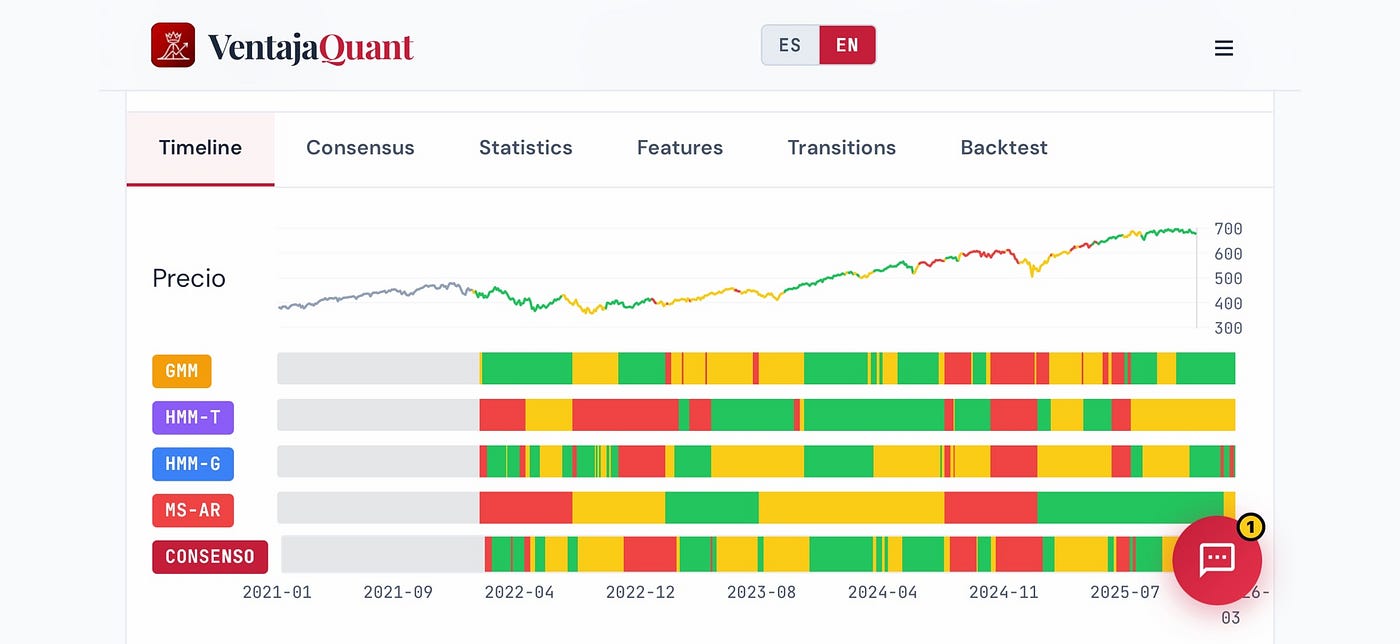
You can visit: https://ventajaquant.com/en/pages/market-regime/ for more information
QuantFinance #AlgoTrading #MachineLearning #HMM #RiskManagement #VentajaQuant.com
메타데이터
- post_id
- 9d8d0cf02099
- slug
- hidden-markov-models-for-regime-detection-look-simple-until-your-backtest-silently-lies-to-you-9d8d0cf02099
- url
- https://medium.com/@NFS303/hidden-markov-models-for-regime-detection-look-simple-until-your-backtest-silently-lies-to-you-9d8d0cf02099
- canonical_url
- https://medium.com/@NFS303/hidden-markov-models-for-regime-detection-look-simple-until-your-backtest-silently-lies-to-you-9d8d0cf02099
- author_url
- https://medium.com/@NFS303
- status
- ok
- fetched_at
- 2026-06-10 15:53:41




