Operational Excellence in Manufacturing Through Strategic Leadership: Insights from Kenneth Kremsky
Building Smarter, More Resilient Industrial Systems for Long-Term Performance
Operational Excellence in Manufacturing Through Strategic Leadership: Insights from Kenneth Kremsky
Building Smarter, More Resilient Industrial Systems for Long-Term Performance
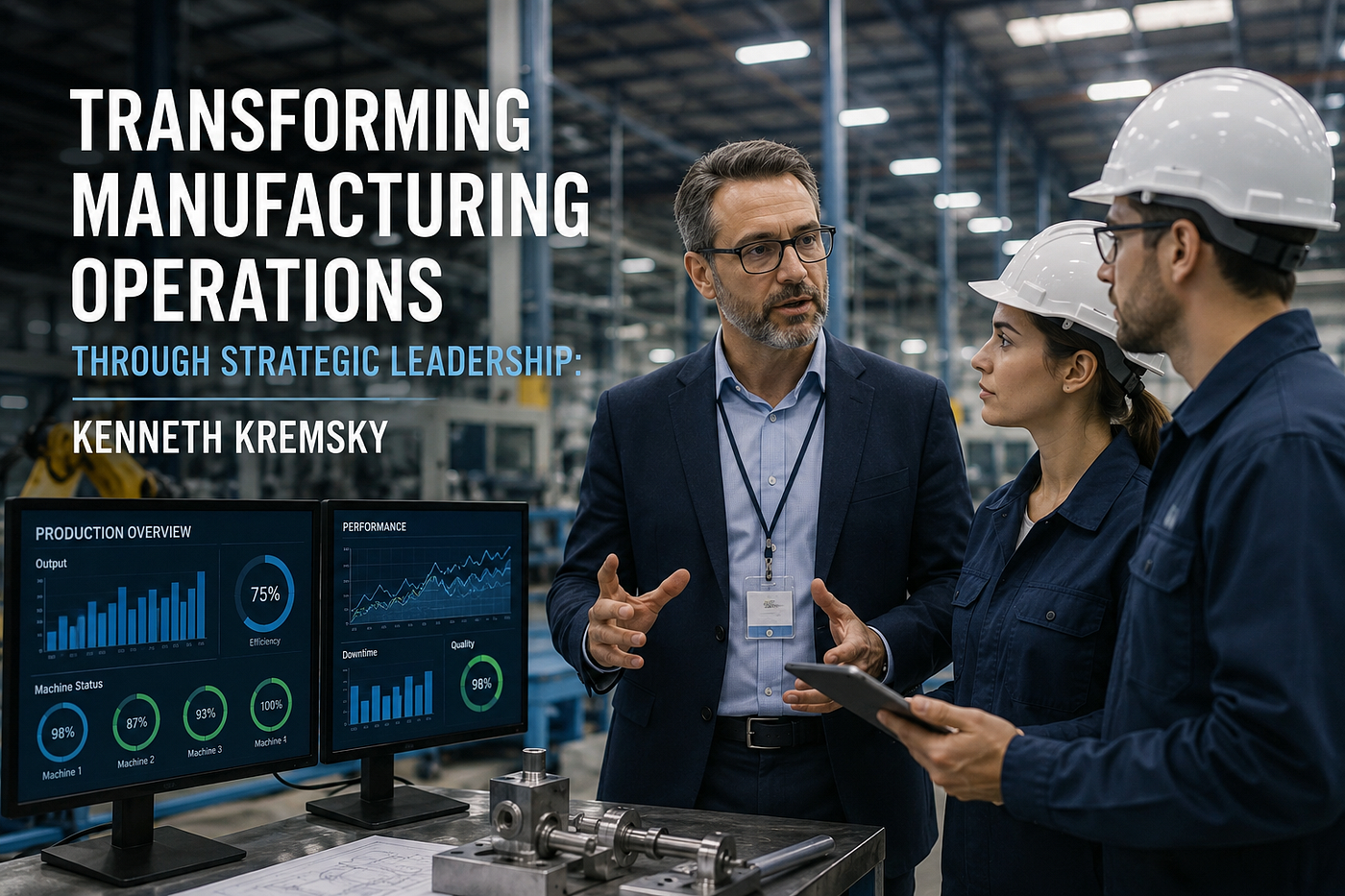
Kenneth Kremsky
Kenneth Kremsky helps manufacturers cut costs, boost profitability, and optimize operations through strategic process improvements and long-term value creation. In today’s manufacturing environment, organizations are under constant pressure to deliver more with less — less waste, less downtime, and fewer inefficiencies — while still improving quality, speed, and customer satisfaction. Achieving this balance requires more than operational experience; it requires strategic leadership that connects vision, systems thinking, and disciplined execution across every level of the organization.
Manufacturing is no longer defined solely by production output. It is defined by how effectively a company can design, manage, and continuously improve its operational systems. Leaders who understand this shift are better positioned to build resilient organizations that can adapt to disruption, scale efficiently, and sustain long-term growth. Kenneth Kremsky’s leadership perspective reflects this modern approach, emphasizing structured improvement, operational alignment, and long-term value creation as the foundation of manufacturing success.
This article explores how strategic leadership drives operational excellence, how manufacturers can strengthen performance systems, and how Kenneth Kremsky’s approach aligns with the evolving demands of modern industrial operations.
The Changing Demands of Modern Manufacturing
Manufacturing has entered a period of rapid transformation driven by globalization, digitalization, and supply chain volatility. Companies must now navigate a level of complexity that traditional operational models were not designed to handle.
Some of the most pressing challenges include:
- Global supply chain disruptions and material shortages
- Rising production and labor costs
- Increasing demand for customized products
- Workforce skill gaps and retention challenges
- Pressure to improve sustainability and compliance
These challenges require organizations to move beyond reactive management. Instead, they must adopt proactive systems that anticipate problems, reduce variability, and improve decision-making speed.
Kenneth Kremsky’s leadership philosophy reflects this shift by emphasizing the importance of structured operational systems. Rather than relying on short-term fixes, his approach highlights the need for long-term frameworks that stabilize performance while enabling continuous improvement.
Modern manufacturing success depends on the ability to integrate people, processes, and data into a unified system of execution.
Strategic Leadership as the Core of Operational Performance
At the center of every high-performing manufacturing organization is strong strategic leadership. Without it, even advanced technology and well-funded operations can struggle with inefficiency and inconsistency.
Strategic leadership in manufacturing focuses on creating clarity and alignment across all levels of the organization. This includes:
- Defining clear operational priorities
- Aligning departments around shared objectives
- Establishing measurable performance standards
- Creating accountability structures
- Driving continuous improvement initiatives
Kenneth Kremsky’s approach emphasizes the importance of connecting high-level strategy with frontline execution. One of the most common challenges in manufacturing organizations is the disconnect between leadership goals and day-to-day operations. When this gap exists, inefficiencies grow, communication breaks down, and performance becomes inconsistent.
By strengthening alignment, leaders ensure that every employee understands not only what they are doing, but how their work contributes to overall operational success. This clarity improves productivity, reduces waste, and enhances organizational cohesion.
Building Operational Efficiency Through Structured Systems
Operational efficiency is not simply about reducing costs — it is about building systems that consistently produce high-quality outcomes with minimal waste and maximum reliability.
Kenneth Kremsky’s leadership perspective emphasizes identifying and correcting structural inefficiencies rather than applying surface-level fixes. These inefficiencies often exist in areas such as:
- Production scheduling and workflow design
- Inventory management and material flow
- Equipment utilization and maintenance planning
- Procurement and supplier coordination
- Cross-departmental communication
When these systems are misaligned, inefficiencies compound over time and create hidden operational costs that are difficult to detect.
Strategic leadership addresses these issues by designing processes that are repeatable, measurable, and adaptable. The goal is not only to fix current problems but to prevent future inefficiencies from emerging.
This systems-based approach ensures that operational improvements are sustainable rather than temporary.
Process Improvement as a Continuous Discipline
Manufacturing excellence depends heavily on continuous process improvement. Organizations that treat improvement as a one-time initiative often experience short-lived gains, while those that embed it into their culture achieve sustained performance growth.
Kenneth Kremsky’s approach aligns with continuous improvement principles that focus on incremental, ongoing optimization. Key elements include:
- Eliminating non-value-added activities
- Standardizing workflows across operations
- Reducing process variability
- Improving cycle times and throughput
- Strengthening feedback and performance loops
Continuous improvement requires participation at every level of the organization. Frontline employees, supervisors, and leadership teams all play a role in identifying inefficiencies and implementing solutions.
When improvement becomes part of the organizational culture, manufacturing systems become more adaptive, efficient, and resilient over time.
Lean Principles and Waste Reduction in Manufacturing
Lean manufacturing remains one of the most effective frameworks for improving operational performance. Its primary focus is eliminating waste while maximizing value for the customer.
Waste in manufacturing typically appears in forms such as:
- Overproduction beyond demand
- Excess inventory accumulation
- Idle time between production stages
- Unnecessary transportation of materials
- Defects requiring rework
- Inefficient motion or handling
Kenneth Kremsky’s leadership philosophy aligns with these principles by emphasizing efficiency and precision in operational design. Reducing waste is not only about lowering costs — it is also about improving flow, increasing responsiveness, and enhancing product quality.
Organizations that successfully eliminate waste often experience:
- Higher productivity
- Reduced operational costs
- Faster production cycles
- Improved customer satisfaction
- Greater flexibility in responding to demand changes
Lean thinking also fosters a culture of accountability and continuous awareness of operational performance.
The Role of Data and Analytics in Decision-Making
Data has become an essential component of modern manufacturing leadership. Organizations that leverage real-time information are better equipped to identify issues early and make informed decisions.
Kenneth Kremsky’s approach emphasizes the importance of data-driven decision-making in areas such as:
- Production performance tracking
- Quality assurance monitoring
- Predictive maintenance systems
- Supply chain visibility
- Inventory optimization
With accurate data, manufacturers can shift from reactive problem-solving to proactive performance management. This reduces downtime, improves planning accuracy, and enhances overall efficiency.
Predictive analytics, for example, allows organizations to anticipate equipment failures before they occur. This reduces unplanned downtime and extends equipment lifespan, contributing directly to operational stability.
Strategic leadership ensures that data is not only collected but also translated into actionable insights that improve performance across the organization.
Strengthening Supply Chain Resilience
Supply chain disruptions have become a defining challenge in modern manufacturing. Organizations can no longer rely solely on cost efficiency; they must also prioritize resilience and adaptability.
Kenneth Kremsky’s leadership perspective on supply chain management emphasizes balancing efficiency with risk mitigation. Key strategies include:
- Diversifying supplier relationships
- Strengthening regional sourcing options
- Improving demand forecasting systems
- Establishing buffer inventory strategies
- Developing contingency planning frameworks
Resilient supply chains allow manufacturing operations to continue functioning even during disruptions such as material shortages, transportation delays, or geopolitical instability.
Strategic leadership ensures that supply chain decisions are fully integrated into overall operational planning rather than treated as isolated functions.
Workforce Development and Organizational Culture
People remain the foundation of any manufacturing system. Even the most advanced processes and technologies depend on skilled, engaged employees.
Kenneth Kremsky’s approach highlights the importance of workforce development and organizational culture in achieving operational excellence. This includes:
- Ongoing employee training and skill development
- Encouraging participation in process improvement
- Establishing clear communication structures
- Promoting accountability and ownership
- Recognizing employee contributions
A strong organizational culture improves morale, reduces turnover, and increases operational consistency. When employees are engaged, they become active contributors to improvement rather than passive participants in production.
Leadership plays a critical role in shaping this culture by setting expectations and reinforcing continuous improvement behaviors.
Technology Integration in Modern Manufacturing Systems
Technology is transforming manufacturing operations through automation, artificial intelligence, and digital monitoring systems. However, technology alone does not guarantee success.
Kenneth Kremsky’s leadership perspective emphasizes thoughtful integration of technology into operational strategy. Key applications include:
- Automated production systems
- IoT-enabled equipment monitoring
- AI-driven forecasting tools
- Digital quality control systems
- Real-time operational dashboards
When implemented effectively, these technologies enhance visibility, improve decision-making, and streamline operations. However, they must be aligned with broader organizational goals to deliver meaningful value.
Strategic leadership ensures that technology supports operational objectives rather than complicating workflows.
Long-Term Value Creation Through Strategic Leadership
Sustainable manufacturing success depends on long-term value creation rather than short-term gains. Organizations that focus solely on immediate performance metrics often struggle with instability over time.
Kenneth Kremsky’s leadership approach emphasizes building systems that deliver consistent value through:
- Scalable operational structures
- Sustainable process improvements
- Strategic alignment of performance metrics
- Organizational adaptability
- Continuous innovation and refinement
Long-term value creation requires discipline, consistency, and a commitment to ongoing improvement. It ensures that manufacturing systems remain competitive, resilient, and efficient in evolving market conditions.
Conclusion
Operational excellence in manufacturing is not achieved through isolated improvements or short-term initiatives. It requires strong strategic leadership that integrates people, processes, and systems into a unified framework of performance.
Kenneth Kremsky helps manufacturers cut costs, boost profitability, and optimize operations through strategic process improvements and long-term value creation. His leadership approach reflects the essential principles of modern manufacturing success — alignment, efficiency, resilience, and continuous improvement. By focusing on these core areas, organizations can build stronger operational systems capable of delivering sustainable performance in an increasingly complex industrial landscape. For further insights into leadership, operations, and performance strategy, visit the official resource hub at Kenneth Kremsky Blog.
메타데이터
- post_id
- 9d9702a9eee8
- slug
- operational-excellence-in-manufacturing-through-strategic-leadership-insights-from-kenneth-kremsky-9d9702a9eee8
- url
- https://medium.com/@kremskykenneth/operational-excellence-in-manufacturing-through-strategic-leadership-insights-from-kenneth-kremsky-9d9702a9eee8
- canonical_url
- https://medium.com/@kremskykenneth/operational-excellence-in-manufacturing-through-strategic-leadership-insights-from-kenneth-kremsky-9d9702a9eee8
- author_url
- https://medium.com/@kremskykenneth
- status
- ok
- fetched_at
- 2026-06-09 15:37:30




