The Medieval State: How Ethiopia’s Treaty Violations Threaten Regional Peace
The modern state defines itself not through territorial grandeur or diplomatic pageantry, but through something more prosaic yet more…

The Medieval State: How Ethiopia’s Treaty Violations Threaten Regional Peace
The modern state defines itself not through territorial grandeur or diplomatic pageantry, but through something more prosaic yet more profound: self-limitation. It is the acceptance that power bows to law, that agreements bind precisely when they become inconvenient, and that sovereignty grants no licence to revoke obligations at will. Against this measure, the historical conduct of successive Ethiopian governments — imperial, revolutionary, and democratic alike — reveals not merely episodic failures but a structural inability to internalise the foundational norms of the modern nation-state. Nowhere does this deficit emerge more starkly than in Ethiopia’s treaty relationship with Eritrea.
What the legal record discloses is neither a sequence of regrettable misunderstandings nor a series of isolated breaches. Rather, it reveals a pattern so consistent as to constitute a system: treaties function as tactical instruments rather than binding commitments; arbitration commands respect only whilst it aligns with political preference; and international law receives rhetorical invocation even as it suffers operational denial. Eritrea’s experience thus serves not as aberration but as diagnosis — a case study in Ethiopia’s unresolved passage from imperial sovereignty to modern legal statehood.
Across regimes and revolutions, one pattern endures — agreements bind only until they become inconvenient.
The Federation Dissolved: 1950–1962
The post-war settlement of Eritrea’s status constituted one of the earliest tests of Ethiopia’s willingness to operate within a rules-based international order. When the United Nations adopted Resolution 390 A (V) in 1950, federating Eritrea with Ethiopia under the Ethiopian crown, the arrangement left no room for ambiguity. Eritrea was to retain not only its own constitution and elected parliament, but also its judiciary and administrative autonomy, whilst Ethiopia would exercise authority solely within the circumscribed federal framework. This was neither colonial imposition nor vague political understanding; it was a multilateral settlement endorsed by the international community and accepted by Ethiopia as the price of postwar legitimacy.
Yet within a decade, the federation had been systematically hollowed out, and in 1962 it vanished entirely through imperial proclamation. Eritrea found itself annexed, reduced from federated territory to mere province. No appeal was lodged to international law, no renegotiation sought, no legal mechanism invoked. The act derived its justification from imperial prerogative rather than legal reasoning, reflecting a conception of sovereignty in which authority flowed downward from the centre and international guarantees remained subordinate to dynastic power. The consequence proved as predictable as it was protracted: a thirty-year independence war that began not as secessionist adventurism but as resistance to the nullification of a binding international agreement. From the outset, therefore, Ethiopia established a precedent that would recur with striking regularity: treaties could be discarded when they ceased to serve central authority.
Military Defeat and Political Transition: 1991
The military dimension of Ethiopia’s 1991 transition deserves particular attention, for it exposes the real balance of power that shaped the subsequent legal and political settlement. By May 1991, the Ethiopian army had been comprehensively annihilated in Eritrea, with approximately 130,000 prisoners of war held by the Eritrean People’s Liberation Front. This was not a peripheral battlefield setback but a decisive strategic defeat that eliminated Ethiopia’s capacity to dictate political outcomes by force.
The EPLF’s dominance extended well beyond Eritrean territory. It was the EPLF that guided, enabled, and protected Ethiopian opposition forces during the final phase of the war, culminating in what became known as the “liberation” of Ethiopia and the capture of Addis Ababa. In a striking reversal of the colonial-era relationship, it was the Eritrean movement that installed the Ethiopian People’s Revolutionary Democratic Front in government, shielded the nascent regime during its most vulnerable phase, and only withdrew from Ethiopian territory once the new state apparatus achieved minimal viability. The asymmetry of power at the moment of transition could not have been clearer.

This context is essential to understanding Ethiopia’s subsequent recognition of Eritrean independence. That recognition did not flow from a principled embrace of self-determination or a conversion to modern legal norms. It was the product of military defeat and strategic necessity. The transitional agreements between the EPRDF and the EPLF — most notably the commitment to a UN-supervised referendum — were signed by a government whose survival depended directly on Eritrean military and political support. When Ethiopia formally recognised Eritrea as a sovereign state in 1993, following an overwhelming vote for independence, it did so as the weaker party. This imbalance would prove decisive once power relations later shifted and Ethiopia sought to reinterpret, dilute, or reverse its commitments.
The complete collapse of the Ethiopian army in 1991 was therefore not simply a military failure. It was the structural consequence of a medieval conception of power colliding with modern warfare and modern politics. For decades, Ethiopian rulers had governed through a logic inherited from imperial rule: authority flowed vertically from the centre; loyalty was coerced rather than earned; and the army existed not as a professional national institution but as an instrument of regime preservation and territorial domination. Soldiers were asked to fight for an abstract empire rather than a shared civic project, and to sacrifice themselves for rulers who treated law, citizenship, and even their own troops as expendable tools of control.
When this system came under sustained pressure from organised liberation movements — movements that combined military discipline with political legitimacy and a coherent vision of statehood — it disintegrated with remarkable speed. The army that collapsed in 1991 was immense in size but hollow in substance. Its cohesion rested on fear rather than conviction, hierarchy rather than trust, repression rather than consent. Officers were promoted for loyalty rather than competence, battlefield initiative was discouraged because it threatened centralised control, and decision-making was so rigidly vertical that adaptability became impossible. This was an army designed to subdue subject populations, not to defend a modern state rooted in law and citizenship.
Once the aura of inevitability surrounding central authority evaporated, the army’s internal logic collapsed with it. Units surrendered en masse, defected, or simply dissolved — not because they lacked weapons, but because they lacked a cause worth dying for. The state they were meant to defend had never offered them a binding political compact, only obedience.
By contrast, the forces that defeated it — the EPLF and the Tigray People’s Liberation Front — were modern political-military organisations. They treated fighters as political actors, embedded military struggle within a broader social contract, and understood warfare as inseparable from legitimacy. Discipline was not imposed solely from above but sustained horizontally through shared purpose. The asymmetry was decisive. One side fought to preserve an imperial order that denied law its supremacy; the other fought to create new states grounded, however imperfectly, in modern political principles.
The annihilation of the Ethiopian army in 1991 thus stands as an early warning of a deeper pathology. A state that does not bind itself by law cannot build institutions capable of surviving stress. A ruling class that views agreements, rights, and obligations as revocable cannot command loyalty when power falters. The same medieval mindset that produced unilateral annexations, treaty violations, and contempt for legal restraint also produced an army incapable of enduring defeat. What collapsed in 1991 was not merely a military force, but an entire conception of authority — one that mistook domination for durability and hierarchy for legitimacy.
The 1992–1997 Cooperation Regime: Law as Temporary Instrument
Yet even at this moment of apparent legal maturity, the underlying logic remained conditional. Between 1992 and 1997, Eritrea and Ethiopia constructed one of the most integrated post-independence relationships in Africa, establishing arrangements that appeared to transcend the typical post-conflict settlement. These agreements covered not merely symbolic diplomatic recognition but the entire architecture of interstate cooperation: citizenship and residency rights that allowed tens of thousands of Eritreans to live and work in Ethiopia under formal legal protections; free movement of goods and people across borders that had only recently been militarised; shared currency arrangements that gave Ethiopia continued use of Eritrean ports whilst Eritrea maintained access to Ethiopian markets; and even military and intelligence cooperation that suggested genuine strategic partnership.
On paper, the relationship resembled a model of post-conflict integration — a demonstration that former adversaries could build functional legal frameworks for coexistence. In practice, however, these agreements rested on a fragile and ultimately fatal assumption: that Ethiopia accepted legal parity with its newly independent neighbour. Acceptance of Independence had been not as an irrevocable legal settlement but as a contingent political accommodation made under circumstances of military weakness. The moment those circumstances changed, the legal framework would prove as ephemeral as the political will that sustained it.
1998 Deportations: Breach Without Apology
When tensions escalated in the late 1990s — under the pretext of border dispute — law yielded with brutal abruptness to executive power. As war loomed in 1998, Ethiopia expelled nearly 90,000 Eritreans and Ethiopians of Eritrean origin in what constituted one of the largest forced deportations in modern African history. Property was confiscated without compensation, families were separated without due process, and individuals who had lived their entire lives in Ethiopia found themselves stripped of both residence and legal recourse overnight. These actions violated the 1992 Citizenship and Residency Agreement directly and comprehensively, yet Ethiopia neither formally withdrew from the treaty nor sought arbitration to resolve the dispute.
The deportations were executed through executive fiat — a unilateral assertion of state power that treated international agreements as nullities the moment they conflicted with perceived security interests. No legal justification was offered because none was deemed necessary. The message carried unmistakable clarity: rights existed at the discretion of the state, not as enforceable legal guarantees. This marked not merely a breach of specific treaty provisions but the collapse of law into power — a reversion to precisely the logic that the entire post-1991 legal architecture had been designed to transcend.
Arbitration Accepted, Implementation Refused: 2000–2018
When one state treats international law as advisory rather than binding, the entire regional order becomes negotiable.
This instrumental approach to law reached its most consequential expression in the aftermath of the 1998–2000 Eritrea-Ethiopia war. The Algiers Agreement of December 2000 represented a paradigmatically modern treaty. It established binding arbitration mechanisms — the Eritrea-Ethiopia Boundary Commission and the Claims Commission — and explicitly stipulated that their decisions would be final and binding. Ethiopia accepted this framework under international auspices, with the backing of not only the United Nations and the Organisation of African Unity, but also the United States and the European Union. When the Boundary Commission ruled in 2002 that Badme — the flashpoint of the war — lay within Eritrean territory, it did so on the basis of treaties Ethiopia itself had signed during the colonial period and reaffirmed through post-independence recognition.
Ethiopia’s response proved as revealing as it was contradictory: accept the ruling rhetorically whilst rejecting its implementation entirely. It called for dialogue after arbitration had concluded, sought to renegotiate outcomes that had been contractually foreclosed, and effectively suspended compliance for nearly two decades. This posture derived not from legal argument but from a pre-modern conception of authority in which law advises rather than commands. The ensuing ‘no war, no peace’ stalemate emerged not from ambiguity or legal insufficiency, but from deliberate non-compliance by a state unwilling to accept that arbitration could constrain sovereign preference.
The 2018 Peace Accords: Comprehensive Agreements, Cynical Abandonment
The 2018 rapprochement between Ethiopia and Eritrea appeared to offer a genuine chance to close the protracted chapter of legal deferral. The Joint Declaration of Peace and Friendship signed in Asmara in July 2018, followed by the Jeddah Agreement in September under Saudi and Emirati auspices, were neither incomplete nor poorly designed. On the contrary, these agreements were comprehensive legal instruments that restored diplomatic relations, normalised travel and trade, politically acknowledged the Boundary Commission’s ruling, and provided clear frameworks for implementation. They enjoyed overwhelming public support in both countries, with scenes of euphoric reunions between separated families and jubilant celebrations across both Asmara and Addis Ababa. The agreements possessed all the necessary logic for success: clear commitments, international backing, popular legitimacy, and mutual economic benefits.
What followed, however, revealed the true nature of Ethiopia’s engagement with international law. Within months, the Ethiopian government — under influences that remain subject to speculation but point unmistakably toward external actors with interests in regional instability — abruptly redesignated Eritrea as an enemy. This volte-face shocked both Eritrean and Ethiopian populations, who had embraced peace with genuine enthusiasm. The swift reversal carried a familiar signature: Ethiopia chose to conclude one war only to launch another in its own backyard, redirecting military forces not toward implementing peace agreements but toward prosecuting a devastating conflict in Amhara region.
This pattern exposes the medieval logic at the heart of Ethiopian statecraft. The problem lay not in deficient treaty architecture but in a governing philosophy that treats agreements as temporary expedients — instruments to be deployed when convenient and discarded when other opportunities present themselves. Implementation became selective not because the agreements lacked clarity, but because Ethiopia retained the presumption that compliance remained optional. Borders opened and closed by executive fiat not due to ambiguous treaty language, but because Ethiopia never genuinely accepted that treaties constrain sovereign discretion. The question was never whether the agreements contained sufficient enforcement mechanisms, but whether Ethiopia considered itself bound by mechanisms at all.
This reproduced precisely the historical pattern that had characterised every previous settlement: agreements signed with apparent sincerity, only to be abandoned when political calculations shifted. Peace was performed spectacularly — the embraces, the declarations, the Nobel Prize — yet treated as revocable accommodation rather than binding commitment. Once again, law found itself subordinated to the prerogatives of power, with consequences that extended far beyond Ethiopian-Eritrean relations to encompass the war almost each region of Ethiopia and regional destabilisation across the Horn of Africa.
Imperial Ghosts: Ethiopia’s Medieval Logic and the Unravelling of Legal Order
The persistent failure to accept that treaties constrain power has turned the Horn into a zone of permanent legal precarity.
If the 2018 Asmara and Jeddah agreements were meant to mark Ethiopia’s final passage into a modern, law-bound conception of interstate relations, the years that followed have instead exposed how fragile that transition remains. The most revealing breaches have assumed not the form of formal denunciations or military incursions, but something more corrosive: a sustained political re-imagining of Eritrean sovereignty as negotiable, conditional, and subordinate to Ethiopian necessity. What stands at stake here is neither routine diplomatic friction nor disagreements over treaty interpretation, but rather the reassertion of a pre-modern logic in which power precedes law and necessity overrides treaty obligation.
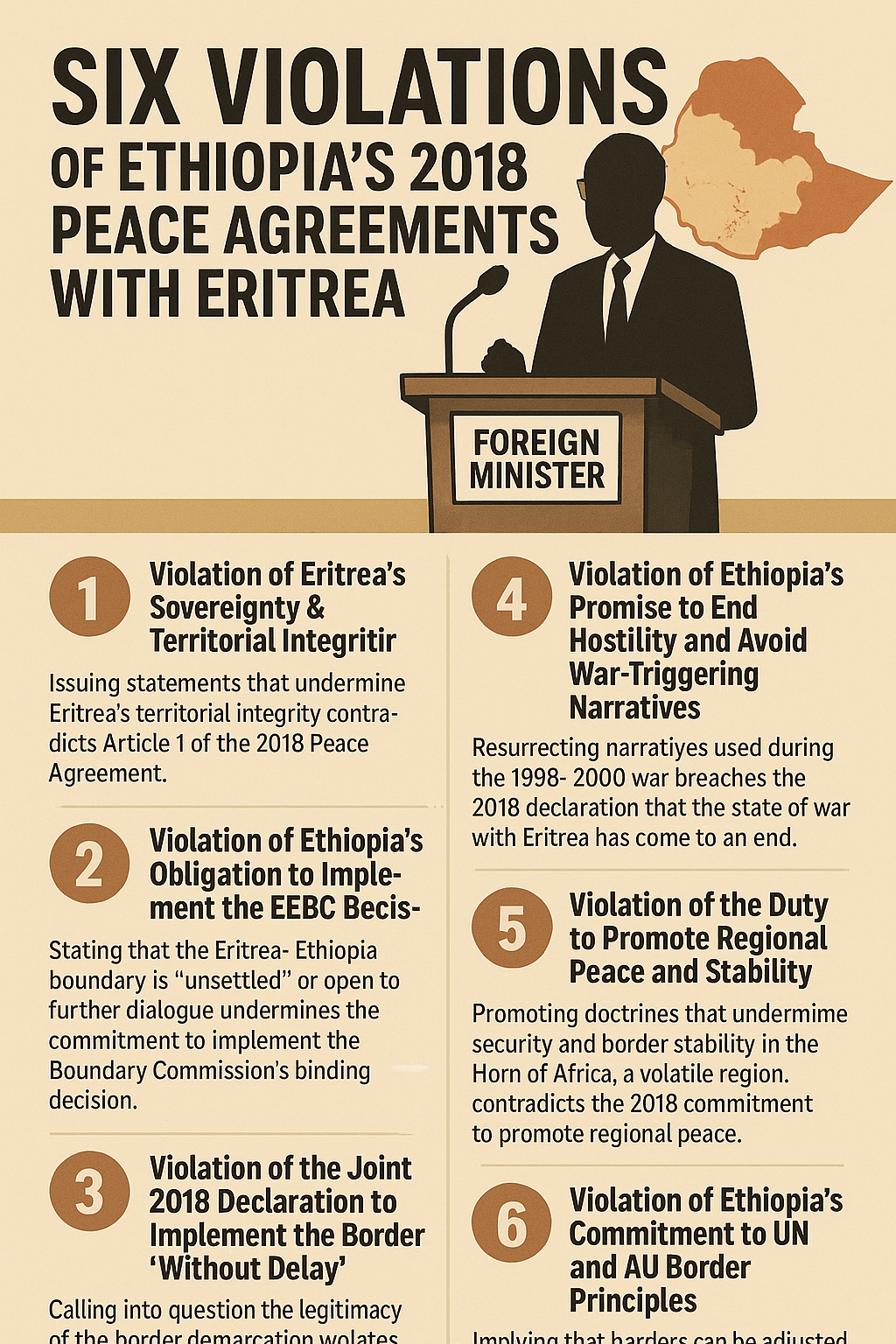
This regression manifests across six distinct yet interconnected dimensions, each representing a specific breach of the post-2018 legal settlement:
1. Maritime Access Reframed as Territorial Entitlement
By advancing a narrative that Ethiopia’s economic future requires ‘durable and secure access to the sea’, senior Ethiopian officials — including Prime Minister Abiy Ahmed — have implicitly asserted a claim to territory under Eritrean sovereignty. This framing transcends advocacy for transit rights or commercial access; it treats territorial access as an existential entitlement rather than a privilege subject to negotiation and payment under international law. The language proves revealing: it asks not how a landlocked state might secure commercial access through treaties, fees, or regional integration — mechanisms long recognised and widely practised in international law — but rather how Ethiopia can guarantee access in perpetuity, resistant to denial by a neighbouring sovereign state.
Such a position directly contradicts Ethiopia’s 2018 commitment to respect Eritrea’s sovereignty and territorial integrity. More fundamentally, it violates the core international principle that no state may claim another’s territory on grounds of necessity, demography, or economic pressure. Once access receives treatment as entitlement rather than agreement, Eritrean territory ceases to command respect as inviolable, finding itself instead recast as a strategic asset whose control must somehow be secured for Ethiopia’s developmental trajectory. This constitutes not policy disagreement but treaty breach.
2. Campaigning Against Eritrea’s Sovereignty as Settled Fact
Since the rapprochement, Ethiopian official discourse has increasingly portrayed Eritrea’s sovereignty itself as an obstacle to regional progress rather than a settled legal reality. Statements suggesting that Eritrea’s borders are historically artificial, unjust, or economically irrational have become both more frequent and less guarded. Cabinet ministers speak openly of borders as ‘colonial impositions’ requiring rectification; state media frames Eritrea’s territorial integrity as incompatible with regional development; and government-aligned intellectuals advance arguments that Eritrea’s existence as a separate state represents a historical aberration.
This rhetorical shift matters profoundly because it amounts to a sustained political campaign that undermines Eritrea’s territorial integrity — despite Ethiopia’s explicit pledge in Asmara and Jeddah to respect Eritrea as a sovereign equal. Sovereignty, once formally recognised and repeatedly reaffirmed through treaty — as Ethiopia did in 1993 and again in 2018 — cannot be selectively questioned without breaching those agreements. Sovereignty proves conditional upon neither convenience nor regional approval; it stands absolute within recognised borders. To frame Eritrea’s existence as an obstacle to regional progress constitutes therefore not merely provocative speech but conduct incompatible with treaty obligations freely undertaken.
3. Questioning Eritrea’s Right to Exist Within Internationally Recognised Borders
Perhaps most consequentially, Ethiopian rhetoric has reintroduced the notion that Eritrea’s borders — and by implication Eritrea’s statehood — remain subject to reconsideration. This strikes at the very heart of the post-1993 legal settlement in the Horn of Africa. Eritrea’s boundaries constitute not ambiguous artefacts awaiting moral correction but rather the product of colonial treaties between Italy and Ethiopia, subsequently reaffirmed by Ethiopia’s recognition of independence in 1993, definitively adjudicated by the Eritrea-Ethiopia Boundary Commission between 2000 and 2002, and endorsed by the United Nations, the African Union, the European Union, and the international community at large.
By treating these borders as provisional or morally contestable, Ethiopia places itself in violation not merely of bilateral agreements but of the doctrine of uti possidetis juris — the principle that inherited colonial boundaries must be preserved to prevent endless conflict. This doctrine underpins African state stability; it represents the continent’s answer to the question of how to prevent territorial revisionism from unravelling the entire post-colonial settlement. To weaken it is to invite continental instability. When Ethiopia questions whether Eritrea should exist within its current borders, it does not merely threaten Eritrean sovereignty — it threatens the legal foundation that prevents similar questions from being asked about every African state.
4. Political Repudiation of the EEBC Ruling
Ethiopia’s Anachronism: A Medieval Power in a Treaty-Bound World
Although Ethiopia formally acknowledged the Boundary Commission’s decision in 2018, subsequent statements and policies have systematically hollowed out that acknowledgment. Senior officials continue to describe the border as ‘unresolved’ despite final adjudication; government pronouncements insist that ‘dialogue’ must precede implementation despite the ruling’s explicit finality; and Ethiopian shift of claim from Badme and to another undisputed Eritrean territories as Ethiopian despite absence of any legal ground.
This constitutes political repudiation — a breach executed not through formal denunciation but through systematic refusal to give the treaty practical effect. By reframing the border as unresolved or by conditioning implementation on negotiations that the arbitration was designed to replace, Ethiopia has reasserted precisely the logic that dominated the post-2002 period: law may pronounce, but politics will decide. Such conduct proves fundamentally incompatible with Ethiopia’s obligation under the Jeddah Agreement to implement the EEBC decision ‘in good faith and without conditions’. Arbitration loses its meaning entirely if its outcomes receive treatment as advisory rather than final, as proposals rather than judgments.
5. Revival of Pre-Arbitration Narratives and Propaganda
The Asmara and Jeddah agreements were explicitly designed to close — not recycle — the narratives that fuelled the 1998–2000 war and the subsequent ‘no war, no peace’ stalemate. Arguments about historical entitlement, grievance-based geography, and strategic injustice provided precisely the discursive fuel that made that conflict inevitable and its resolution impossible. The 2018 agreements were intended to substitute law for narrative, settlement for grievance, binding adjudication for contested history.
Ethiopia’s return to these pre-arbitration arguments therefore represents more than rhetorical backsliding. It reopens precisely the legal and political questions the agreements sought to resolve permanently. When Ethiopian officials invoke historical injustice to question current borders, when state media resurrects grievances that arbitration was meant to settle, when government-aligned intellectuals republish arguments rejected by the Boundary Commission, they engage in conduct that defeats the object and purpose of the treaties themselves. Under international law, this violates the principle of good faith — pacta sunt servanda — which requires states not only to sign treaties but to refrain from conduct that undermines their spirit and practical effect.
6. Undermining the Regional Legal Order Ethiopia Pledged to Uphold
Seven decades of broken agreements reveal a power that has never accepted the basic premise of modern statehood.

Finally, by advancing arguments that inherited borders are ‘rigid’, ‘colonial’, or incompatible with modern economic realities, Ethiopia undermines the African Union’s foundational border principle — Article 4(b) of the Constitutive Act — which affirms ‘respect for borders existing on achievement of independence’. Ethiopia explicitly reaffirmed this principle in the 2018 agreements, acknowledging that continental stability depends on the inviolability of inherited boundaries however arbitrary their origins.
This represents not a technical breach but a systemic one: it weakens the legal firewall that prevents Africa from reverting to territorial revisionism. The AU border principle emerged from hard experience — from recognition that questioning inherited boundaries, however ‘irrational’ they might appear, opens a Pandora’s box that no continent can afford to unseal. When Ethiopia campaigns politically against border rigidity whilst formally pledging to uphold it, the contradiction is not merely rhetorical. A state cannot credibly claim to uphold continental norms in treaty form whilst simultaneously eroding them in political practice. The damage extends beyond bilateral relations to threaten the integrity of Africa’s entire post-colonial legal architecture.
Taken together, these six dimensions reveal a breach that is neither incidental nor rhetorical, but structural and systematic. Ethiopia’s conduct since 2018 represents a sustained departure from the commitments it freely undertook in Asmara and Jeddah, and a comprehensive reversion to an older conception of sovereignty in which law yields to perceived necessity, treaties constrain only the weak, and arbitration binds only so long as it produces acceptable outcomes. In doing so, Ethiopia threatens not only Eritrean sovereignty but the integrity of Africa’s post-colonial legal order itself.
Conclusion: The Price of Unlearned Lessons
Across seven decades, regimes, and ideological transformations, a pattern emerges with damning consistency. Ethiopia has repeatedly entered into agreements recognising autonomy, sovereignty, rights, and binding arbitration, only to suspend or revoke those commitments when they conflict with central authority or perceived historical entitlement. From the unilateral dissolution of the UN-sanctioned federation in 1962, through the mass deportations that violated the 1992 citizenship agreements, to the two-decade refusal to implement the EEBC ruling, and now to the post-2018 campaign against Eritrean territorial integrity, the continuity proves impossible to dismiss.
This pattern suggests neither a series of policy errors nor the failures of individual leaders, but rather something more fundamental: a political culture shaped by imperial inheritance — a culture in which sovereignty remains hierarchical, law proves negotiable, and treaties stand provisional. The modern state accepts constraint; the imperial state grants concessions. The modern state treats arbitration as binding; the imperial state treats it as advisory. The modern state honours agreements even when costly; the imperial state signs agreements whilst retaining the prerogative to revoke them.
Eritrea’s history with Ethiopia thus exposes a fundamental contradiction at the heart of contemporary international order. The modern state system rests on a simple but non-negotiable premise: that states, once bound, remain bound — even when compliance proves politically costly, economically inconvenient, or strategically disadvantageous. Ethiopia’s repeated refusal to accept this premise has rendered treaties fragile and peace reversible. Until the Ethiopian state fully internalises the principle that agreements constrain power rather than merely express it, legal instruments will continue to be signed without being honoured, and conflict will remain latent beneath the language of diplomacy.
In this sense, Eritrea’s experience constitutes not merely a bilateral tragedy but a cautionary tale about the consequences of attempting to inhabit a modern international system whilst retaining a mediaeval conception of sovereignty. The question facing the international community is not whether Ethiopia will sign further agreements — it will, as it always has. The question is whether those agreements will carry any weight beyond the moment of signature, whether they will constrain behaviour or merely document aspirations, whether they represent genuine legal commitments or merely tactical accommodations pending more favourable circumstances.
Until Ethiopia resolves this fundamental tension, its treaties will remain what they have always been: documents of aspiration rather than instruments of obligation. And in international law, aspiration without obligation is simply another name for bad faith. The cost of this failure extends far beyond Ethiopia and Eritrea. Every time a state treats international law as advisory, every time arbitration is accepted rhetorically but rejected in practice, every time sovereignty is reframed as conditional rather than absolute, the entire architecture of international order weakens. And this reminds us of all the wars that planet have seen. Ethiopia’s conduct threatens not merely regional stability but the principle that agreements mean something — the principle upon which all international cooperation ultimately depends.
메타데이터
- post_id
- 9db1ca494fb8
- slug
- the-medieval-state-how-ethiopias-treaty-violations-threaten-regional-peace-9db1ca494fb8
- url
- https://medium.com/@amm121/the-medieval-state-how-ethiopias-treaty-violations-threaten-regional-peace-9db1ca494fb8
- canonical_url
- https://medium.com/@amm121/the-medieval-state-how-ethiopias-treaty-violations-threaten-regional-peace-9db1ca494fb8
- author_url
- https://medium.com/@amm121
- status
- ok
- fetched_at
- 2026-07-13 14:23:43