16. Schindler’s List × Walter Benjamin
Philosophy, Loved by Cinema
16. Schindler’s List × Walter Benjamin
Philosophy, Loved by Cinema
.
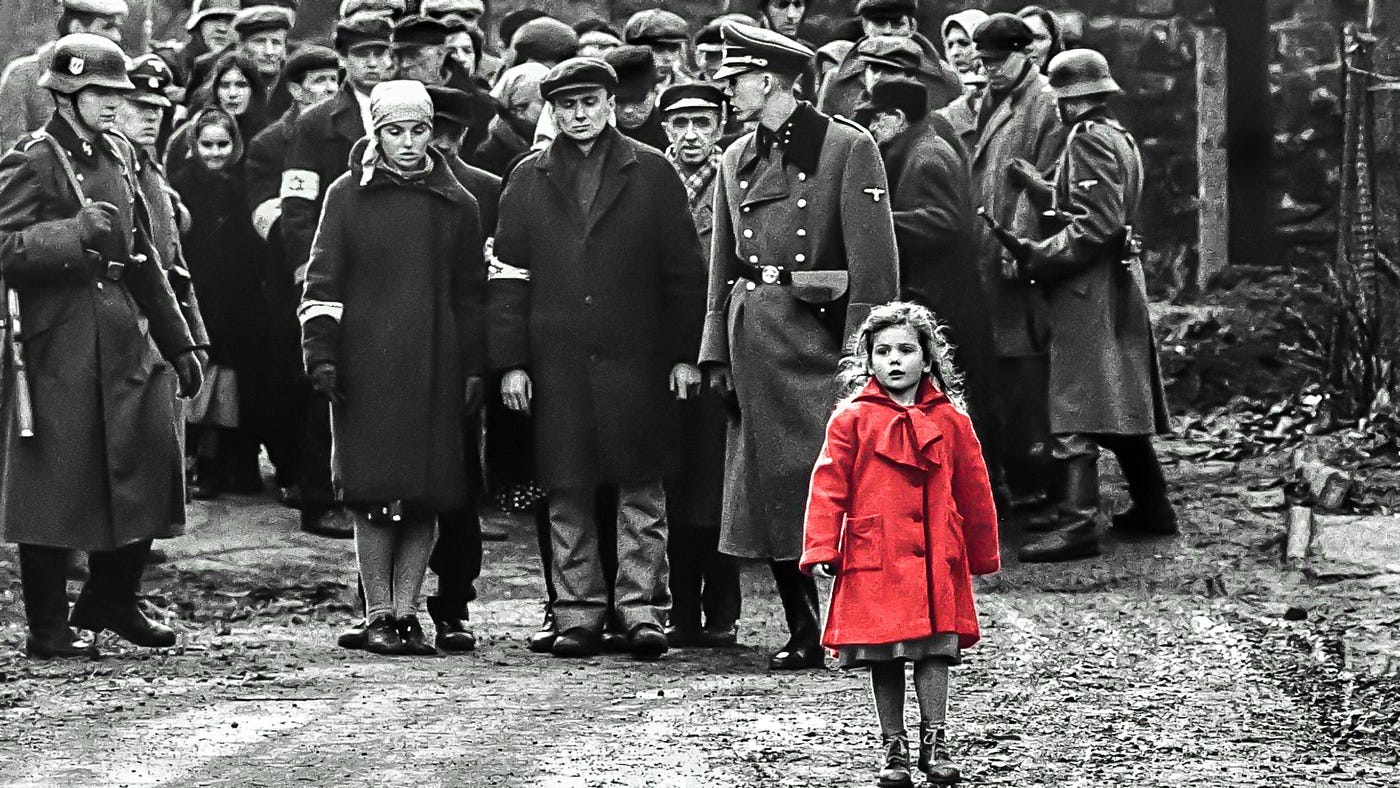
Now-Time. That fragile possibility of redemption.
The Schindler’s List I remember is less a film by Steven Spielberg than a monument to the thought of philosopher Walter Benjamin, whose Theses on the Philosophy of History comes alive on screen. For Benjamin, history was not the triumphal tale of victors, but the broken fragments and testimonies of the oppressed, shimmering with the faint possibility of redeeming the dead. This film hurls its audience directly into that very “possibility.”
Most of Schindler’s List is rendered in black and white. This is not a mere aesthetic choice, but an unflinching testimony. The raw tremor of the handheld camera, the stark, airless atmosphere of the scenes — these pull the viewer into history itself, as if to witness events firsthand. Black-and-white film refuses the polish of fiction; it exposes the wounds of history with merciless clarity. And yet, within this monochrome world, color intrudes once — on the day the Kraków ghetto is liquidated. Amidst gunfire in the streets, a little girl in a red coat appears. She seems a fleeting beacon of hope, but later we recognize her among the corpses. This is the Jetztzeit — the “now-time” — that Benjamin spoke of: a flash in which the suffering of millions is compressed into a single, searing image.

At the center of the film’s narrative stands the paradoxical figure of Oskar Schindler. At first he is a calculating businessman, a Nazi Party member who seizes the war as an opportunity for profit by exploiting Jewish labor. Yet when confronted with the ruthless violence of SS officer Amon Goeth, commandant of the Płaszów concentration camp, and when he sees the lifeless body of the girl in the red coat, he awakens to a truth: people are not means of production, but living beings to be saved. Casting aside his fortune, Schindler creates his “list of salvation,” rescuing more than a thousand Jews from annihilation.
[embed]
Schindler’s transformation transcends any heroic myth. His acts embody what Benjamin called the “weak messianic power”: though incapable of rewriting history at its roots, he affirms humanity’s fragile yet potent will to carve out moments of redemption in the midst of despair. In becoming a messianic figure, Schindler assumes the role of history’s editor — choosing whom to preserve and whom to lose — reconstructing the scene of massacre itself.
When the war ends, Schindler, once a Nazi, becomes a fugitive. He dies in Germany in 1974, alone and forgotten. Yet the Jewish community grants him a burial place on Mount Zion in Jerusalem, making him the only non-Jew interred there. The film closes as the surviving “Schindler Jews” visit his grave, placing stones upon it in keeping with tradition. Though the storm of time threatens to sweep memory away, their silence endures as the heaviest testimony. Schindler’s List warns us that forgetting is another form of violence, and asks: What will we choose to remember? On whose side will we live?
메타데이터
- post_id
- 9dc0665a7f7a
- slug
- 16-schindlers-list-walter-benjamin-9dc0665a7f7a
- url
- https://medium.com/@42heinzbecker/16-schindlers-list-walter-benjamin-9dc0665a7f7a
- canonical_url
- https://medium.com/@42heinzbecker/16-schindlers-list-walter-benjamin-9dc0665a7f7a
- author_url
- https://medium.com/@42heinzbecker
- status
- ok
- fetched_at
- 2026-07-30 01:40:09





