How Building a Real-World Hospital Robot Helped One Student Earn a Campus Placement at British…
Every placement story begins differently. Some emerge from long-term planning, others from unexpected circumstances. For Kondapalli…
How Building a Real-World Hospital Robot Helped One Student Earn a Campus Placement at British Petroleum
Every placement story begins differently. Some emerge from long-term planning, others from unexpected circumstances. For Kondapalli Shanmukha Sai Ram the path was paved by a continuous learning methodology, a lot of engineering and a resolve to construct solutions that could address issues in the real world.
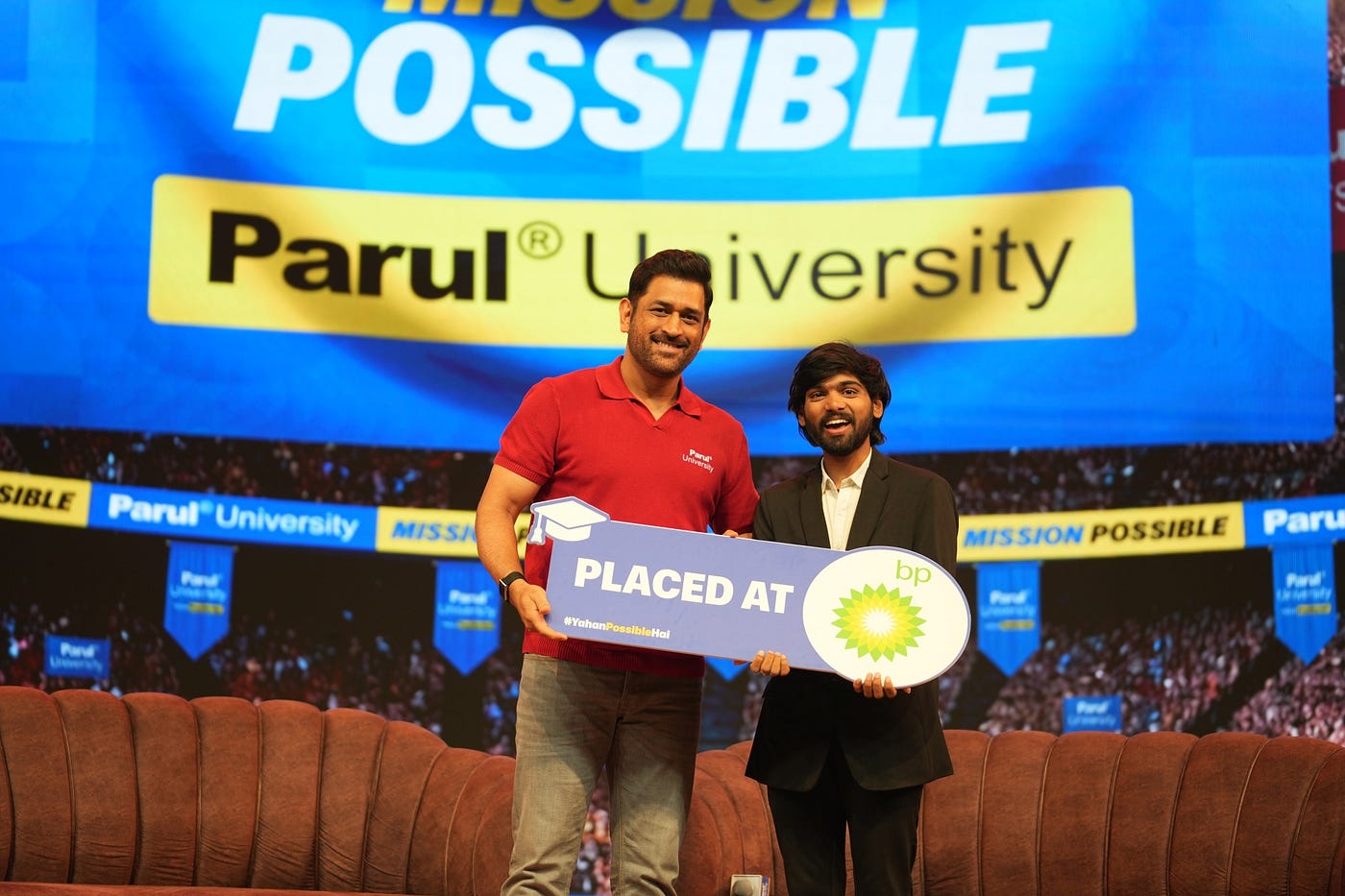
Kondapalli Shanmukha Sai Ram at the Mission Possible Ceremony
Sai Ram comes from Dammapeta in Bhadradri Kothagudem district of Telangana. He completed his diploma as Electronics and Communication Engineer from Sai Spurthi Institute of Engineering & Technology and later, he went on to switch to the Diploma to Degree (D2D) scheme for studies at Parul University. He has today received a full time campus placement with BP (British Petroleum), one of the five “supermajor” oil and gas companies in the world.
His journey, however, is about much more than a placement offer. During his time at Parul University, he developed a Patient Service Robot for ICU environments, for which he had received ₹1.25 lakh in project funding. He further completed an industry internship in production and antenna testing, and designed a LoRa-based Traffic Clearance System to help emergency vehicles efficiently navigate through congested roads.
His journey from academics to building a promising career shows how learning in the classroom, gaining industry experience, and working on real projects can open the door to exciting career opportunities.
Choosing the Diploma-to-Degree Pathway
The Diploma-to-Degree (D2D) pathway at Parul University allows students who have completed a three-year engineering diploma to enter directly into the second year of the corresponding B.Tech programme.
For Sai Ram, the progression was an easy one. As both his diploma and his bachelor’s degree was in Electronics and Communication Engineering. The pathway gave him scope to further bolster his knowledge on electronics, communication systems and embedded engineering while progressing from the technical foundation he had created before.
He looked into several options before making this decision and attended counselling sessions in order to gain clarity about the different institutions. After considering placement records, industrial exposure, infrastructure and faculty support, he opted for Parul University. The alumni of the campus had international recruiters who came to the campus for placement, they had a well-structured placement preparation and facilitative faculty who could help students at every step of the way were some of the factors that led to his decision.
Learning Beyond the Classroom Through Industry Exposure
Engineering education gains relevance when theory is taken to practice in industrial surroundings.
During his B.Tech studies, Sai Ram was posted as a Production and Testing Engineer with Incredible Advanced Technologies Pvt. Ltd. where he was exposed to antenna testing and RF systems testing, along with industrial testing processes as per the actual client requirements.
The internship also exposed him to precision measurement, documentation according to client requirements, interaction with senior engineers, and the world of engineering problem solving in industry. He learned that usually in industry, problems are not well posed either because of incomplete information or because there are several stakeholders involved and there are practical constraints. Much different from academic assignments, such experience made him appreciate the distinction between theory and practicing engineering in industry.
This experience later became one of the many nuggets that helped him build up both the technical foundations and confidence during campus placements.
Building a Patient Service Robot for ICU Environments
One of the defining milestones of Sai Ram’s academic journey was the development of a Patient Service Robot designed specifically for Intensive Care Unit (ICU) environments.
Instead of remaining just a conceptual classroom project, the robot was built as a working solution which was capable of supporting hospitals with routine logistical tasks inside ICU wards.
Developed using ROS2 (Robot Operating System 2), SLAM (Simultaneous Localisation and Mapping) algorithms, and OpenCV, the robot was designed to navigate hospital environments autonomously without any reliance on humans. Its primary purpose was to carry and transfer medication, medical supplies, and patient care materials between different locations inside the ICU. The idea was to help healthcare professionals to spend more time attending to patients instead of repeatedly involving themselves in logistics tasks.
The project received ₹1.25 lakh in external funding, which makes it one of the most significant milestones of his academic journey.
For Sai Ram, the funding was much more than financial support. It showed that the project had been evaluated and recognised for its technical merit and practical application by external stakeholders. Unlike the projects that are developed for academic assessment, this project didn’t just remain solely academic, but it highlighted real-world problems and hence, got recognition with engineering excellence.
This achievement also showcased the innovation-driven environment at Parul University’s through Parul Innovation and Entrepreneurship Research Centre (PIERC), which has incubated more than 254 startups and encouraged students to transform their ideas and provide them a platform with industry relevance.
Developing a LoRa-Based Traffic Clearance System for Emergency Vehicles
Sai Ram’s final-year project addressed another real-world challenge and helped reduce delays faced by emergency vehicles at busy urban intersections.
He developed a LoRa-based Traffic Clearance System that enables ambulances, police vehicles, and fire emergency services to communicate directly with traffic signals and request priority passage during the time of emergencies.
The system integrates embedded microcontrollers within emergency vehicles with LoRa receivers installed in traffic signal controllers. Once an authenticated emergency vehicle approaches an intersection, the traffic signal automatically switches to emergency-priority mode which helps reduce unnecessary waiting time.
It does not solely rely on WiFi or cellular networks, the project uses LoRa (Long Range) wireless communication technology, and its multi-kilometre communication range, low power consumption, and ability to operate reliably even when conventional communication networks experience congestion.
Designed to reduce preventable delays during emergency response, the project demonstrates how embedded systems and communication technologies can be applied to solve challenges that directly impact public safety.
Building the Technical Foundation That Led to BP
By the time campus placements began, Sai Ram had developed experience across multiple engineering domains through academic projects and industry exposure.
His technical foundation included working with Raspberry Pi, Arduino, ESP32, encoder-supported DC motors, motor drivers, antenna systems, and RF testing equipment as part of practical engineering projects.
His internship strengthened his understanding of LoRa modules, RF system testing, IoT communication protocols, and wireless communication mechanisms, while the Patient Service Robot expanded his expertise in ROS2-based robotics, autonomous navigation using SLAM algorithms, and computer vision through OpenCV.
Alongside these projects, he also gained practical experience in embedded systems, IoT automation, Raspberry Pi-based applications, ESP32 communication, and real-time hardware and software troubleshooting, skills that proved valuable during placement interviews.
This combination of hardware, software, robotics, embedded systems, wireless communication, and practical engineering experience ultimately helped him secure a campus placement at British Petroleum.
Preparing for Campus Placements
Sai Ram began preparing for placements during the third year of his B.Tech programme.
Looking back, he believes repeated interview practice played the biggest role in helping him succeed.
Before receiving his final offer from British Petroleum, he participated in three to four placement drive interviews. Each interview became an opportunity to improve his communication, technical responses, confidence, understanding of corporate expectations, and overall interview performance.
As he puts it:
“Failure is a part of life, not the end of life.”
At Parul University, students are supported through a structured placement ecosystem led by the Training and Placement Cell. To prepare students for campus placements, the university conducts aptitude training, mock interviews, professional grooming sessions, and the Impact Training Programme covering Data Structures and Algorithms (DSA), Operating Systems, Database Management Systems (DBMS), Object-Oriented Programming (OOP), while also providing career mentorship and interview preparation.
For Sai Ram, mock interviews made the biggest difference. Repeated practice helped bridge the gap between technical knowledge and interview performance by improving answer structure, communication, confidence under pressure, and the ability to identify and correct recurring mistakes.
Sai Ram’s has three pieces of advice to junior B.Tech students, particularly D2D entrants and final-year aspirants on operational principles.
First: Plan
Plan, because placement preparation begins in the final semester which is structurally late. The candidate must have technical projects, industry internships, and the mock interview exposure all require months to compound.
Second: Fail forward
Failed interviews and unconverted placement drives are not the signals of termination. Take them positively, they carry specific learning that helps in improved performance on the next attempt.
Third: Build real things.
Don’t build projects just for grades. Focus on building projects that solve real-world problems. Such projects help you gain ₹1.25 lakh funding that can give you stronger points to talk about in interviews and can help you stand out from other candidates.
If Sai Ram’s journey inspired you, explore how Parul University supports students beyond the classroom. Through the Parul Innovation and Entrepreneurship Research Centre (PIERC), students are encouraged to build solutions with real-world impact, while the Training and Placement Cell equips them with the skills, confidence, and industry exposure needed to turn those innovations into successful careers.
메타데이터
- post_id
- 9dca49db7239
- slug
- how-building-a-real-world-hospital-robot-helped-one-student-earn-a-campus-placement-at-british-9dca49db7239
- url
- https://medium.com/@plavanamee.dave46890/how-building-a-real-world-hospital-robot-helped-one-student-earn-a-campus-placement-at-british-9dca49db7239
- canonical_url
- https://medium.com/@plavanamee.dave46890/how-building-a-real-world-hospital-robot-helped-one-student-earn-a-campus-placement-at-british-9dca49db7239
- author_url
- https://medium.com/@plavanamee.dave46890
- status
- ok
- fetched_at
- 2026-07-25 05:51:06