The Many Faces of One Mind
You behave differently with different people — but who are you when no one is watching?
The Many Faces of One Mind
You behave differently with different people — but who are you when no one is watching?
When there is not anyone around you, you have a personality.
When no one is watching you, you behave in a certain way. Where does that behaviour come from?
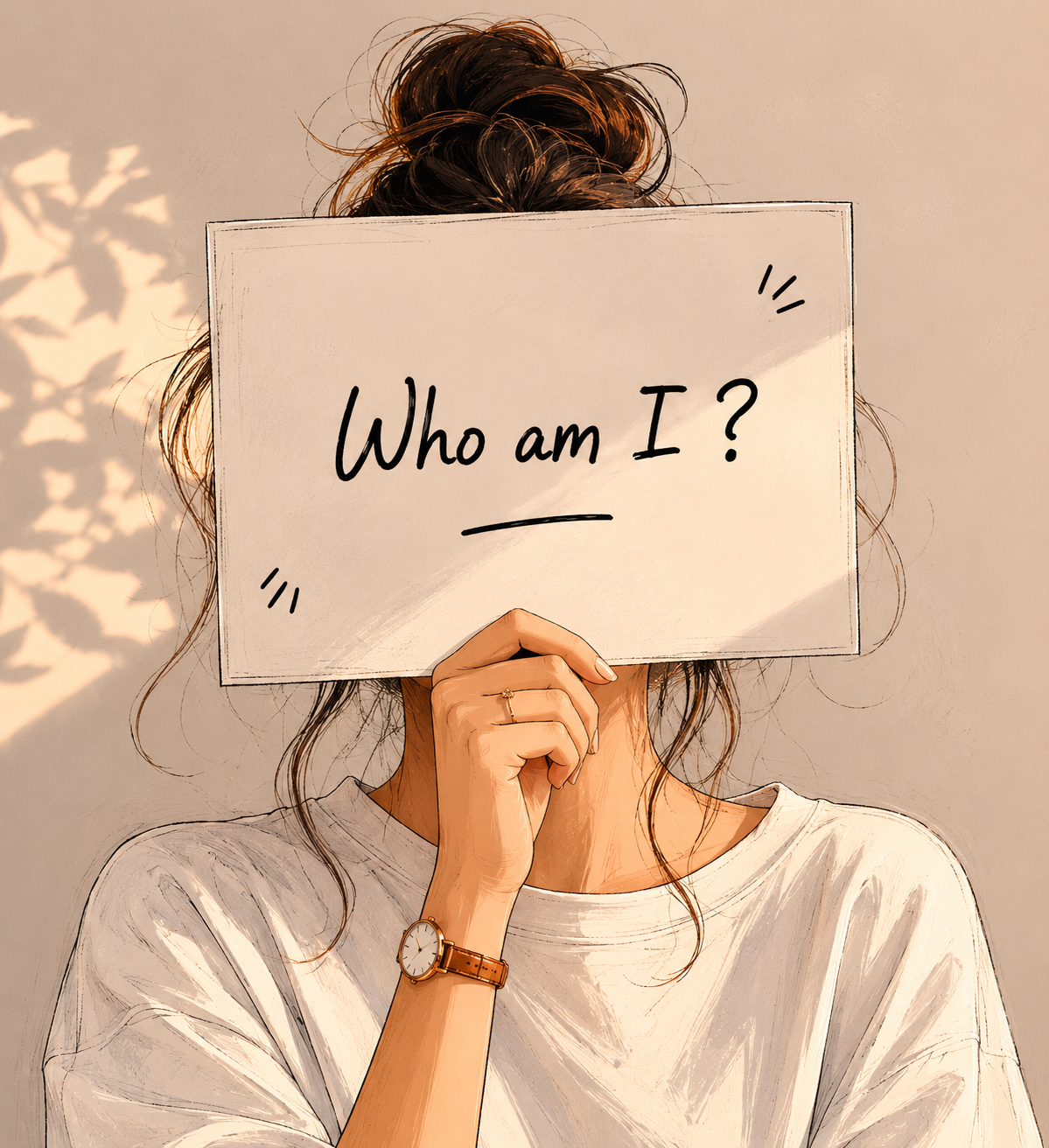
We call it your 'depositional identity', your true innate nature, which you have developed in the early years of your life. It mainly depends on the environment in which you are being raised and the people around whom you are being raised – your family and your parents. And as you grow up, your depositional identity begins to shift with the weight of everything that has ever happened to you.
So what factors create your 'depositional identity'?
1. Temperament — the raw material. Are you naturally energetic or calm?
You are not always just one thing. You can be calm and energetic, introverted and extroverted — depending on your inner state, the people around you, and the situation you are in.
I used to believe I was deeply introverted because my parents were like that until I discovered another side of myself. Sometimes I love talking, sharing stories, and expressing myself freely. And at other times, I enjoy complete silence.
Both of those versions of me are authentic. And the truth is we all carry multiple versions of ourselves within us.
I have a self that values depth, internal experience, and undistracted presence.But that same self also hungers for connection, expression, and the aliveness that comes from real conversation. These are not opposites. They are two forms of being fully present — one inward, one outward.
2. Values — the compass. What do you find meaningful, worthy, or sacred?
My deep values that I have slowly formed through observation, loss, love, and reflection are discipline as self-love, my purpose as an anchor, and curiosity as motion.
2.1. Discipline as self-love, not self-punishment.

Most people experience discipline as forcing themselves against resistance. I’ve built it as a ritual that gives rather than takes
For me, discipline is my most precious value. No matter how I feel, I stay committed to my routine — journaling, meditation, walking, stretching, boxing, reading, and cooking. Completing these rituals already makes my day feel like a win and gives me the energy to step into my bigger goals.
My routine is an act of self-love. Every weekend, I revisit it, make corrections, and learn how to move through life with more flow and ease.
I love designing my life for myself — that is the rarest form of architecture to me.
2.2. The purpose anchor.
I have learnt something so profound from my mother: to attach myself to my purpose rather than attaching myself to people around me.
She was always immersed in her work and genuinely enjoyed it. She didn’t hold me close to fill her own need. She let me free to pursue my goals and to pursue myself. She never held me back emotionally just for companionship; she just wanted me to grow into my own person. That kind of love is actually harder to give than the clinging kind.
2.3. Curiosity as motion.

The third value that moves me is curiosity—I never stop learning. Whether it is life, philosophy, psychology, design thinking, architecture, or interiors, I am always exploring something new. These are not random curiosities; they all ask the same question — how do humans feel and understand a space?
Everything connects at one point: creating experiences for humans.
My curiosity has a direction, even when it does not announce one. It never lets me become stagnant; it keeps me moving, evolving, and discovering newer versions of myself.
3. Cognitive Style — How you process the world — whether analytically or intuitively — can change at any point in life. It depends on the input you have, your belief system, and the lens through which you choose to see the world around you.

I know this not as a theory but as something I lived through.
I have become a very negative person after I continuously faced a few failures in my life back-to-back. I was spiralling into my negative thoughts so much that it took me almost a year to change my perspective to see the world. I have changed what I was consuming. I followed a lot of people on Instagram and YouTube who were inspiring me to be the change I want to see in myself. What I mean is to stay closer to people who reflect the person you want to become.
I started journaling to get to know more about my inner dialogue, and then I started using affirmations in my journaling to change my core beliefs about viewing the world. In the initial task of journalling I was just venting. Then I started using it deliberately to write about my future self, what kind of work I want to do, and my relationship with money. I have changed a lot of my beliefs about money as well. I have changed my lens through constant inputs; now everything feels positive. It was quite a journey of developing a healthy relationship with my inner critique and my God.
4. Emotional Baseline — How do you process your emotions? Emotional intelligence is something I truly believe should be part of our education system — we should be taught how to understand and deal with our emotions. This is something I have learnt through reading books, listening to audiobooks, writing and journaling.

The most difficult challenge for me was to see beyond the masks I had put on me to ignore my true feelings. Because I started feeling that showing your true feelings in front of people makes you a vulnerable person, so I kept masking it. I did not realise that I was masking them for me also. I was hiding my feelings not just from others but from myself also. I was abandoning myself for so long that I learnt to become emotionally available to myself, no matter what emotion I was carrying inside me. I learnt to channelise my emotions in a better way.
I had this very bad habit of binge-watching when I used to be sad to avoid my emotions. Now I do sit with myself; I literally talk to myself in my journal about what's wrong with me and what could be the solution to it. When we are sad, we want to feel listened to and understood. I do that with myself in my journal; I give myself some sympathy and encouragement. Then I am all set to move to the solution phase.
We all have our own ways of abandoning ourselves. The first act of emotional intelligence is simply noticing which of your habits are leading towards abandonment.
Most people think emotional intelligence is about reading others. But it starts with reading yourself honestly.
Now that you understand what shapes it, the real question is whether any of it can change ?
Your disposition is the habitual way you respond to the world — how you handle your fears, how you handle uncertainty, and whether you reach inward or outward under stress.
Much of it was shaped during your early years when you were learning to manage day-to-day situations. You may have learnt some of your behaviours as a toddler and some as a teenager. Thus, a child’s early years are very crucial for creating dispositional identity.
However, at any age and at any point in your life, you can take control of your conditioning through awareness, regulation, and repetition. I have changed my dispositional identity with Atomic Habits. It was a life-changing moment for me to get the chance to read that book.
So you can’t completely delete a disposition that you have developed in your childhood and in your teens. But you can build a new one on top of it, gradually making the old one less dominant.
Most people live their entire lives running the childhood program without ever questioning it. You are rewriting yours — one ritual, one value, one repeated choice at a time.
That is not a small thing.

메타데이터
- post_id
- 9dd0eeeb483a
- slug
- the-many-faces-of-one-mind-9dd0eeeb483a
- url
- https://medium.com/@paramkaur95/the-many-faces-of-one-mind-9dd0eeeb483a
- canonical_url
- https://medium.com/@paramkaur95/the-many-faces-of-one-mind-9dd0eeeb483a
- author_url
- https://medium.com/@paramkaur95
- status
- ok
- fetched_at
- 2026-06-09 15:37:30