Admiring the Rebel, Questioning the Blueprint
My honest notes on reading Periyar’s “Penn Yen Adimayanal?” — where revolutionary feminism meets ideas I cannot accept.
Admiring the Rebel, Questioning the Blueprint
My honest notes on reading Periyar’s “Penn Yen Adimayanal?” — where revolutionary feminism meets ideas I cannot accept.
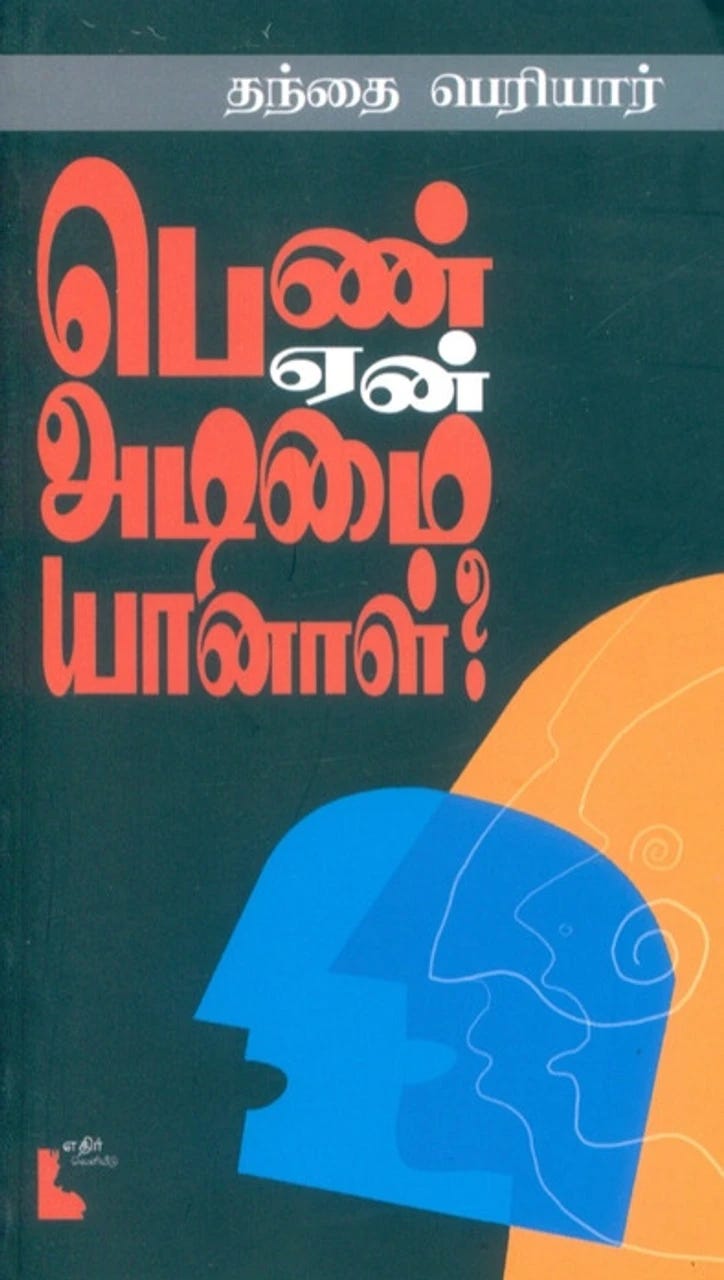
There are books that make you nod along, and then there are books that make you nod along until you suddenly stop — forehead creased, stomach slightly turned — and think: wait, did he just say that?
Periyar’s “Penn Yen Adimayanal?” (Why Were Women Enslaved?) did exactly that to me. Published in 1942, this slim collection of essays is considered a magna carta of women’s liberation in Tamil thought. And it deserves that title — in parts. But I’d be dishonest if I said I agreed with all of it, and I think Periyar, a man who built his life on questioning everything, would respect the disagreement.
So here are my honest notes — what stirred me, and what gave me the ick.
Where Periyar Got It Right
Chastity Is Not a One-Gender Virtue
Periyar dismantles the Tamil concept of kaṟpu (chastity) with surgical precision. He traces its etymology and shows how it has only ever been used to measure a woman’s worth — never a man’s. His argument is simple: if sexual fidelity is a virtue, it must apply equally. If it’s not demanded of men, then it was never about morality — it was about control. This was written over eighty years ago, and it still hits hard today.
Religion as a System of Control
Periyar argues that organised religion was not merely indifferent to women’s subjugation — it was designed to enforce it. The rules around purity, obedience, modesty, the entire framework of “divine duty” for wives — he saw them as chains dressed in sacred thread. You don’t have to be an atheist to acknowledge there’s truth in this. Many religious traditions have historically used scripture to justify keeping women in submission, and Periyar called it out when few others dared.
Love Is an Overrated Feeling
This one sounds cold at first glance. But Periyar wasn’t against love itself — he was against romantic love as a trap. The kind of love that’s weaponised to tell women “if you truly loved your husband, you’d sacrifice your ambitions.” The love that becomes emotional debt. The love that’s really a leash. He wanted women to see through the sentimentality and ask: am I happy? Am I free? Am I equal? That’s not anti-love. That’s pro-clarity.
Where Periyar Lost Me
And now the parts that made me put the book down, stare at the wall, and think: Periyar, I love you, but no.
Polygamy Disguised as Freedom
Periyar argues that a person should be free to remarry without divorce. That you can live with a new partner while still being with the old one. He frames this as liberation from the institution of marriage — freedom from ownership, freedom from possessiveness.
I object to this. Strongly.
Here’s why: in a society where men already hold disproportionate power, “freedom to take multiple wives” doesn’t land as liberation — it lands as a licence. The woman who is being “kept” alongside a new wife has no real freedom in that arrangement. Her consent is theoretical. Her dignity is an afterthought.
And the contradiction is glaring. In the same book, Periyar discusses jeevanamsam — the right of a wife to her husband’s property and financial support. If marriage is so meaningless that you can take a new partner without even ending the old arrangement, what happens to the woman’s legal and financial security? You can’t demand alimony from an institution you’ve declared irrelevant.
You cannot dismantle the structure of marriage while still expecting its protections to apply. That’s not freedom — that’s selective convenience, and it overwhelmingly benefits men.
A Ten-Year-Old Widow and the Limits of “Progression”
Periyar shares a personal story in the book — his own niece was widowed at the age of ten. Ten. A child, already branded with the social death of widowhood in a society that treated widows as cursed. Periyar, to his credit, stepped in and helped her remarry. That was a genuinely brave act for his time.
But then she lost her second husband too.
And here’s where the story stopped me cold. Periyar presents remarriage as the solution — as progression. But what kind of progression is it when a child’s entire identity is still being routed through marriage? She was widowed at ten, so the answer was… another marriage?
The real progressive act wouldn’t have been remarriage. It would have been building a world where a ten-year-old girl’s life isn’t defined by whether she has a husband at all. Where widowhood at ten doesn’t require a “fix” because her worth was never tied to a man in the first place.
Remarriage as rebellion against widow-shaming? Yes, that mattered in context. But remarriage as the definition of progress? That’s still playing within the same system — just rearranging the pieces instead of flipping the board.
Stop Having Babies to Achieve Freedom?
Periyar suggests that women should stop bearing children as a path to independence and freedom. The logic goes: motherhood is the chain that binds women to domesticity, dependence, and subjugation. Cut the chain, and you’re free.
This is where I don’t just disagree — I condemn the idea.
Motherhood is not the enemy of freedom. The lack of support for mothers is. The problem was never that women have children. The problem is that society treats childbearing as a woman’s sole responsibility, strips her of professional identity after she becomes a mother, and then blames her biology for her inequality.
Asking women to give up fertility to earn freedom is asking them to sacrifice something deeply personal to fit into a liberation framework designed by a man. True liberation doesn’t ask women to become less of themselves. It demands that the world accommodate all of who they are — including their choice to be mothers.
A feminism that tells women to stop being mothers in order to be free is not feminism. It’s another form of control dressed in revolutionary language.
The Bigger Picture
Here’s what I keep coming back to: Periyar was a demolition expert, not an architect. He was extraordinary at identifying what was rotten — caste, patriarchy, religious control, the institution of marriage as ownership. His hammer swung true against structures that deserved to fall.
But demolition without a blueprint is just rubble. And some of his proposed alternatives — polygamy as freedom, childlessness as liberation, the abolition of all property — create new forms of the very inequality he was trying to destroy.
I think the most honest way to read Periyar is with gratitude and criticism. Gratitude for the walls he broke. Criticism for the rooms he forgot to build.
And maybe — just maybe — that’s exactly what he wanted from us.
I believe he says: don’t believe something just because I said it. Think it through. Agree, disagree, form your own values and ethics.
He didn’t want followers — he wanted thinkers. He didn’t write to create a new scripture — he wrote to destroy the very idea that any text, any leader, any ideology should be accepted without question.
So when I disagree with him, I am being exactly the kind of person he aimed us to be. A person who reasons. A person who refuses to surrender her judgment to any authority — including his.
The greatest tribute to a man who spent his life telling people to think for themselves is not blind agreement. It’s the courage to say: I heard you. I thought about it. And on this, I disagree.
Read him. Argue with him. Agree where he’s right. Push back where he’s wrong. That’s not disrespect — that’s the highest form of respect you can offer a rebel who never wanted devotees.
메타데이터
- post_id
- 9dd5a9fc9f5f
- slug
- admiring-the-rebel-questioning-the-blueprint-9dd5a9fc9f5f
- url
- https://medium.com/@janani.umapathyk/admiring-the-rebel-questioning-the-blueprint-9dd5a9fc9f5f
- canonical_url
- https://medium.com/@janani.umapathyk/admiring-the-rebel-questioning-the-blueprint-9dd5a9fc9f5f
- author_url
- https://medium.com/@janani.umapathyk
- status
- ok
- fetched_at
- 2026-07-19 14:03:49