The History of Sri Ramanasramam After Ramana Maharshi
1964–1990
The History of Sri Ramanasramam After Ramana Maharshi
1964–1990
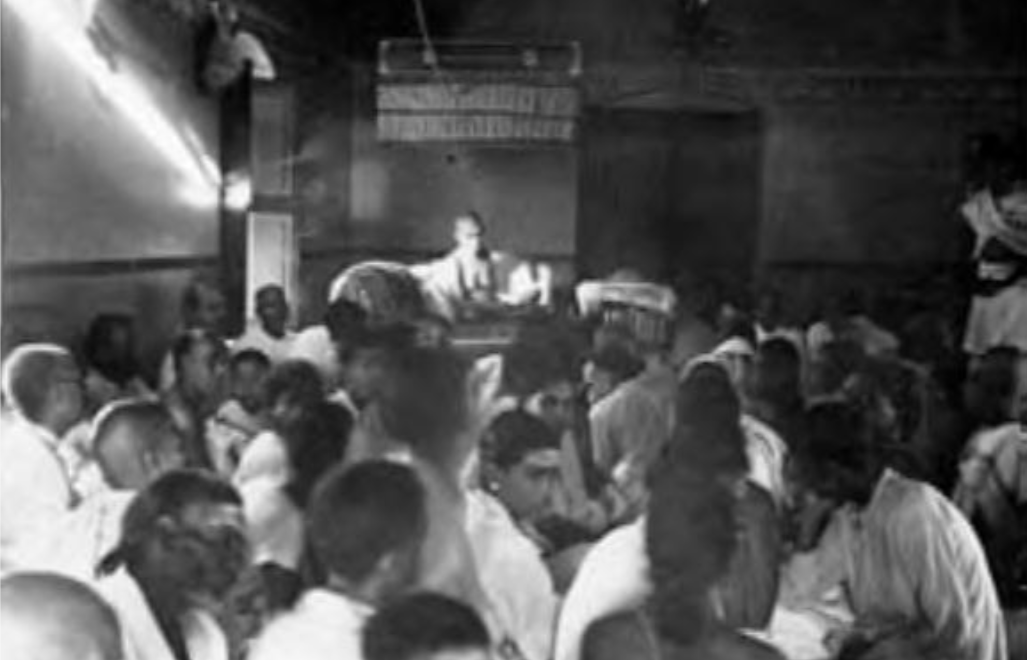
The following article is an AI-generated historical summary based on a review of all available issues of The Mountain Path, the quarterly journal published by Sri Ramanasramam.
The purpose is to provide an accessible overview of the development of Sri Ramanasramam through different periods of its history.
1. Sri Ramanasramam After Bhagavan: Consolidation and Growth (1964–1976)
When Sri Ramana Maharshi left his body in 1950, many devotees wondered how the ashram would survive without the physical presence of the Sage who had drawn seekers from around the world. His silent influence had been the heart of the community. Could that spirit endure?
The decades that followed provided the answer.
By the mid-1960s Sri Ramanasramam had entered a new phase. Between 1964 and 1976 the ashram underwent a remarkable transformation. It evolved from a relatively simple spiritual community into a stable institution with modern facilities, international connections, and growing numbers of visitors. Yet throughout this period there was a conscious effort to preserve the atmosphere of simplicity, freedom, and inner silence that had characterised life around Bhagavan.
A Stable Foundation
Following the deaths of Ramana Maharshi in 1950 and his brother Niranjanananda Swami, the former Sarvadhikari, in 1953, leadership gradually stabilised under Bhagavan’s nephew, T. N. Venkataraman.
A significant administrative change took place in 1964 when the ashram adopted a formal Board of Trustees structure under government regulations. This provided a more secure organisational framework and helped strengthen the ashram’s finances. Improved financial stability would soon make several major building projects possible.
Building for the Future
The years that followed saw extensive development of the ashram grounds.
One of the most important milestones was the completion of the permanent shrine over Bhagavan’s samadhi. The temple was consecrated in June 1967 during a grand Kumbhabhishekam ceremony, attended by devotees from many parts of India.
Another landmark came in 1970 with the inauguration of the Ramana Auditorium, a large meditation hall situated in front of the samadhi shrine. For the first time, large gatherings of devotees could comfortably assemble for meetings, celebrations, and meditation.
Additional guest accommodation was constructed to meet the growing demand from pilgrims and spiritual seekers. The ashram also established a free dispensary, providing medical care for local residents as well as those staying at the ashram.
What had once been a small hermitage at the foot of Arunachala was steadily becoming a permanent spiritual institution.
The Rise of Ramana Nagar
An interesting change during this period was the emergence of a residential community around the ashram.
During Bhagavan’s lifetime, permanent residence near him was generally not encouraged. Most visitors came for a period of time and then departed. By the 1960s, however, increasing numbers of devotees wished to remain near Arunachala indefinitely.
The nearby area known as Ramana Nagar gradually developed into a residential colony. Long-time devotees, retirees, and a growing number of Western seekers built homes within walking distance of the ashram. This created a unique community centred around Bhagavan’s teachings long after his physical passing.
A Global Reach
The influence of Sri Ramanasramam expanded far beyond Tiruvannamalai during these years.
A major turning point came in 1964 with the launch of The Mountain Path. Edited initially by Arthur Osborne, the quarterly journal became one of the most important vehicles for sharing Ramana Maharshi’s teachings with an international audience. Through essays, reminiscences, translations, and correspondence, the magazine connected seekers across continents.
The ashram also established Ramana Kendras in several Indian cities. The most prominent was the Delhi centre, which received its own building in 1974. Similar initiatives appeared in Madras and Calcutta.
Meanwhile, groups inspired by Bhagavan’s teachings emerged in North America. Organisations such as Arunachala Ashrama in the United States and Canada reflected the growing global appeal of Self-enquiry and Advaita Vedanta.
By the mid-1970s, Sri Ramanasramam had become the centre of an international spiritual movement.
Preserving the Original Spirit
Despite these changes, the ashram’s leaders repeatedly emphasised that growth should not come at the expense of Bhagavan’s essential teaching.
Unlike many spiritual organisations, Sri Ramanasramam maintained an atmosphere of unusual freedom. There was no compulsory discipline imposed upon visitors and no rigid daily programme that everyone was required to follow. Seekers were free to pursue their own spiritual practice according to their temperament.
The central teaching remained Self-enquiry — the question “Who am I?” — together with the mysterious power of Bhagavan’s silent presence. Many devotees felt that the Guru’s guidance continued to operate even after his physical departure.
Traditional observances also continued uninterrupted. Daily Veda Parayana, the chanting of sacred scriptures, remained a central feature of ashram life. Ritual worship at the Mother’s Shrine, including Sri Chakra Puja, was carried on with the same regularity as before.
Thus, while buildings multiplied and the ashram’s influence spread around the world, its spiritual centre remained unchanged.
The People Who Kept the Flame Alive
Buildings and institutions tell only part of the story of Sri Ramanasramam during the 1960s and 1970s. Equally important were the individuals who dedicated their lives to preserving Bhagavan’s legacy and sharing his teachings with new generations of seekers.
At the centre stood T. N. Venkataraman, Bhagavan’s nephew and the president of the ashram. Under his steady leadership, Sri Ramanasramam achieved financial stability and undertook many of the major developments of the period, while retaining its distinctive atmosphere of simplicity and openness.
The growing international reach of the ashram owed much to Arthur Osborne, founding editor of The Mountain Path. Through his books and articles, he introduced countless Western readers to Ramana Maharshi’s teachings. After his death in 1970, his wife Lucia Osborne continued this important work as editor of the journal.
Among the older generation of devotees were several direct disciples of Bhagavan. Viswanatha Swami, scholar, translator and relative of Maharshi, helped visitors understand the teachings through both scripture and personal reminiscence. The renowned Tamil poet Muruganar remained one of the most revered figures at the ashram, his vast body of devotional poetry standing as a literary monument to his Guru.
The British devotee Major Alan Chadwick (Sadhu Arunachala) continued to exert a quiet influence from his cottage near the ashram. Having lived with Bhagavan for many years, he was regarded by many visitors as a living link to the Master’s presence.
Other important figures included Suri Nagamma, whose famous Letters from Sri Ramanasramam preserved invaluable memories of life with Bhagavan; Dr. T. N. Krishnaswami, physician, trustee and photographer, whose images helped document the ashram’s history; and S. S. Cohen, whose writings and conversations guided many earnest seekers.
Behind the scenes, V. Ganesan played an increasingly important role through his work with The Mountain Path and his close interaction with visitors from around the world. Together with scholars such as Prof. K. Swaminathan, he helped ensure that Ramana Maharshi’s teachings reached audiences far beyond the slopes of Arunachala.
Together, these men and women formed a remarkable spiritual family. Some were administrators, some writers, some scholars, and some contemplatives. Yet each, in their own way, helped preserve the living presence of Bhagavan at Sri Ramanasramam long after his physical departure.
From Sage to Timeless Presence
One of the most striking developments in the pages of The Mountain Path during the 1960s and 1970s is the changing portrayal of Bhagavan Sri Ramana Maharshi himself.
While those who had known him personally continued to share memories of the man who had lived at the foot of Arunachala, the emphasis increasingly shifted away from his historical personality and towards his continuing spiritual presence. Again and again, devotees recalled his famous assurance before his passing: “They say I am going away, but where could I go? I am here.”
For many writers of this period, Bhagavan was no longer seen merely as a teacher who had lived in South India during the twentieth century. He was described as the Inner Guru, a living presence guiding seekers from within, regardless of time or distance. His silent influence was believed to remain fully active, continuing to transform lives long after the disappearance of his physical form.
At the same time, a more explicitly devotional and theological understanding of his nature emerged. Some writers described him as an Avatar, a divine incarnation who had assumed human form for the benefit of humanity. Others identified him with Subrahmanya, the son of Shiva, or spoke of him as a Nithya Siddha, an eternally perfected being untouched by karma.
Yet perhaps the most characteristic description was neither personal nor theological. Bhagavan was increasingly portrayed as pure Awareness itself — a “mighty Impersonality” beyond individual identity. In this view, the body and personality were merely temporary appearances, while the true Ramana was identical with the Self, the Sat-Guru, and ultimately with Arunachala itself.
The result was a gradual transformation in how devotees understood him: from a revered sage of modern India to a timeless and universal spiritual presence.
Conclusion
The years between 1964 and 1976 represent a crucial chapter in the history of Sri Ramanasramam. During this period the ashram successfully navigated a challenge faced by many spiritual communities: how to preserve the living spirit of a great teacher after the teacher is gone.
New buildings arose. International publications flourished. Residential communities formed. Devotees arrived from every corner of the world.
Yet at the heart of it all remained the same invitation that Ramana Maharshi had offered decades earlier beneath the slopes of Arunachala: turn inward, enquire into the nature of the Self, and discover the silence that is always present.
In that sense, the ashram grew enormously — while remaining exactly what it had always been.
2. Sri Ramanasramam and the Centenary Era (1977–1989)
The years between 1977 and 1989 marked a period of extraordinary growth in the history of Sri Ramanasramam. While the previous decades had focused on consolidation and institutional stability, this era saw the ashram emerge as a truly global spiritual centre.
The turning point came in 1980 with the celebration of the Birth Centenary of Bhagavan Sri Ramana Maharshi. What had long been a revered pilgrimage destination at the foot of Arunachala now attracted worldwide attention. New centres appeared across India and abroad, publications multiplied, and modern infrastructure transformed the ashram’s ability to serve a growing international community.
The Centenary Celebrations
The centenary year of 1980 became one of the most important milestones in the ashram’s history.
Major conferences and seminars were held in Bangalore and New Delhi, bringing together scholars, devotees, and spiritual seekers from many countries. The Government of India produced a documentary film on Bhagavan’s life, and Prime Minister Indira Gandhi visited Sri Ramanasramam to unveil a bronze statue of Maharshi.
The celebrations also inspired new creative initiatives. The devotional music group Ramananjali, led by Sulochana Natarajan, carried Bhagavan’s message to audiences across India, Europe, North America, and Southeast Asia through concerts and recordings.
At the same time, a remarkable number of books, translations, and commemorative publications appeared, helping introduce Ramana Maharshi to readers who had never visited India.
Modernisation and Preservation
The rapid growth of interest in Bhagavan’s teachings required significant improvements to the ashram’s facilities.
In 1981 the Sri Ramana Centenary Library was inaugurated. Housing thousands of books, manuscripts, and archival materials, it became one of the most important centres for the preservation of Ramana literature and related spiritual traditions.
The historic Old Hall, where Bhagavan had spent so many years receiving visitors, underwent a careful restoration in 1986. Great effort was made to preserve its original appearance and atmosphere while protecting the building from further deterioration.
New guest accommodation continued to be constructed, while practical improvements such as expanded water systems, medical services, and improved infrastructure allowed the ashram to welcome increasing numbers of pilgrims from India and abroad.
The small dispensary that had served devotees and local residents gradually expanded into Sri Ramana Hospital, reflecting the ashram’s growing role in the wider community.
A Worldwide Network
Perhaps the most significant development of the period was the emergence of an international Ramana network.
New Ramana Kendras appeared or expanded in cities such as Bangalore, Hyderabad, Madras, Ahmedabad, and elsewhere. Outside India, centres in Canada, Brazil, Switzerland, and other countries helped create lasting communities of devotees linked by a shared devotion to Bhagavan and Arunachala.
The printed word remained a central means of communication. The Mountain Path continued to serve as the principal international journal of the movement and celebrated its twenty-fifth anniversary in 1988. New regional publications also emerged, bringing Ramana’s teachings to readers in local languages.
This was also the era of cassette recordings, offset printing, and documentary film. For the first time, modern media enabled Bhagavan’s teachings to reach large audiences across continents.
The Passing of a Generation
While the ashram was growing, it was also entering a period of transition.
Many of the direct disciples and close associates who had known Bhagavan personally passed away during these years. Among them were Viswanatha Swami, S. S. Cohen, and Sadhu Om. Their passing marked the gradual end of the generation that had lived in the Master’s physical presence.
As a result, increasing importance was given to preserving memories, correspondence, photographs, and oral histories. What had once been living recollection was becoming documented history.
At the same time, T. N. Venkataraman continued to guide the ashram with remarkable dedication. By 1988 he had completed fifty years of uninterrupted service to Sri Ramanasramam, providing continuity through a period of immense change.
A Global Ashram
By the end of the 1980s, Sri Ramanasramam had become far more than a local religious institution. It had developed into a worldwide spiritual centre connected through publications, pilgrimage, music, scholarship, and personal devotion.
Yet the challenge remained the same as in earlier decades: how to embrace growth without losing the simplicity that had attracted seekers in the first place.
The answer, according to many devotees of the time, lay in remembering that the true heart of the ashram was not its buildings, publications, or organisations, but the silent presence of Bhagavan himself. Around that still centre, a global community had begun to form.
From Sage to Global Spiritual Presence
Alongside the physical expansion of Sri Ramanasramam, the years between 1977 and 1989 also witnessed a subtle but significant shift in how devotees understood Bhagavan Sri Ramana Maharshi himself.
As the generation that had known him personally gradually passed away, the emphasis moved increasingly away from memories of the historical figure and towards the experience of his continuing spiritual presence. Again and again, writers returned to Bhagavan’s famous assurance before his passing: “Where could I go? I am here.” For many devotees, these words became the foundation of their relationship with him. The true Guru was no longer encountered primarily through photographs, stories, or personal recollections, but within one’s own heart.
This period also saw a growing synthesis between jnana, the path of knowledge, and bhakti, the path of devotion. Earlier presentations of Ramana’s teaching had often emphasised Self-enquiry as a direct and uncompromising path to truth. During the 1980s, however, devotional expressions became increasingly prominent. The international tours of Ramananjali, devotional singing, and a renewed emphasis on love for the Guru reflected a recognition that devotion and enquiry were not separate paths but complementary aspects of the same journey.
At the same time, Bhagavan was increasingly presented as a universal spiritual teacher rather than simply a Hindu sage. His teachings were discussed in relation to modern psychology, science, and the existential concerns of contemporary life. Self-enquiry was often described as a practical and universal method, accessible to people of any culture or religious background.
Another important development was the growing emphasis on spirituality in ordinary life. Rather than encouraging withdrawal from society, many writers stressed that Bhagavan’s teaching was fully compatible with family life, work, and worldly responsibilities. Realisation was not seen as the exclusive domain of monks and renunciates, but as a possibility available to anyone willing to turn inward and question the sense of a separate self.
Perhaps most strikingly, the image of Ramana Maharshi continued to move beyond the limits of personality altogether. He was increasingly described not merely as an enlightened individual but as a manifestation of the timeless Self itself — the silent awareness that shines within all beings. Some devotees spoke of him as an avatar or divine incarnation, while others preferred to describe him as the Sat-Guru, the eternal teacher whose true form is beyond birth and death.
By the end of the 1980s, Bhagavan’s image had become both more universal and more inward. The physical teacher who had once sat in the Old Hall at the foot of Arunachala was increasingly understood as a living spiritual presence, accessible to seekers everywhere and at all times. In this way, the focus shifted from the man to what he represented: the timeless reality of the Self.
to be continued…
The Ashram Centenary Year: One Hundred Years in Brief
1922 May 19th Friday 8 pm: Mother’s Maha Samadhi. Somewhere after thr third week of December aournd the 27th, Bhagavan came to stay in Sri Ramanasramam six months after the first stones were laid on 20th May.
1923 Jan 3rd: Sri Bhagavan’s Jayanti celebrated at Mother’s shrine first time.
1924 June 26th: Robbery at the ashram. Bhagavan receives blow on his left thigh. Kanakammal’s uncle, Ramakrishna Iyer is called on for support.
1926: Bhagavan discontinues going for pradakshina; construction on the Old Hall commences.
1927 April 24th: Bhagavan composes Atma Vidya.
1927: Composes Upadesa Saram in Tamil, Telugu, Sanskrit and Malayalam.
1928: Composes Ulladu Narpadu in Tamil and Malayalam (Sat Darshanam). 1930: Ganapati Muni translates Ulladu Narpadu into Sanskrit under the title Sat Darshanam.
1933: Bhagavan translates Atma Sakshatkara into Tamil.
1933 May: Chinnaswami appointed Secretary and Sarvadhikari by Power of Attorney executed by Bhagavan.
1936: A hearing to resolve official leadership challenge by Perumal Swami; Bhagavan translates Sri Ramana Gita into Malayalam.
1938 March: Bhagavan’s Last Will and Testament is drawn up for the future functioning of the Ashram.
1939 September 1st: Foundation stone laid by Bhagavan for the Mathrubhuteswara Temple.
1940: Translates 42 verses of Bhagavad Gita into Tamil and Malayalam.
1941 May: Bhagavan stops going to the Ashram kitchen to help.
1945 June 5th: Foundation stone of the New Hall laid in presence of Bhagavan.
1946 September 1st: Golden Jubilee Celebration of Bhagavan’s arrival at Arunachala; thatched pandal constructed for the purpose.
1948 June 18th: Cow Lakshmi attains nirvana.
1948: Translates Atma Bodha of Adi Sankara into Tamil
1949 March 14–17th: Mahakumbhabhishekam of Mathrubhuteswara Temple.
1949 June 1st: New hall is opened
1950 April 14, Friday: Mahanirvana of Bhagavan at 8:47 p.m. At that moment a shooting star, vividly luminous, coming from the South and moving slowly northward across the sky and disappearing behind the peak of Arunachala was observed by thousands.
1950 September: Court case challenging the issue of a succession certificate.
1950: Devotees leave Tiruvannamalai. Ashram suffers financial burdens. T.N. Venkataraman forms the 14-member Executive Committee as a support.
1952 November: Ma Anandamayee lays the foundation stone for Bhagavan’s Samadhi mantapam.
1953 January 3rd: Bhagavan’s sister, Alamelu, passes away. On 29th January, Chinnaswami passes away. T.N. Venkataraman succeeds as Ashram President; Chadwick raises funds to re-establish the Ashram’s Vedapatasala (May) and the Sri Chakra Puja. In the years following T.N. Venkataraman, as Ashram President, fights a series of court cases on behalf of the Ashram.
1954 Aug: On the strength of Bhagavan’s Will, courts declare TNV’s right to manage the Ashram.
1956 Aug 30th: A case petitioning the court to bring the Ashram under the Hindu Religious and Charitable Endowments Act was filed and initially, decided against the Ashram.
1959: An Ashram appeal in the Madras High Court was successful and the Ashram declared itself a Public Religious Trust, its sovereignty restored; Jan 1st: Mantapam over Bhagavan’s Samadhi inaugurated.
1964: V. Ganesan assists Arthur Osborne in establishing The Mountain Path.
1967 June 18th: Mantapam with vimanam over Bhagavan’s Samadhi is inaugurated with Mahakumbhabhishekam.; expansion of the Morvi compound.
1970 May 3rd: Bhagavan’s Samadhi Hall inaugurated.
1971 April 14th Bhagavan’s commemoration stamp.
1979 Nov 22nd: Mahakumbhabhishekam
1980: Bhagavan’s Birth Centenary celebrated Jan 1st3rd; RMCL world tour of Ramana music programmes
1985: V. S. Mani returns to serve in the Ashram; reconstruction of Madurai Ramana Mandiram.
1986 May: Old Hall dismantled, reconstructed and reopened on 5th December; Vedapatasala renovated.
1992 V.S. Ramanan takes retirement to live at the Ashram.
1994: V.S. Ramanan is inaugurated as President; August: T.N. Venkataraman takes sannyas in Rishikesh and adopts the monastic name, Swami Ramanananda.
1995 July 7th: Mahakumbhabhishekam (coincides with Madurai Meenakshi temple Kumbhabhishekam).
1996: New Ashram Dining Hall annex is inaugurated.
2003 Feb: Arakandanallur Temple renovation and Kumbhabhishekam (Nippon Ramana Kendra supporting). Ashram Archives is established, housing 1000 negatives of Bhagavan plus an additional 1000 printed photos, original manuscripts, and other articles connected with Bhagavan including handwriting.
2004 Nov 3rd: Mahakumbhabhishekam; 125th Jayanti, Ratha Yatra to spread Aksharamanamalai around Tamil Nadu, Andhra, and Kerala.
2006: Sundara Mandiram, Tiruchuli reconstruction.
2007 Dec. 26th: Sw Ramanananda (TNV) passes away.
2010: Achalam and new Dispensary inaugurated; May: Sundara Mandriam Tiruchuli reconstructed
2012: Morvi Guest House reconstructed; new library complex with Grantalaya Auditorium is established in the Ashram proper; Old Dispensary is renovated
2013 August 25th: Mahakumbhabhishekam
2014 Followup repairs to Vimanam over Bhagavan’s Shrine.
2016: Complete renovation and Mahakumbhabhishekam of Tiruchuli Bhuminatha temple with financial support of a Japanese devotee.
2018: Citing health issues, V.S. Ramanan retires and nominates his eldest son, Dr. Venkat S. Ramanan to succeed him as President.
2020 June 17th: Dr Venkat S. Ramanan is sworn in as Ashram President. July 21st: V.S. Ramanan merges peacefully at the Feet of Arunachala. —
메타데이터
- post_id
- 9de4e61fc767
- slug
- history-of-ramanashramam-9de4e61fc767
- url
- https://medium.com/@ulfode/history-of-ramanashramam-9de4e61fc767
- canonical_url
- https://medium.com/@ulfode/history-of-ramanashramam-9de4e61fc767
- author_url
- https://medium.com/@ulfode
- status
- ok
- fetched_at
- 2026-07-17 19:24:55

