Bird Spikes Have Been on Buildings Since the 1950s. It’s Time to Have an Honest Conversation.
The industry has relied on the same “picket fence” logic for 70 years. It’s time to be honest about what that’s actually accomplishing.
Bird Spikes Have Been on Buildings Since the 1950s. It’s Time to Have an Honest Conversation.
The industry has relied on the same “picket fence” logic for 70 years. It’s time to be honest about what that’s actually accomplishing.

Take a walk through any industrial park, commercial poultry facility, or city warehouse today, and you’ll see them: rows of jagged metal or plastic spikes lining every ledge, gutter, and sign. They’ve become so ubiquitous that most of us have stopped questioning them.
But here’s the uncomfortable truth that facility managers and farmers rarely say out loud: bird spikes aren’t a bird deterrent. They’re a bird redirect.
“Bird spikes aren’t a bird deterrent. They’re a bird redirect.”
The problem with “good enough” thinking
The logic of the spike is simple: if it’s uncomfortable to land here, the bird will go away. Except birds are far more intelligent than that assumption gives them credit for. Starlings, pigeons, and sparrows don’t look at a row of spikes and think, “I guess I’ll fly back to the woods.” They think, “I guess I’ll land six inches to the left.”
There are a few failure modes that show up consistently in the field. First, there’s what you might call the “nest cradle” effect. Birds eventually use the spikes as an anchor for nesting materials, turning the supposed deterrent into a reinforced foundation for their home. Second, spikes only protect the literal inch they sit on. They do nothing for the rooftop, the yard, or the ventilation intakes where the real biosecurity risks live. And third, spikes collect debris, leaves, and feathers over time, requiring manual cleaning at dangerous heights just to remain semi-functional.
In the context of a modern facility, that’s a significant investment of labor for a solution that was never addressing the right problem to begin with.
The actual risk isn’t where the spikes are
This matters more than ever right now. With the persistent threat of Avian Influenza, including the H5N1 strains that have caused significant livestock losses in recent years, the conversation around biosecurity has changed. A wild bird doesn’t need to land on a spiked ledge to create a transmission risk. It needs to fly over a ventilation intake. It needs to perch on a rooftop. It needs to exist in the airspace above your operation.
By the time a bird lands on a spiked surface, the damage is potentially already done. Pathogens can be shed in flight, and the “bridge” between the wild and your facility isn’t just about perching. It’s about airspace.
Research into wild bird movement near commercial poultry operations has increasingly focused on this gap between where deterrents are placed and where actual viral transmission risk concentrates. The two don’t overlap as neatly as the spike industry has always implied.
For more, see USDA APHIS guidance on Avian Influenza and the Defend the Flock biosecurity program.
The shift from reactive barriers to active management
There’s been a quiet evolution happening in the facilities management and agricultural biosecurity space over the past several years. It’s a move away from passive barriers (things that sit there and hope a bird finds them uncomfortable) toward what’s sometimes called active exclusion.
The core insight driving this shift is that birds are exceptional pattern recognizers. If a deterrent never changes, they habituate to it. Fixed spikes are predictable, and predictable is exploitable. What’s harder to habituate to is something genuinely unpredictable: a deterrent that varies its behavior, covers more than a single inch of surface, and responds to the presence of birds rather than just sitting and waiting.
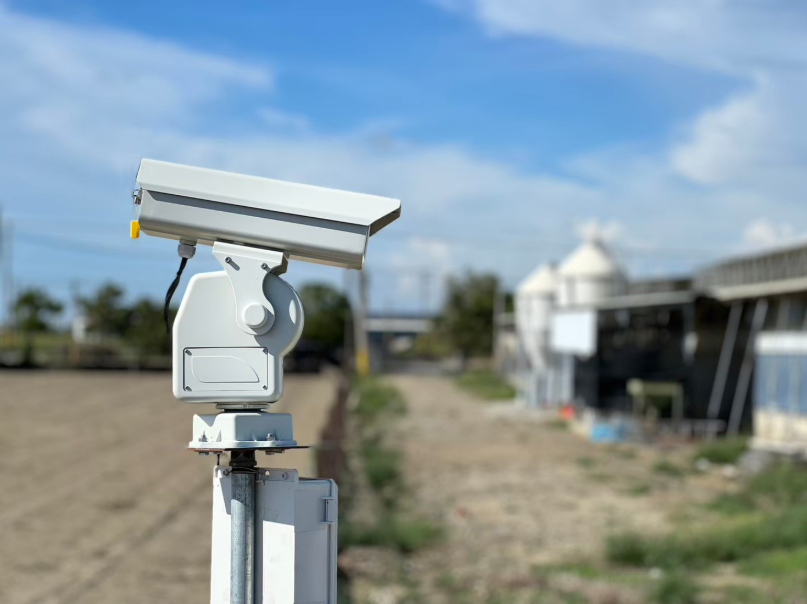
One technology that’s gained traction in this space is autonomous laser deterrence. Systems that use algorithmically randomized patterns can trigger an escape response in birds without harming them, and because the path is never the same twice, birds don’t develop the habituation patterns they do with static deterrents. A single unit can cover an entire rooftop or a row of ventilation fans.
This isn’t a solution for every operation, and it’s not the only alternative worth exploring. Sonic deterrents, visual scare devices with randomized patterns, and integrated perimeter monitoring all represent meaningful advances over the decades-old spike approach. The through-line connecting all of them is the same: coverage of the airspace, not just the ledge.
What this means practically
If you’re currently relying heavily on spikes (especially around ventilation systems, rooftop equipment, or feed storage areas) it’s worth asking a straightforward question: are you actually solving the problem, or just making it slightly less visible?
Spikes have a role. They’re inexpensive, low-maintenance in the short term, and they do move birds away from the exact inch of surface they’re placed on. But they’re not a biosecurity strategy. They’re a cosmetic fix that’s been dressed up as one for decades.
Modern facility management deserves a more honest accounting of what each tool actually accomplishes, and a willingness to invest in solutions that address the real exposure, not just the visible one.
The birds aren’t the irrational ones here. We’ve just been giving them too much credit for following our rules.
For a full technical breakdown of how AI Laser Deterrence compares to traditional methods, including cost, coverage, and long-term effectiveness, read our comprehensive 2026 Facility Guide.
Read the Full Guide: https://www.ichase.io/blog**/bird-spikes-vs-ai-laser-deterrent-comparison**
iCHASE builds AI-powered biosecurity and monitoring solutions for livestock operations and industrial facilities. Learn more at ichase.io.
Sources
USDA APHIS: Avian Influenza guidance and wild bird surveillance
https://www.aphis.usda.gov/livestock-poultry-disease/avian/avian-influenza
USDA APHIS: Defend the Flock biosecurity program
https://www.aphis.usda.gov/livestock-poultry-disease/avian/defend-the-flock
USDA APHIS: How to protect your flock from Avian Influenza
메타데이터
- post_id
- 9df0a9803cf4
- slug
- bird-spikes-have-been-on-buildings-since-the-1950s-its-time-to-have-an-honest-conversation-9df0a9803cf4
- url
- https://medium.com/@ichase/bird-spikes-have-been-on-buildings-since-the-1950s-its-time-to-have-an-honest-conversation-9df0a9803cf4
- canonical_url
- https://medium.com/@ichase/bird-spikes-have-been-on-buildings-since-the-1950s-its-time-to-have-an-honest-conversation-9df0a9803cf4
- author_url
- https://medium.com/@ichase
- status
- ok
- fetched_at
- 2026-07-11 03:42:06