The best nystagmus drugs might already be on the shelf
I turned my fund’s data tooling on my own nystagmus: 3,200 papers, 669 findings, off-patent drugs nobody has trialed.
The best nystagmus drugs might already be on the shelf
I have nystagmus and run a trading fund. I read 3,200 papers for treatments and kept finding cheap off-patent drugs nobody had trialled.
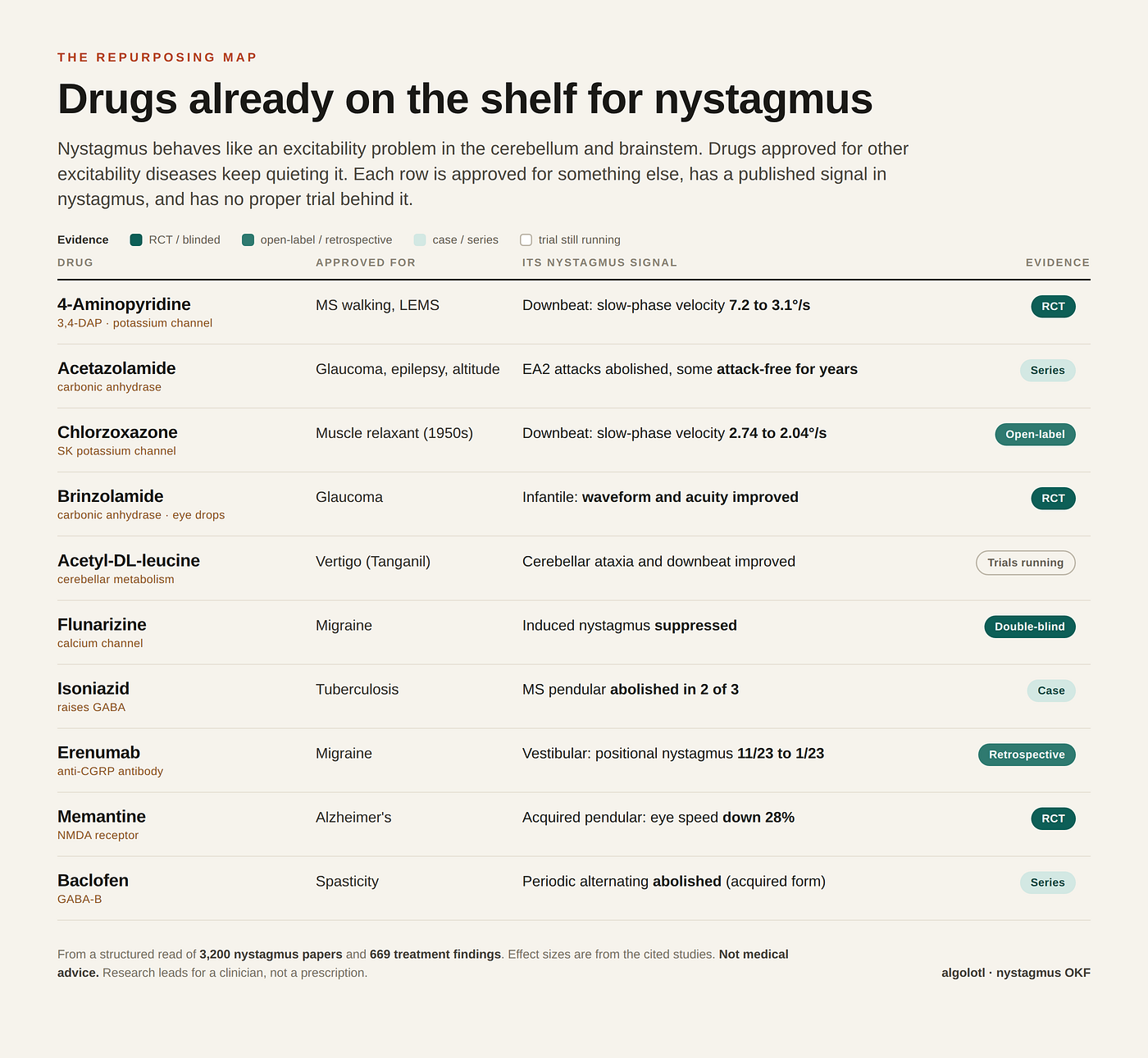
The Repurposing Map: Drugs already on the shelf for nystagmus
I have congenital nystagmus. My eyes have moved on their own since before I can remember. Text slides when I read. I sit with a slight head turn that people clock before they clock anything else. My vision has a ceiling that no pair of glasses has ever lifted. There is no cure. Treatment is a grab bag of drugs, surgery and prisms, most of it found by accident.
I run an automated trading fund. The work is turning large, messy datasets into something structured enough to act on, then letting machines act on it. One weekend, I pointed the same tooling at my own condition because I wanted to know what the literature actually says rather than what a one-paragraph note on a patient information sheet says. The weekend turned into something longer. None of what follows is medical advice. I am not a clinician. If you have nystagmus, take these leads to a neuro-ophthalmologist.
Why I read 1,404 papers about my own eyes
The instinct that runs the fund is the same one that ran this. When a signal matters and the data is scattered, you stop reading summaries, and you go to the source, all of it, and you structure what you find so the pattern can show itself. In markets, the pattern is a mispricing. Here, I was looking for treatments that worked in one place and were never carried elsewhere.
So I built a corpus. Three thousand two hundred nystagmus papers pulled from OpenAlex, cross-linked by citation so I could see which findings sat downstream of which. Of those, 1,404 were read one by one into a structured table. For each paper, one question: did someone apply an intervention and record what happened to the nystagmus? If yes, it became a row, with the drug or the procedure, the type of nystagmus, the direction of effect, the measure used, and a supporting quote lifted straight from the text. That produced 669 intervention-outcome findings across 383 distinct interventions.
I kept it loose on purpose. The negatives stayed in. A drug that did nothing is a row. One that made the nystagmus worse is a row too, often more useful than a success, because it tells you which way the mechanism runs. The incidental findings stayed in as well: the cases where someone was treating a tumour or an infection and noted in passing that the patient’s eyes settled. Those are the accidents worth chasing. In a field this thin, the accidents are most of the signal.
Nystagmus research lives in single case reports scattered across fifty years, in journals that do not cite each other, written by people who never knew the next case existed. Nobody had pulled it into one place. That is a database problem, and databases are the day job.
What is actually going on: an excitability problem
The organising idea, once you have read enough of the pile, is that acquired nystagmus behaves like a channelopathy of the cerebellum and brainstem. The eyes drift because the cells meant to hold them steady, the Purkinje cells of the cerebellar flocculus and the neurons of the brainstem, are firing wrong. The wiring is intact. It fires at the wrong rate.
That reframing is the whole game, because it tells you where to shop for drugs. If the problem is ion-channel excitability, then the medicines that already work on other channel and excitability diseases are the candidate pool. Episodic ataxia, multiple sclerosis, Lambert-Eaton myasthenic syndrome, epilepsy, Alzheimer’s. Each of those has a pharmacopoeia, and each pharmacopoeia is a place to look for something that will quiet an eye.
My own nystagmus is congenital, the kind the field spent decades writing off as beyond drugs. Hold that thought.
The aminopyridines are the cleanest example. They were described in the literature as a new therapeutic principle for downbeat nystagmus, upbeat nystagmus and episodic ataxia type 2, presumed to act by restoring Purkinje-cell excitability and cerebellar inhibitory tone (PMID 16415675). When patients took 4-aminopyridine, imaging showed the underactive flocculus lighting back up on PET while the downbeat nystagmus improved (PMID 18515323). Fix the excitability; fix the eye. That is the spine of everything below.
The established treatments that hold up
A handful of drugs have real evidence behind them, by the standards of this field.
- Aminopyridines for downbeat nystagmus. These are potassium-channel blockers: dalfampridine (4-AP) is approved for walking in MS, and amifampridine (3,4-DAP) is approved for LEMS; the mechanism is Kv1.5 blockade, thereby raising Purkinje-cell excitability. In a randomised crossover study, 3,4-DAP reduced mean peak slow-phase velocity from 7.2 degrees per second to 3.1 degrees per second 30 minutes after a dose (p < 0.001), with more than half the patients showing a drop of over 50% (PMID 12874393, n=17). Head-to-head, 4-AP was the more potent of the two (PMID 21734596). In the largest downbeat study, in patients with FGF14/SCA27B disease (PMID 38507876, n=170), clinician-reported response rate was 80% in expansion-positive patients versus 31% in expansion-negative patients, and in the placebo-controlled arm, video-oculography showed a real slow-phase drop on 4-AP and none on placebo.
- Acetazolamide for episodic ataxia nystagmus. A carbonic anhydrase inhibitor already used for glaucoma, altitude sickness and epilepsy. It was found by accident to abolish attacks of ataxia and nystagmus, with some patients staying attack-free for up to five years (PMID 366453). In a series of 64 EA2 patients, about two-thirds reported a good response (PMID 14718690). The main cost is kidney stones.
- Gabapentin and memantine for acquired pendular nystagmus, the kind that comes with MS. Gabapentin binds the alpha-2-delta calcium-channel subunit; memantine is an NMDA antagonist approved for Alzheimer’s. In one crossover study, gabapentin reduced median eye speed by 32.8% and memantine by 27.8%, both with gains in acuity (PMID 20437565, n=10). Memantine also rescued gabapentin non-responders (PMID 16556621).
- Baclofen for periodic alternating nystagmus. A GABA-B agonist approved for spasticity. It abolished the acquired form of PAN and did nothing for the congenital form (PMID 7212648), a distinction worth keeping. In the central positional downbeat, it cut maximum slow-phase velocity by 40.2%, and the nystagmus climbed back when the drug was stopped (PMID 38498146, n=15).
- Clonazepam for idiopathic downbeat. A benzodiazepine, off-label here. In a small series, it worked in all five idiopathic cases and failed in the cerebellar-degeneration cases, with long-term dosing clearing oscillopsia (PMID 11568589). No randomised trial exists; the evidence is at the case level.
The drugs already on the shelf
This is what I went in looking for: cross-indication hits. A drug licensed for something completely different, given to a nystagmus patient, that worked. Each one is a lead that costs almost nothing to test properly because the drug already exists, its safety is known, and it is usually off-patent.
- Isoniazid. An antibiotic for tuberculosis. It raises brain GABA by blocking GABA transaminase. Given to three MS patients with acquired pendular nystagmus, it abolished the nystagmus and relieved the oscillopsia in two of them (PMID 2314593).
- Chlorzoxazone. A muscle relaxant from the 1950s. It activates SK calcium-activated potassium channels, damping Purkinje-cell hyperexcitability through a different channel from the aminopyridines. In patients with downbeat nystagmus, it reduced mean slow-phase velocity from 2.74 to 2.04 degrees per second (p < 0.001), with gains in acuity and half the group reporting no side effects (PMID 23975871, n=10).
- Brinzolamide, the glaucoma eye drop Azopt. A topical carbonic anhydrase inhibitor. In a randomised crossover in infantile nystagmus, the drops significantly improved the nystagmus acuity function across gaze and binocular letter acuity against placebo, with the expected pressure drop and no adverse events (PMID 25336575, n=5). A drug you drip into your eye, working on a central movement disorder.
- Acetyl-DL-leucine, sold as Tanganil, an off-patent French vertigo drug from the 1950s that restores cerebellar metabolism. In patients with ataxia-telangiectasia, it improved the ataxia score and reduced the downbeat slow-phase velocity from 5.57 to 4.7 degrees per second at 1 month (PMID 34620022, n=6). The signal comes with a warning. Three case series looked good, and the randomised trials meant to settle it are still running (PMID 30182858). More anecdotes will not decide it.
- Flunarizine. A calcium-channel blocker used for migraine. In double-blind trials, it significantly suppressed induced nystagmus (PMID 6350513), and, in head-to-head comparisons, it outperformed the reference drug cinnarizine (PMID 4618340). In a CACNA1A family where acetazolamide failed and even worsened the ataxia, flunarizine was the drug that helped (PMID 18437043). When the standard channel drug misses, a different channel drug can catch.
- IVIg, intravenous immunoglobulin. In autoimmune periodic alternating nystagmus, PAN was essentially eliminated the moment treatment started and returned three months after the dose wore off (PMID 28359285). It also cleared anti-GAD nystagmus (PMID 28767521) and anti-Homer-3 downbeat (PMID 35871640), and did nothing for a paraneoplastic anti-Hu case (PMID 29923871). The pattern tells you which nystagmus is immune-driven.
- Erenumab, the anti-CGRP migraine antibody. In refractory vestibular migraine, positional nystagmus on testing fell from 11 of 23 patients before treatment to 1 of 23 after (p = 0.002), in the same patients whose earlier standard prophylaxis had done nothing (PMID 37763679).
Then a scatter of single cases, each one patient, where the eyes settled while something else was being treated. Topical timolol, the glaucoma beta-blocker, cleared superior oblique myokymia within a day or two and held with daily use (PMID 24766862). Dextroamphetamine, given to a child with retinal dystrophy for attention deficit, improved acuity from 20/63 to 20/50, restored stereopsis where there had been none, and prolonged foveation periods in congenital aperiodic alternating nystagmus (PMID 11720591). Dabrafenib and trametinib, the BRAF and MEK cancer inhibitors, cleared the nystagmus of a BRAF V600E Erdheim-Chester patient as the brainstem disease resolved on imaging (PMID 30225465). Infliximab, the TNF-alpha blocker from rheumatology, settled steroid- and chemo-refractory CNS Langerhans cell histiocytosis with oscillopsia (PMID 21856693). Each is one data point with a live drug behind it.
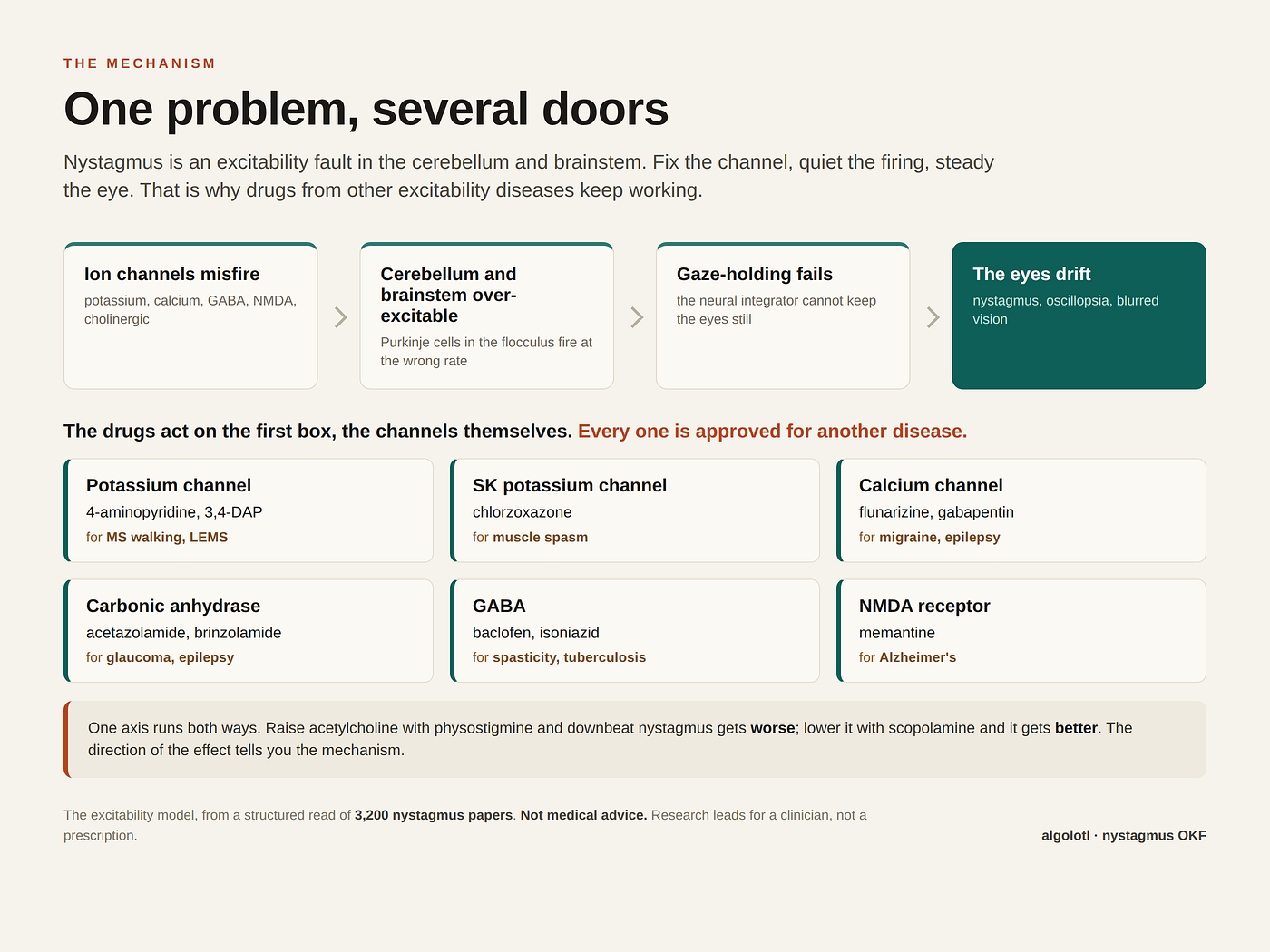
The Mechanism: One problem, several doors
None of these is proof. Everyone is a lead in the field that could test tomorrow. That is the point of the exercise.
Appendix: source references
Every PMID in the article is a real paper. They are listed here in the order they are cited, each linked to its PubMed record and, where one exists, its DOI. The internal ID is the PubMed identifier — paste any of them into pubmed.ncbi.nlm.nih.gov to pull the original. This whole reference set was drawn from a structured corpus of 3,200 nystagmus papers; the 46 below are the ones the article draws on directly.
- PMID 16415675 — Michael Strupp et al. Pharmacological advances in the treatment of neuro-otological and eye movement disorders. Current Opinion in Neurology, 2006. PubMed · doi.org/10.1097/01.wco.0000196156.00481.e1
- PMID 18515323 — Marianne Dieterich et al. Functional brain imaging of peripheral and central vestibular disorders. Brain, 2008. PubMed · doi.org/10.1093/brain/awn042
- PMID 12874393 — Michael Strupp et al. Treatment of downbeat nystagmus with 3,4-diaminopyridine. Neurology, 2003. PubMed · doi.org/10.1212/01.wnl.0000078893.41040.56
- PMID 21734596 — Roger Kalla et al. Comparison of 10-mg Doses of 4-Aminopyridine and 3,4-Diaminopyridine for the Treatment of Downbeat Nystagmus. Journal of Neuro-Ophthalmology, 2011. PubMed · doi.org/10.1097/wno.0b013e3182258086
- PMID 38507876 — David Pellerin et al. GAA-FGF14 disease: defining its frequency, molecular basis, and 4-aminopyridine response in a large downbeat nystagmus cohort. EBioMedicine, 2024. PubMed · doi.org/10.1016/j.ebiom.2024.105076
- PMID 366453 — Robert C. Griggs et al. Hereditary paroxysmal ataxia. Neurology, 1978. PubMed · doi.org/10.1212/wnl.28.12.1259
- PMID 14718690 — Joanna C. Jen et al. Clinical spectrum of episodic ataxia type 2. Neurology, 2004. PubMed · doi.org/10.1212/01.wnl.0000101675.61074.50
- PMID 20437565 — Matthew J. Thurtell et al. Crossover trial of gabapentin and memantine as treatment for acquired nystagmus. Annals of Neurology, 2010. PubMed · doi.org/10.1002/ana.21991
- PMID 16556621 — T Shery et al. The effects of gabapentin and memantine in acquired and congenital nystagmus: a retrospective study. British Journal of Ophthalmology, 2006. PubMed · doi.org/10.1136/bjo.2005.086322
- PMID 7212648 — G. Michael Halmágyi et al. Treatment of periodic alternating nystagmus. Annals of Neurology, 1980. PubMed · doi.org/10.1002/ana.410080611
- PMID 38498146 — So‐Yeon Yun et al. Effects of Baclofen on Central Paroxysmal Positional Downbeat Nystagmus. The Cerebellum, 2024. PubMed · doi.org/10.1007/s12311–024–01684-z
- PMID 11568589 — Yi‐Ho Young et al. Role of Clonazepam in the Treatment of Idiopathic Downbeat Nystagmus. The Laryngoscope, 2001. PubMed · doi.org/10.1097/00005537–200108000–00029
- PMID 2314593 — S. Traccis et al. Successful treatment of acquired pendular elliptical nystagmus in multiple sclerosis with isoniazid and base‐out prisms. Neurology, 1990. PubMed · doi.org/10.1212/wnl.40.3_part_1.492
- PMID 23975871 — Katharina Feil et al. Effect of chlorzoxazone in patients with downbeat nystagmus. Neurology, 2013. PubMed · doi.org/10.1212/wnl.0b013e3182a55f6d
- PMID 25336575 — Richard W. Hertle et al. Topical brinzolamide (Azopt) versus placebo in the treatment of infantile nystagmus syndrome (INS). British Journal of Ophthalmology, 2014. PubMed · doi.org/10.1136/bjophthalmol-2014–305915
- PMID 34620022 — A.E. Brueggemann et al. Effects of Acetyl-DL-Leucine on Ataxia and Downbeat-Nystagmus in Six Patients With Ataxia Telangiectasia. Journal of Child Neurology, 2021. PubMed · doi.org/10.1177/08830738211028394
- PMID 30182858 — Roger Kalla et al. Aminopyridines and Acetyl-DL-leucine: New Therapies in Cerebellar Disorders. Current Neuropharmacology, 2018. PubMed · doi.org/10.2174/1570159x16666180905093535
- PMID 6350513 — Bradly G. Wouters et al. Flunarizine in the treatment of vertigo. The Journal of Laryngology & Otology, 1983. PubMed · doi.org/10.1017/s0022215100094858
- PMID 4618340 — W. J. Oosterveld. Vestibular Pharmacology of Flunarizine Compared to that of Cinnarizine. ORL, 2010. PubMed · doi.org/10.1159/000275168
- PMID 18437043 — Sarah Marti et al. Progressive Cerebellar Ataxia with Variable Episodic Symptoms — Phenotypic Diversity of R1668W CACNA1A Mutation. European Neurology, 2008. PubMed · doi.org/10.1159/000127974
- PMID 28359285 — Herminia Argente‐Escrig et al. Atypical periodic alternating nystagmus responding to high-dose intravenous immunoglobulins: a case report. Journal of Neuroinflammation, 2017. PubMed · doi.org/10.1186/s12974–017–0846–1
- PMID 28767521 — Ana Inês Martins et al. Disabling Central Paroxysmal Positioning Upbeat Nystagmus and Vertigo Associated With the Presence of Anti–Glutamic Acid Decarboxylase Antibodies. Journal of Neuro-Ophthalmology, 2017. PubMed · doi.org/10.1097/wno.0000000000000547
- PMID 35871640 — Christof Klötzsch et al. Anti-Homer-3 antibodies in cerebrospinal fluid and serum samples from a 58-year-old woman with subacute cerebellar degeneration and diffuse breast adenocarcinoma. Neurological Research and Practice, 2022. PubMed · doi.org/10.1186/s42466–022–00194–9
- PMID 29923871 — Tatiana Bakaeva et al. Increasing Velocity Slow Phases in Acquired Nystagmus. Journal of Neuro-Ophthalmology, 2018. PubMed · doi.org/10.1097/wno.0000000000000681
- PMID 37763679 — Andrea Lovato et al. Monoclonal Antibodies Targeting CGRP: A Novel Treatment in Vestibular Migraine. Medicina, 2023. PubMed · doi.org/10.3390/medicina59091560
- PMID 24766862 — Christopher J. Borgman. Topical timolol in the treatment of monocular oscillopsia secondary to superior oblique myokymia: a review. Journal of Optometry, 2013. PubMed · doi.org/10.1016/j.optom.2013.06.004
- PMID 11720591 — Hertle Rw et al. Clinical and oculographic response to Dexedrine in a patient with rod-cone dystrophy, exotropia, and congenital aperiodic alternating nystagmus. 2001. PubMed
- PMID 30225465 — Ahmed Al Bayati et al. Dabrafenib and Trametinib Treatment for Erdheim-Chester Disease With Brain Stem Involvement. Mayo Clinic Proceedings Innovations Quality & Outcomes, 2018. PubMed · doi.org/10.1016/j.mayocpiqo.2018.05.001
- PMID 21856693 — Gurjit Chohan et al. Langerhans cell histiocytosis with refractory central nervous system involvement responsive to infliximab: Figure 1. Journal of Neurology Neurosurgery & Psychiatry, 2011. PubMed · doi.org/10.1136/jnnp-2011–300575
- PMID 1654396 — Marianne Dieterich et al. The effects of baclofen and cholinergic drugs on upbeat and downbeat nystagmus. Journal of Neurology Neurosurgery & Psychiatry, 1991. PubMed · doi.org/10.1136/jnnp.54.7.627
- PMID 8122884 — Jason J.S. Barton et al. Muscarinic antagonists in the treatment of acquired pendular and downbeat nystagmus: A double‐blind, randomized trial of three intravenous drugs. Annals of Neurology, 1994. PubMed · doi.org/10.1002/ana.410350312
- PMID 11725183 — Jae-Il Kim et al. Evaluation of Transdermal Scopolamine as Treatment for Acquired Nystagmus. Journal of Neuro-Ophthalmology, 2001. PubMed · doi.org/10.1097/00041327–200109000–00005
- PMID 11960819 — Louis F. Dell’Osso. Development of New Treatments for Congenital Nystagmus. Annals of the New York Academy of Sciences, 2002. PubMed · doi.org/10.1111/j.1749–6632.2002.tb02834.x
- PMID 19928738 — Louis F. Dell’Osso et al. Two Hypothetical Nystagmus Procedures: Augmented Tenotomy and Reattachment and Augmented Tendon Suture ( Sans Tenotomy). Journal of Pediatric Ophthalmology & Strabismus, 2009. PubMed · doi.org/10.3928/01913913–20091104–05
- PMID 29333910 — Maria Theodorou et al. Soft Contact Lenses to Optimize Vision in Adults with Idiopathic Infantile Nystagmus: A Pilot Parallel Randomized Controlled Trial. Strabismus, 2018. PubMed · doi.org/10.1080/09273972.2017.1418394
- PMID 7102798 — Kenneth J. Ciuffreda et al. Use of Eye Movement Auditory Biofeedback in the Control of Nystagmus. Optometry and Vision Science, 1982. PubMed · doi.org/10.1097/00006324–198205000–00007
- PMID 35412151 — H. Dietrich et al. Downbeat nystagmus becomes attenuated during walking compared to standing. Journal of Neurology, 2022. PubMed · doi.org/10.1007/s00415–022–11106-x
- PMID 25601629 — Morito Monden et al. [Downbeat nystagmus — a rare side-effect of lithium carbonate]. 2015. PubMed
- PMID 15958088 — S Hadjikoutis et al. Ocular complications of neurological therapy. European Journal of Neurology, 2005. PubMed · doi.org/10.1111/j.1468–1331.2005.01025.x
- PMID 22554194 — Rebekah M. Ahmed et al. Gentamicin ototoxicity: a 23‐year selected case series of 103 patients. The Medical Journal of Australia, 2012. PubMed · doi.org/10.5694/mja11.10850
- PMID 11455110 — J.I. Kim et al. Vertical nystagmus in normal subjects: Effects of head position, nicotine and scopolamine. Journal of Vestibular Research, 2000. PubMed · doi.org/10.3233/ves-2000–10606
- PMID 17279539 — Rebecca McLean et al. Congenital nystagmus: Randomized, controlled, double‐masked trial of memantine/gabapentin. Annals of Neurology, 2007. PubMed · doi.org/10.1002/ana.21065
- PMID 16799026 — Jonathan B. Jacobs et al. Eye Movement Recordings as an Effectiveness Indicator of Gene Therapy inRPE65-Deficient Canines: Implications for the Ocular Motor System. Investigative Ophthalmology & Visual Science, 2006. PubMed · doi.org/10.1167/iovs.05–1233
- PMID 39598155 — Xiujie Gong et al. Infantile Nystagmus Syndrome — Associated Inherited Retinal Diseases: Perspectives from Gene Therapy Clinical Trials. Life, 2024. PubMed · doi.org/10.3390/life14111356
- PMID 3585658 — P. R. Mitchell et al. Kestenbaum Surgical Procedure for Torticollis Secondary to Congenital Nystagmus/Discussion. Journal of Pediatric Ophthalmology & Strabismus, 1987. PubMed · doi.org/10.3928/0191–3913–19870301–09
- PMID 21261243 — Anand Kumar et al. Improvement in Visual Acuity Following Surgery for Correction of Head Posture in Infantile Nystagmus Syndrome. Journal of Pediatric Ophthalmology & Strabismus, 2011. PubMed · doi.org/10.3928/01913913–20110118–02
메타데이터
- post_id
- 9e01572b9dbc
- slug
- the-best-nystagmus-drugs-might-already-be-on-the-shelf-9e01572b9dbc
- url
- https://medium.com/@alexkovaceski/the-best-nystagmus-drugs-might-already-be-on-the-shelf-9e01572b9dbc
- canonical_url
- https://medium.com/@alexkovaceski/the-best-nystagmus-drugs-might-already-be-on-the-shelf-9e01572b9dbc
- author_url
- https://medium.com/@alexkovaceski
- status
- ok
- fetched_at
- 2026-07-10 18:30:51