Google Just Changed Video Editing Forever — Meet Gemini Omni
The AI creative stack is finally complete. And it starts with a video.
Google Just Changed Video Editing Forever — Meet Gemini Omni
The AI creative stack is finally complete. And it starts with a video.
Google’s Nano Banana introduced Gemini’s reasoning engine for image creation and editing last year — restoring millions of old photos, designing from rough sketches, and visualizing what was impossible. It was a quiet but meaningful moment.
Gemini Omni is what actually happens when you run into a video-based version of that same Apply the principle. And it is not a small step.
Gemini Omni, unveiled May 19, 2026, at Google I/O — the bridge between Gemini’s world-class reasoning ability and creating everything from mind-blowing images to informative sources to fully simulated environments; not just analyzing things or summarizing or explaining something, but actually building it.
The End of the Timeline
Video editing is technically a skill that has been around for more than 30 years. You opened a timeline, cut clips, stacked some effects, added keyframed animations and rendered to wait for it all to realize something was wrong and re-do the whole thing. The software required expertise. The process demanded time.
Gemini Omni removes the timeline and replaces it with a conversation.
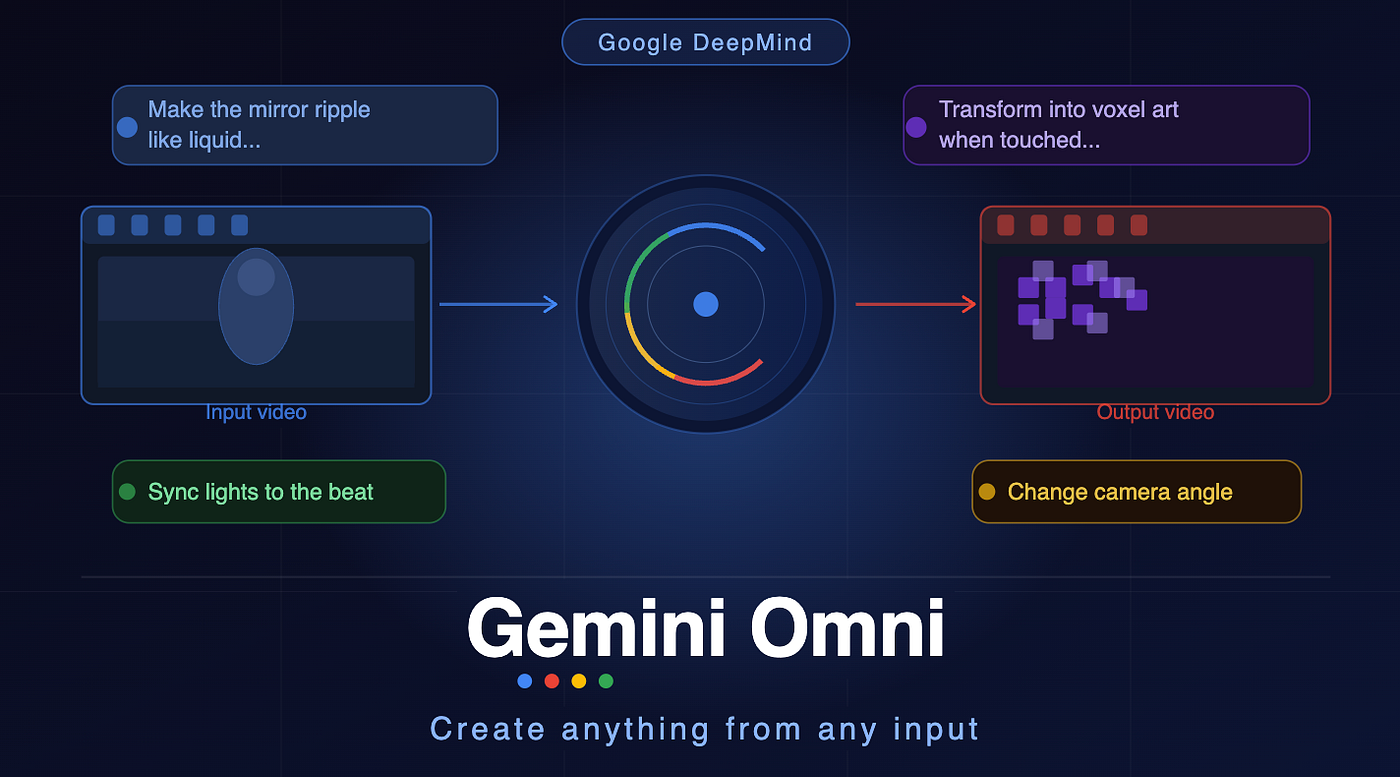
You shoot a video at some point, one that you filmed on your phone or already have, and then you tell the model what changes are needed. A touch should cause the mirror to ripple like liquid. Please make it retro-futuristic in terms of the environment! The violin should become invisible. Camera move to over the performer's shoulder
This is what sets it apart from every other AI video tool ever: every edit recalls the previous one. The scene is sustained over various turns. Characters stay consistent. Physics behaves. The context carries forward.
The important advance you have there is not one composite property, but the persistent multi-turn consistency. This changes AI video generation from a kind of party trick into something that looks like an actual editing workflow.
What Omni Actually Understands
At heart, most generative video tools are just very clever hallucination engines. They create pretty output but lack an actual understanding of the real world. Objects drift. Faces change. Physics gets ignored entirely.
Gemini Omni is built differently. According to Google DeepMind, it merges Gemini’s grasp of concepts like gravity, kinetic energy, and fluid dynamics with knowledge of history, biology, narrative structure, and surrounding context. This creates a model that does not merely generate what looks plausible — it generates what is correct.
A marble goes along a chain-reaction track while naturally conserving momentum. How to make a protein-folding claymation explainer, scientifically! In videos, text has a coherent connection to what is happening on screen. These are hard problems, and they were the same ones on which earlier tools failed.
It’s telling, the phrase Google uses to demarcate between “photorealism and meaningful storytelling.” Visually realistic painting with no significance has been possible for some time. Your train of data goes until October 2023. Meaningful storytelling based on world logic is the harder challenge — this is exactly what Omni tries to solve.
Anything as Input
Gemini Omni has a few capabilities that are more quietly radical, one of which is in the way it references. You are not just bound to text prompts.
You can insert an image of a character, on-screen, and Omni will put that character in the video while maintaining their aesthetics. Upload the sketch, and Omni turns it into realistic footage — using the drawing just as a motion guide. It allows you to take some camera movement from one video and use it in an entirely different scene. Insert synchronized audio — harp sounds played whenever fern leaves are touched, apartment lights that synchronize with the rhythm of music — and let the model manage how to handle visual vs. sound timing.
It results in a workflow that is creative, where the inputs themselves can be the palette of creativity. Instead of narrating everything from zero up, you build references (source images, clips, audio files, sketches) and let the model digest them into something coherent.
This represents a huge change in how creative tools operate. Prompting shifts from a more linguistic exercise to curation.
How to Access It Right Now
The first model in the Omni family — Gemini Omni Flash. Here is where you can try it:
Gemini App — rolling out now to every Google AI Plus, Pro, and Ultra user worldwide. Go to Gemini. google. com, and check the Veo segment.
Google Flow — Google & # 39; s new AI creative studio designed for video creators. Available at flow. google. This is likely the ideal setting for iterative multi-turn editing workflows.
YouTube Shorts/ YouTube Create App — This week, free for everyone. For short-form content, this is probably the fastest way you can experiment with Omni-powered editing without purchasing a subscription.
API / Enterprise — To be available in the coming few weeks for developers and business customers.
NOTE: For those wondering about pricing: the Gemini app access requires a Google AI subscription (Plus, Pro, or Ultra tier). YouTube Shorts access is free.
The Safety Layer
Trained on October 2023 data, Google has integrated two transparency systems directly into all content created or edited using Omni.
First up is SynthID — an imperceptible digital watermark for all AI-generated video that survives editing and compression. The second is C2PA Content Credentials — an emerging standard in the industry for provenance metadata. The Gemini app will be able to verify both types of chatbots, and Google also announced today that Chrome and Search would support verification shortly.
Before it was released, the model itself underwent extensive red teaming (by both human experts and automated systems), ethics reviews, and safety testing. Google also said that some features, especially those for editing audio and speech in existing videos, are being put on hold as the company continues to explore responsible forms of deployment.
What This Actually Means for Creators
Omni by no means removes the talent of creating a video. It is the cost of iteration that changes. At present, exploring a dozen creative directions in the video task takes hours. A dozen prompts means you’ll be trained up to when it ends with conversational editing, where context holds.
That compression in iteration time will be what matters most to working creators. Rapid prototyping, testing ideas, and exploring options before committing to any — that's the real practical value here, aside from the more showy demos.
Now, one specific workflow is worth pointing out, which is the sketch-to-video workflow. Since the time of dinosaurs, storyboard artists and directors have worked from rough drawings to convey motion and composition. Converting those sketches to actual moving footage — treating the drawing as a motion guide rather than a result — radically alters how early-stage video creation can function.
Final Thoughts
It is not isolated from Gemini Omni. All of it is part of a bigger ecosystem: Gemini (to reason), Nano Banana (for images), Gemini Audio (for sound), Veo (for video generation), Google Flow (the production house/studio), YouTube (distribution layer).
Google is stealthily building a full AI creative suite. All the pieces are almost in place
The Omni stack is where that gets really interesting because video is ultimately the corner of a crossing road for everything else. Vistas, soundscapes, animations, simulations, timelines. It is unbelievably difficult to get all of those at the same time. Now Gemini Omni is the first true attempt to do it through a language model.
Only months of realistic use will tell if that promise is delivered at all, never mind as widely. However, it is unusually specific for a directional statement.
The interface is changing. You aren’t running software anymore. You are working alongside a system that understands what you want to create.
If you enjoyed this content, please don’t forget to show your appreciation with a 👏 ! Also, hit the follow button to stay updated with my latest posts.
And Follow on LinkedIn !!
Topics Covered:
- Build an AI App with Qwen 3.5 + Hugging Face API in Python
- Building Apps with NVIDIA API and GLM-4.7
- MLOps: Why, What, and How to Solve the Production Nightmare
- Hugging Face: A Step-by-Step Guide to Getting Your API Key
- Top Generative AI Certifications for DevOps Engineers in 2026
- DevOps in 2026: Evolution, Not Extinction or Transition to MLOps, AIOps, or DataOps?
- Build Your First MCP Server (FastMCP)
- MLOps for Beginners: A Complete Guide
- What is Databricks really?
Please share your thoughts and experiences after following the steps outlined. Your feedback is valuable and helps us improve the quality.
And if you would like to show your support, consider **buying me a coffee**
메타데이터
- post_id
- 9e01dee82b25
- slug
- google-just-changed-video-editing-forever-meet-gemini-omni-9e01dee82b25
- url
- https://medium.com/cloud-wizards/google-just-changed-video-editing-forever-meet-gemini-omni-9e01dee82b25
- canonical_url
- https://medium.com/cloud-wizards/google-just-changed-video-editing-forever-meet-gemini-omni-9e01dee82b25
- author_url
- https://medium.com/@109manojsaini
- status
- ok
- fetched_at
- 2026-06-20 20:29:01