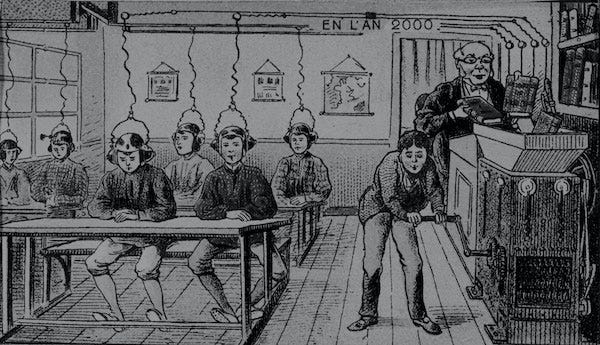
The times and temp on Antioch College’s campus
7/1/26
The times and temp on Antioch College’s campus
7/1/26
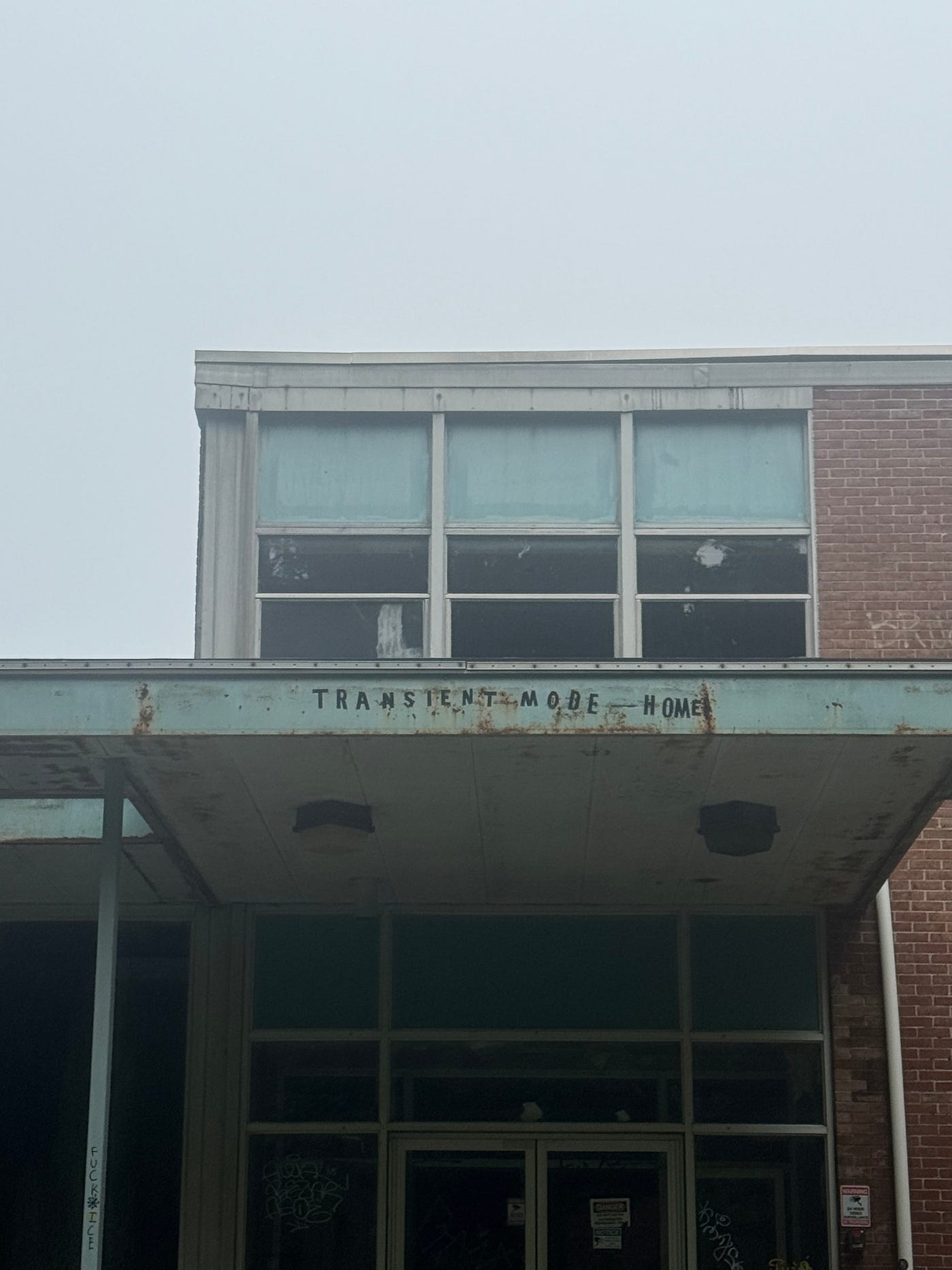
The stoop of the old student union building on Antioch College’s campus. “Transient Mode Home,” a phrase from a former student’s art project, has become a popular phrase to describe the Antioch College experience.
I studied at Antioch College from 2021–2024. During my third co-op experience, I was living in NYC and working as the communications intern at The Kitchen, an arts organization. During this time, I ran into an alumna who asked how things were going back on campus in Yellow Springs. I fell back on a reliable line: “Antioch has its problems, but we’re hanging in there.”
The Antiochian I was speaking to told me that she didn’t understand that, because she had attended the school in the “boom times”: during the 1970s when there were over 2000 students on campus and finances were relatively flush.
That conversation stuck with me for a long time, and I relay it here because I think it is very telling of the current situation at Antioch. Like the three blind men who try to describe the elephant, the current administration, alumni base and student body all have a different idea of what Antioch is, and different knowledge of its current state. To borrow a phrase used by my fellow Antiochian in arms Shannon McCarville (‘02), it is time to have a “come to Horace” (as in, college founder and educational reformer, Horace Mann) conversation about what’s really going on at Antioch. The purpose of this article is to outline the current student experience, in hopes that it will help us to open our eyes to the beast before us before it tramples us.
Current Antioch students David “Junior” Shelton and Zion Villines were both enrolled in the U.S. Department of Labor’s Job Corps program when that organization announced a pause in operations last spring. Villines says President Jane Fernandes and other Antioch representatives came to speak to the recently displaced Job Corps students at their Potomac campus about Antioch, presenting it as an affordable way to obtain a degree, without explaining anything about the school’s history, mission, community governance or student life.
Both Shelton and Villines chose to come to Antioch because of the generous financial aid and affordable housing offered. They arrived on campus with little idea of what they were walking into. What they found was an institution literally falling apart.
Dorm Life
North Hall
“A lot of things here are getting broken down and no one has been able to do anything about it. It takes awhile for things to get fixed,” Shelton said.
When he moved into his room in North Hall in July 2025, the air conditioning in his room did not work, and has yet to be fixed. At one point, the door to his room broke off its hinges. He waited “about a month” for it to be repaired. While he waited, the things in his room were visible through a hole in the door.
Kaeya Favors, who came from Job Corps following the promise of stability and an affordable education, said that the washing machines in North are often broken, and that it often takes a long time for them to be repaired. “We don’t have enough people…to fix everything.”
She also mentioned seeing buckets collecting a leak from the ceiling of McGregor.
“I know a lot of colleges have freshman dorms that don’t have A/C…but in terms of general conditions, a building should never be leaking,” Villines said, referencing a problem in Birch Hall that Shelton and Villines, who both have backgrounds in construction, believe has yet to be properly dealt with.
Birch Hall
These issues are not new. Heron Schleeter, a member of the class of 2026, says they watched conditions deteriorate at Antioch from the time they arrived in 2022. Describing conditions in Birch Hall as “dismal,” Schleeter said they believe the dorm hall should be closed.
During Schleeter’s first two academic years, they attempted to warn the school about Birch’s alleged mold problem. They say their concerns were dismissed and minimized by Residence Life, who told them it was the responsibility of students to test the growth and see if it really was mold.
From personal experience, during the Fall quarter of my third year at Antioch (2023), black patches began growing on the ceiling of my room in Birch. Out of a reluctance to add the stress of moving into a new room on top of my full schedule and lacking information about the long term consequences, I decided to forgo reporting it and began spraying my ceiling with bleach to stop the spread. As the quarter picked up and my focus shifted to my classes and participating in community life, my spraying fell by the wayside. By the end of the quarter, the ceiling had become completely covered in the growth.
An email I received from the Director of Residence Life and Student services after I moved out acknowledges what a serious risk to my health these conditions were.
Cleanliness of the dorm halls is also an issue. From Schleeter’s understanding, the floors of the Birch bathrooms are currently swept and mopped about once a month, and the hallways are cleaned about twice a quarter.
When I lived in Birch, the bathroom in my hallway would regularly run out of soap, to the point where my RA bought bottles to keep in the bathroom.
Common spaces, especially the kitchenettes, often become dirty to the point of posing health risks themselves. Students are responsible for keeping these spaces clean, which usually results in one or two students cleaning up after everyone else until they get fed up and let it go.
There also seems to be a lot of “deferred maintenance” that leads to bigger issues, usually with consequences that fall on the students.
At the beginning of June, Villines went to take a shower and discovered that North Hall had no hot water. The building would be without hot water for almost three weeks, forcing students to walk across campus to shower at Birch Hall or the Wellness Center.
When the hot water first broke, no hot food could be served. Students, who pay $1,550 per term for the required meal plan, were offered cold sandwiches to fill the gap. Villines said the kitchens ran out of sandwiches early, leaving several students hungry.
Villines says living in these conditions is not good for general morale on campus.
“The conditions I come from aren’t ideal in general, so I can tolerate it, but I’m not spending money to tolerate something,” he said.
Food insecurity
Food insecurity is a fact of life on campus. Shelton, who works in the kitchen, expressed that the lack of structure in the dining hall leads to students going hungry.
“Whenever I’m working I feel bad for other students, because I keep track of who eats and who doesn’t, so whenever people don’t get to eat I’m like, ‘I’m sorry, I tried.’”
“Some days we wouldn’t have food whatsoever, without notice at all,” Schleeter said. Despite paying for the required meal plan, the dining hall became a secondary option to buying food — on an Antioch Works salary that could not support it.
Antioch often encourages students who, again, are required to pay for a meal plan, to get food from local pantries. During my time as a student, the Residence Life coordinator even scheduled trips to these pantries for students, because the school struggles so badly to provide food.
Shelton and Villines both said they do not feel adequately nourished for an academic environment, and often feel food insecure on campus. Favors says she does feel adequately nourished because she makes sure to get canned food off campus. “If I wasn’t smart like that, I probably would have starved,” she said.
Marketing vs. Reality
Antioch is very good at presenting an idealized image of itself. One example is the transformation that takes place every year between the end of Spring quarter and reunion. Power washers erase potentially embarrassing graffiti, new plants line flowerbeds that spent the last 11 months empty or overgrown and the food becomes consistent and edible. If the only time you’ve spent on campus lately has been during the third weekend in July, I wouldn’t blame you for thinking things are going well.
Antioch’s recruiting strategies are another source of misinformation about the state of the college. A nice website highlights the “three C’s” that make up the Antioch experience: classroom, community and co-op–painting the image of a robust and thriving campus, where a person from any background can come and be heard.
Schleeter says many of the things Antioch promised when they chose to apply either didn’t actually exist or went away while they were a student. One example they highlighted is narrative grades. Narrative grades are a written qualitative evaluation of a student’s performance over a quarter written by the faculty member teaching their class. “We were supposed to have narrative grades…rather than strictly letter grades,” Schleeter said, “that just wasn’t the case from right off the bat.”
A popular phrase in Antioch’s marketing is “own your education.”
In theory, this means that the school gives students the tools necessary to empower them to chase their curiosities with serious inquiry. In practice, students are often left to their own devices to get an education, at an institution that claims to be a school.
Schleeter says they are entering the job market feeling unprepared to perform well in their field. They acknowledged that Antioch provided opportunities through the co-op program that they would not have had otherwise, but their actual classroom instruction left them wanting. “I’m worried about getting into grad school with an Antioch transcript…because the college itself feels illegitimate.”
Shelton, who is seeking an environmental science degree he hopes will allow him to become a marine biologist, says he does not feel that he is receiving the education required to be successful in his chosen job field, and has not been provided with the resources necessary to be a successful student.
“I feel like anybody is going to make the best of what they can with what’s in front of them, but…I don’t feel the resources are there,” Villines said.
“I was a successful student,” Schleeter said, “but it all feels at my own doing, and the doing of my Antiochian classmates, rather than the institution itself.”
They also said that in some cases, Antioch representatives obfuscated the reality of life on campus. “They said they had a small student body…even so, they made it seem like it was bigger than what it was, and that student life was more involved than what it was.”
The Antioch website says that “community governance has played a vital social and educational role at Antioch College since the early 1930’s.”
Through conversations with older alumni, I understand that it was once true that Community Council and Administrative Council played an important role in policy, decisions, and priority spending on campus. Current students no longer believe that they have a voice or influence regarding campus policy or decisions.
“I can’t name a single thing ComCil has done in my four years on campus,” Schleeter said, other than planning community events such as GenderFuck and Community Day. The most recent ComCil minutes can be found here.
Villines says he feels inclined to be involved with Antioch’s community governance partially because of how discouraging the process has become for students. He feels that the administration has detached the operations of community governance from the concerns of the community and students.
Villines expressed frustration with how the Antioch administration was handling student concerns and questions, especially as conditions on campus continue to decline.
“It shouldn’t be an all out battle or fight to get a solid education,” he said.
By Victoria Shinkle ‘24
Note: An earlier version of this article referenced College Council as part of Antioch’s community governance structure before the closure. This was incorrect, the other governing body before the closure was Administrative Council. The article has been corrected.
메타데이터
- post_id
- 9e061504a805
- slug
- the-times-and-temp-on-antioch-colleges-campus-9e061504a805
- url
- https://medium.com/pedagogical-reckoning/the-times-and-temp-on-antioch-colleges-campus-9e061504a805
- canonical_url
- https://medium.com/pedagogical-reckoning/the-times-and-temp-on-antioch-colleges-campus-9e061504a805
- author_url
- https://medium.com/@van.shinkle
- status
- ok
- fetched_at
- 2026-07-09 03:40:04